



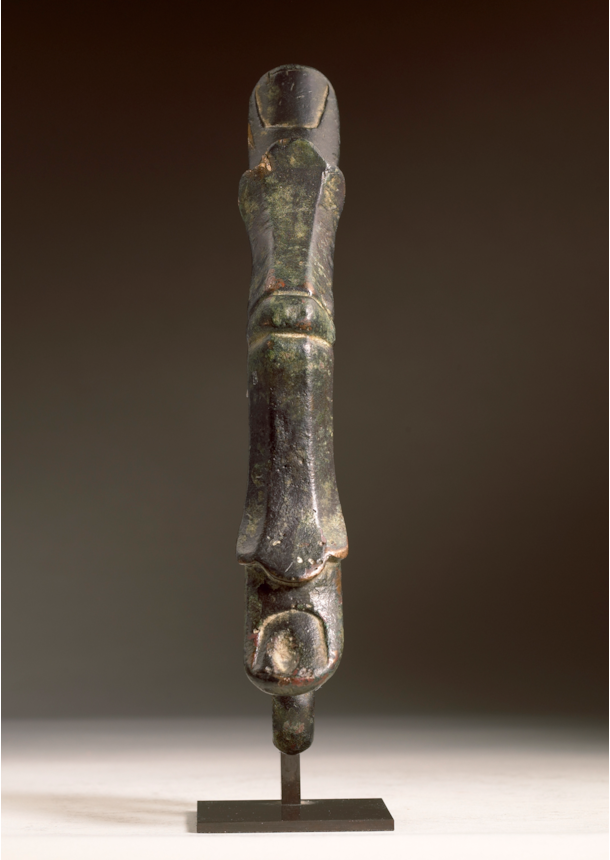
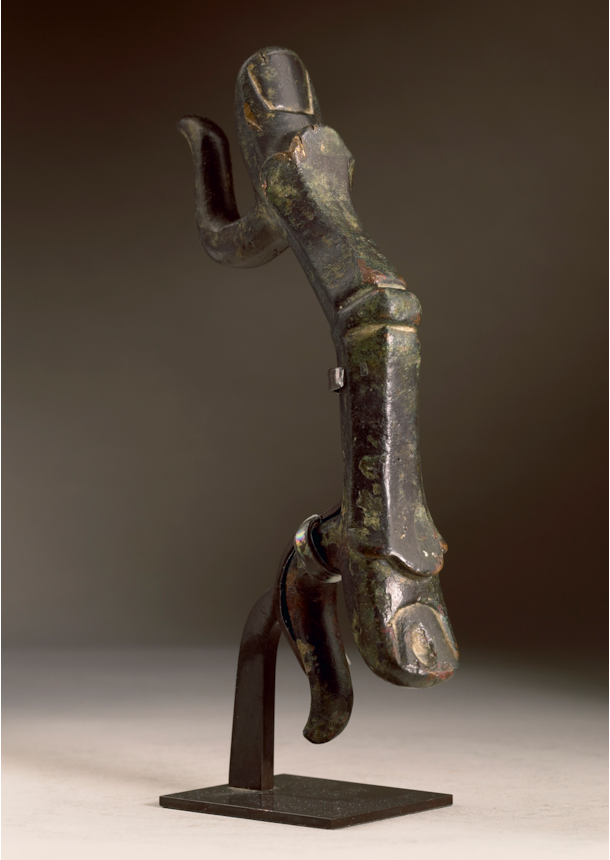
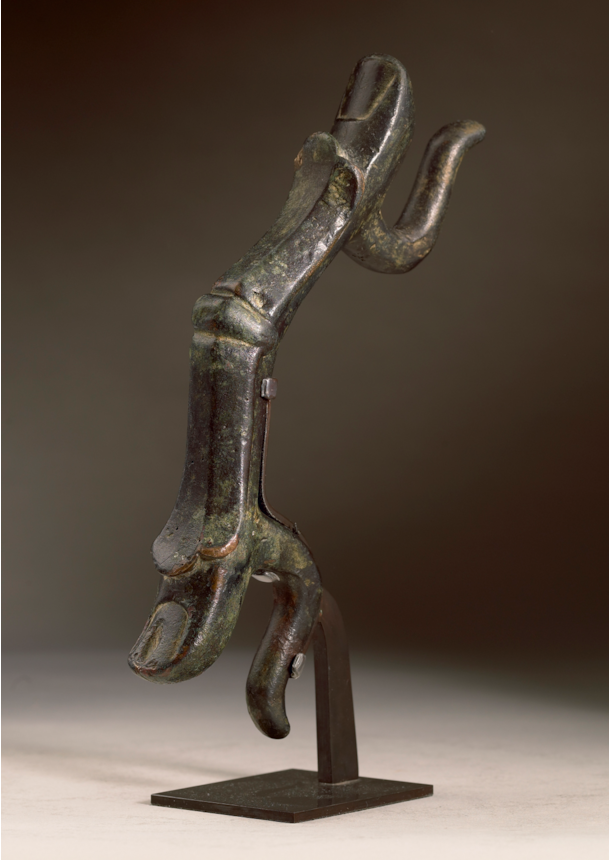





Roman, 1st-2nd century A.D.
6. Handle Formed of Two Opposing Thumbs
Bronze
22cm (8 1⁄2 in.) high / 24.5 cm (9 1⁄2 in.) high, overall / 4cm (1 1⁄2in.) wide / 7cm (2 3⁄4 in.) deep
£9,500
Jean-Philippe Mariaud de Serres, Galerie Serres, Paris, France
Private collection, United Kingdom


The present work is a rare Roman bronze handle modelled in the form of two thumbs. As with their Greek predecessors, the Romans implemented elaborate ornamentation in the craft of their various vessel handles. Cast in bronze, these handles were fashioned into a wide variety of forms, including serpents, acrobats, deities, animals, and knotty tree branches. Notably, a pair of bronze handles in the form of human hands were discovered in Pompeii. They are believed to have been used to carry large bowls, stoves, and other heated vessels, allowing them to be conveniently lifted. This splendid example may have been used to lift a cooking pail, which, when placed over a charcoal fire would have become extremely hot; in such a context, a separately cast, cool bronze ‘hand’ would have been highly functional, providing a practical solution for handling heated vessels safely.
The high regard for such elaborate Roman bronze handles during the eighteenth century is demonstrated by a remarkably similar piece which can be found today in the British Museum. Previously part of the collection of renowned antiquarian Charles Townley, the British Museum’s handle reflects the enduring appreciation for such objects by collectors and scholars of the period.