



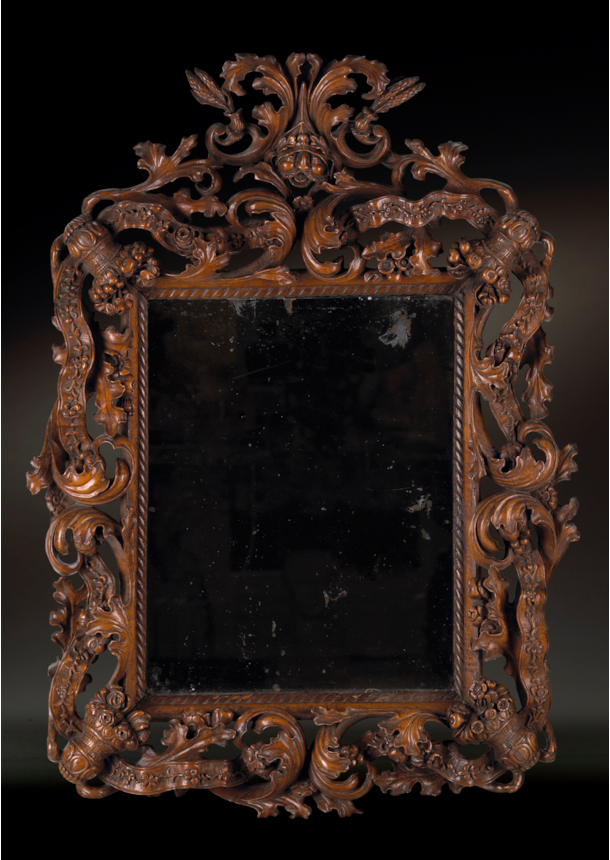



Andrea Brustolon (1662 – 1732) (Circle of)
12. Mirror
Venice, late 17th – early 18th century
Boxwood
119 x 88.5 cm (46 ⁷/₈ x 34 ⁷/₈ inches)
£18,000


A. M. Spiazzi, Scultura Lignea Barocca nel Veneto, Milan, 1997
A remarkable tour de force of wood carving, the present mirror epitomises, through its sculptural depth and minute detailing, the rich Baroque style, which emerged in Rome around 1600 and flourished throughout Europe in the seventeenth and first half of the eighteenth century. Often conceived as part of a decorative ensemble, mirrors were a central element in full-blooded Baroque interiors, as they allowed artists to manipulate both light and space. During the day, they enhanced and guided the daylight coming through the windows, whilst at night, they reflected the soft candlelight, transforming the room in a shimmering kaleidoscope of shapes.
Of rectangular shape, contoured by scrolled foliage and sprays culminating in a crest decorated with an open-mouthed male mask flanked by ears of wheat, the design of the present frame is in keeping with the Baroque style and reflects its distinct artistic vocabulary. Finely carved, the acanthus leaves are intertwined with a scroll embellished with floral motifs, whilst four vases filled with rich bouquets accentuate the corners, in a flamboyant composition that fulfils the Baroque desire for luxuriance and ornamental decoration. The ever-growing ornamental repertoire used by sculptors, carvers and furniture makers was disseminated throughout Italy, and beyond into Europe, through a myriad of designs, such as those of Filippo Passarini, published in Rome in his model book titled Nuove inventioni d’ornamenti d’architettura e d’intagli diversi: utili ad argentieri, intagliatori, ricamatori et altri professori delle buone arti del disegno.
The remarkable sculptural quality of the present frame, displayed in its treatment of the rich, intricate ornamental design, suggests that it originated within the circle of Andrea Brustolon (1662 – 1732), the celebrated Venetian woodcarver best known for his ‘Fornimento Venier’, a furniture ensemble comprising not less than forty pieces, realized for the nobleman Pietro Venier, now in the Ca’ Rezzonico, Venice. Evident in Brustolon’s oeuvre is his remarkable artistic and technical virtuosity, seen across various media; his playful inventiveness is also reflected in his designs, such as the drawing for an allegorical frame in the Museo Civico, Belluno. The elaborate and exuberant carving of the present frame reveals our artist’s awareness and close study of Brustolon’s work, with which it shares many stylistic similarities. This is perhaps best observed in the treatment of the flowers and the serrated acanthus leaves, whose sinuous curvilinear forms and veining are closely comparable to those of Brustolon, as exemplified by numerous frames, such as the one in the Museo Civico, Belluno. Attributed to Brustolon is another mirror frame in a private collection, bearing Count Agosti’s coat of arms, which displays a very similar treatment of the acanthus leaves (Spiazzi 1997, p. 101-2).