



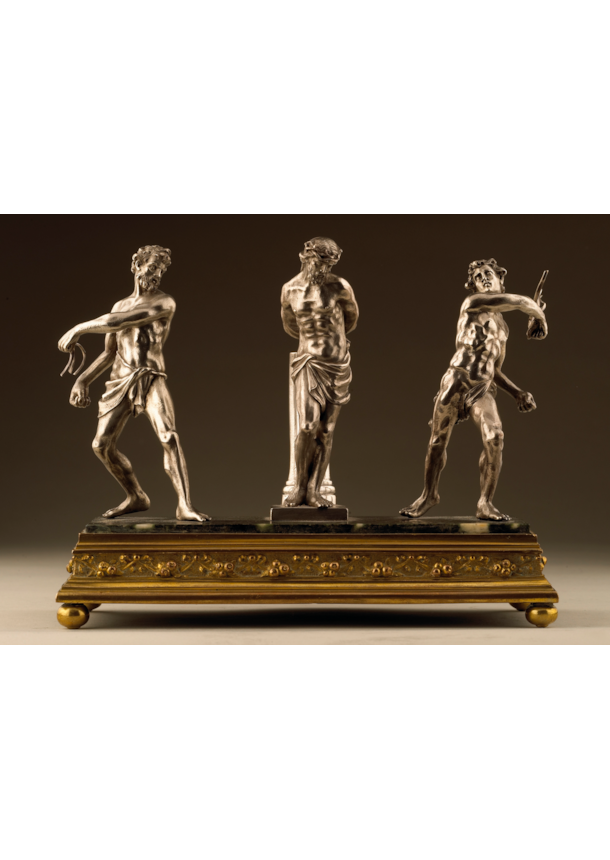



Luigi Valadier (Rome 1726-11785) (Attributed to)
17. The Flagellation of Christ
Rome, 18th century
Silver gilt bronze and Verde Antico marble
20 x 17 x 9.5 cm (7 ⁷/₈ x 6 ³/₄ x 3 ³/₄ inches)
£12,800
Trinity Fine Art, London, United Kingdom, until 2011


This dynamic representation of the Flagellation of Christ has been attributed to Luigi Valadier (1726– 1785), a prolific draftsman, designer, goldsmith, silversmith, and bronze founder of the eighteenth century whose work combined Neoclassical ideals and late Romanticism. Although both of his parents were French, he was born in Rome, where he inherited his father’s business in 1759. Thanks to his son, Giuseppe Valadier (1762–1839), who in 1810 compiled a Registro Generale, we can comprehend the scale of his workshop, which included eighty assistants and collaborators. Highly sought after, Valadier’s work was commissioned by Popes and major noble families such as the Borghese. Both father and son shared an avant-garde aesthetic that blended elements of the Neoclassical and Rococo.
This particular work is an excellent example of compositional balance and fluidity, demonstrative of the elegant classicism which Valadier was known for. The arrangement is identical to that of the piece in the Collection of the Ciechanowiecki Foundation at the Royal Castle in Warsaw, attributed to the so-called ‘Ciechanowiecki Master’. Although the composition is likely related to the ‘Ciechanowiecki Master,’ who was working in the sixteenth and early seventeenth centuries, there are indications that the object was made in the late eighteenth century and therefore cannot be attributed to him. There is a clear transmission of ideas from Alessandro Algardi (1598-1654) and François Duquesnoy (1597-1643) models of the flagellation made in Rome in the seventeenth century, however, Jennifer Montagu argues that it is probably the latter that had more influence in this case. In 1985, she divided popular compositions of the subject from the seventeenth century into two categories, where this particular model would fall into ‘Type A,’ due to the balance created by the twisting movements of the flagellators, as well as Christ’s hair falling over his ears, which were details attributed to models by Duquesnoy. Given that Valadier’s workshop was located in Rome and that he frequently engaged with established iconographic subjects, it is reasonable to assume that he was familiar with these earlier Baroque models. Ciechanowiecki’s model in particular suits the style of Valadier’s decadence, while also providing him the opportunity to display his exceptional silversmithing skill. The present work thus stands as a testament to his synthesis of classical restraint, technical virtuosity, and late eighteenth-century decorative opulence.