








South German Master
2. Bagpiper (Dudelsackpfeifer)
Nuremberg, first quarter of the 16th century
Bronze
66 cm (30 in.) high, the figure
Michel Meyer, 1970s
Private collection, United Kingdom


S. Dobalova, ‘The Singing Fountain at Prague Castle and Its Links to Nuremberg’, Studia Rudolphina 20, 2020, pp. 13-23.
F. M. Kammel, Der Nurnberger Dudelsackpfeifer, Monatsanzeiger des Germanischen Nationalmuseum, Januar 2003.
H. Maas, Nuremberg: History and Stories, (Nuremberg, 1976).
J. Riederer, “Metallanalysen Augsburger Bronze- und Messingskulpturen des 16. Jahrhunderts,” Berliner Beiträge zur Archäometrie 10 (1988), pp. 85–95.
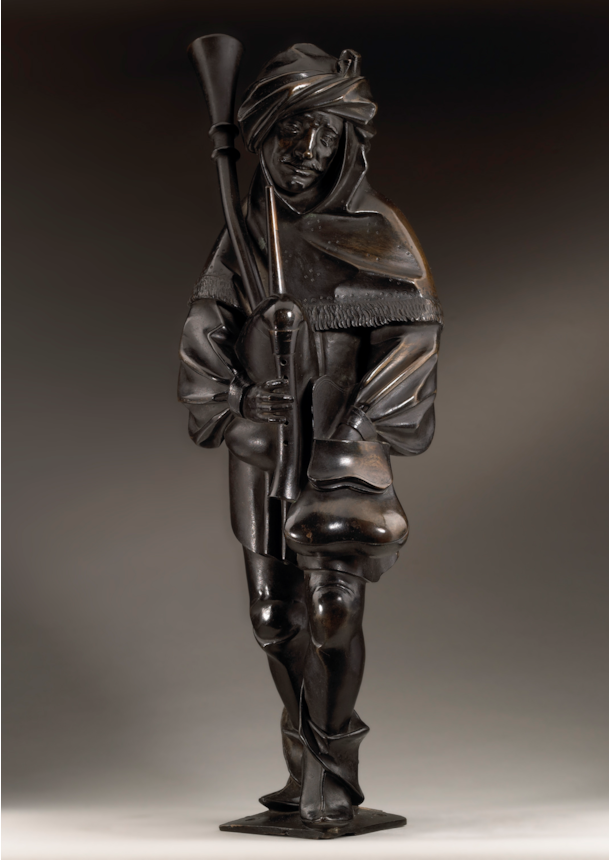
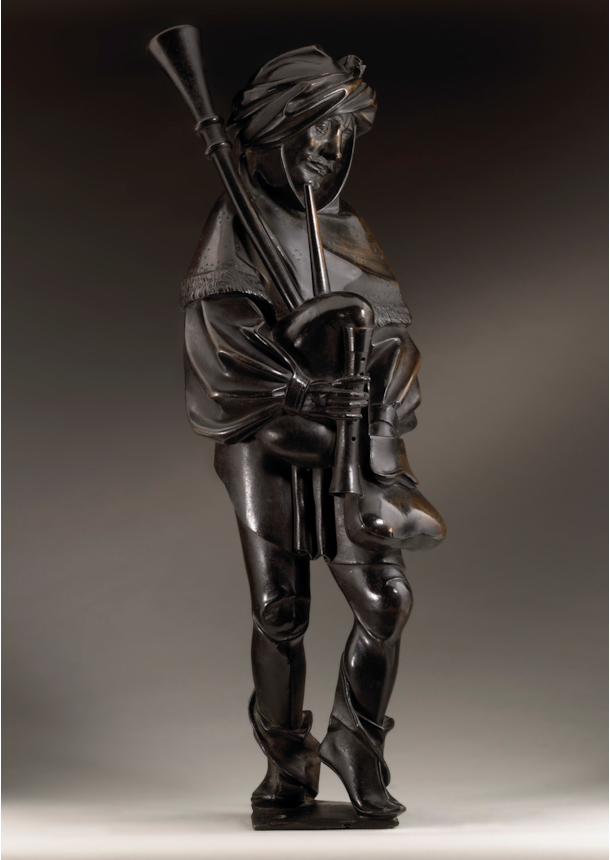
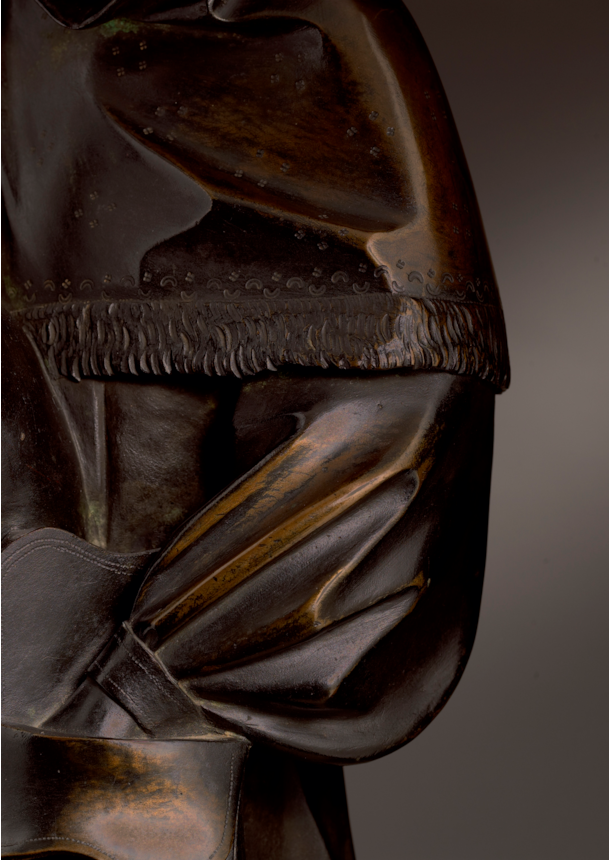
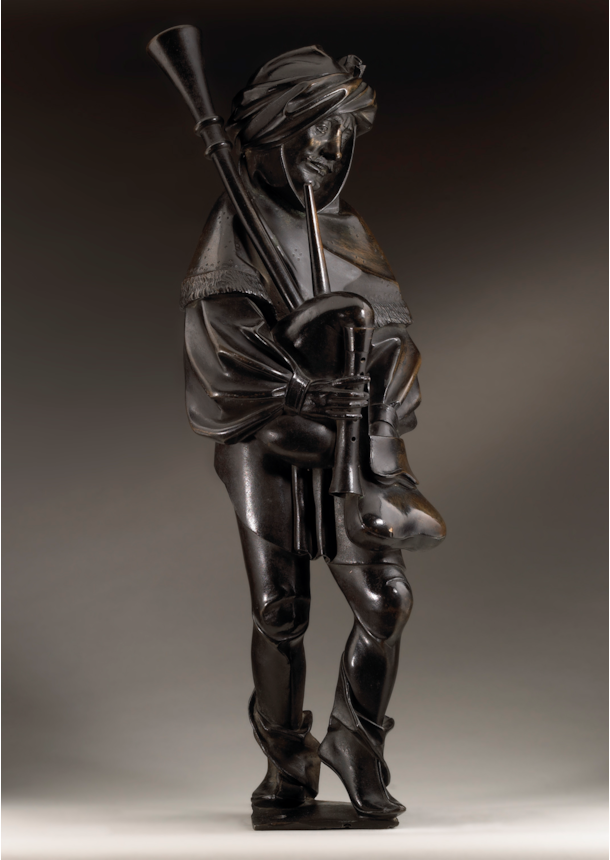
The present work is a bronze figure of a bagpiper (dudelsackpfeifer), cast in Southern Germany, almost certainly in Augsburg, in the first quarter of the sixteenth century.
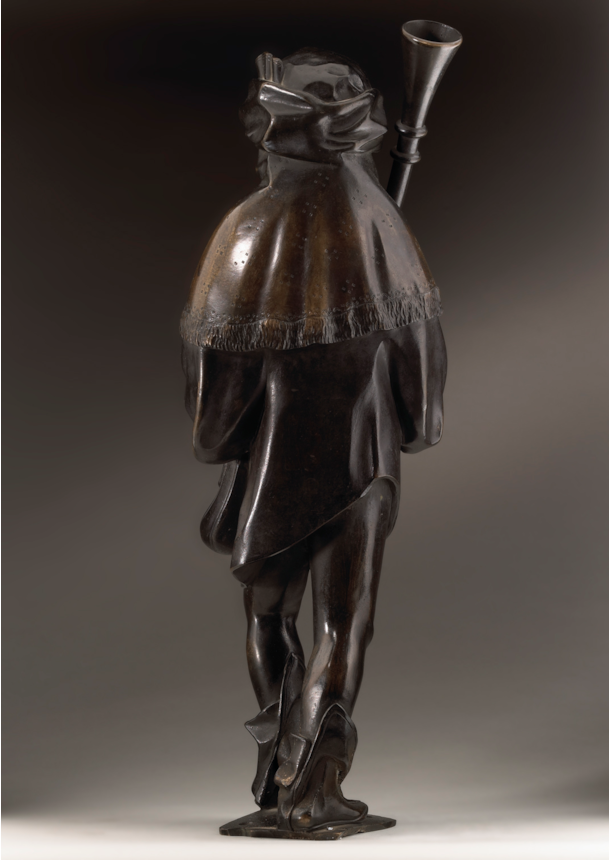
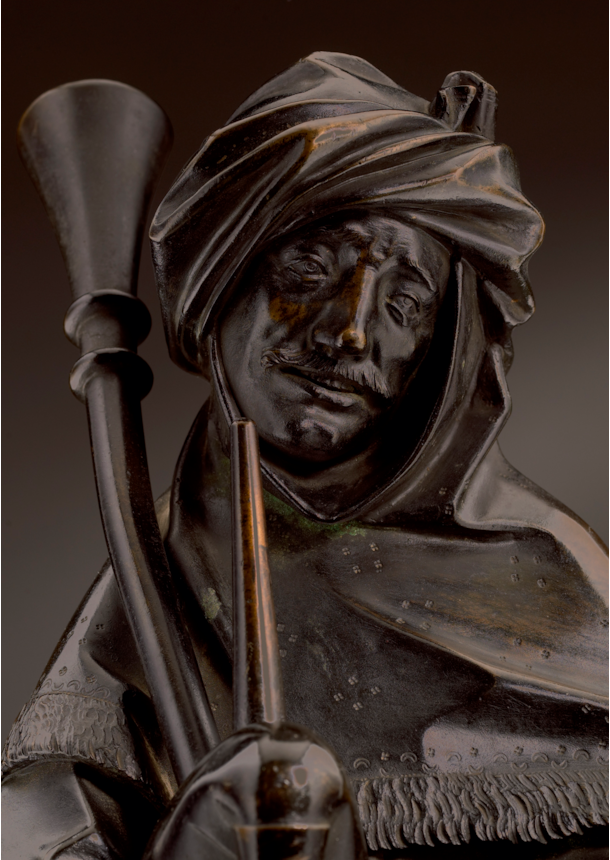
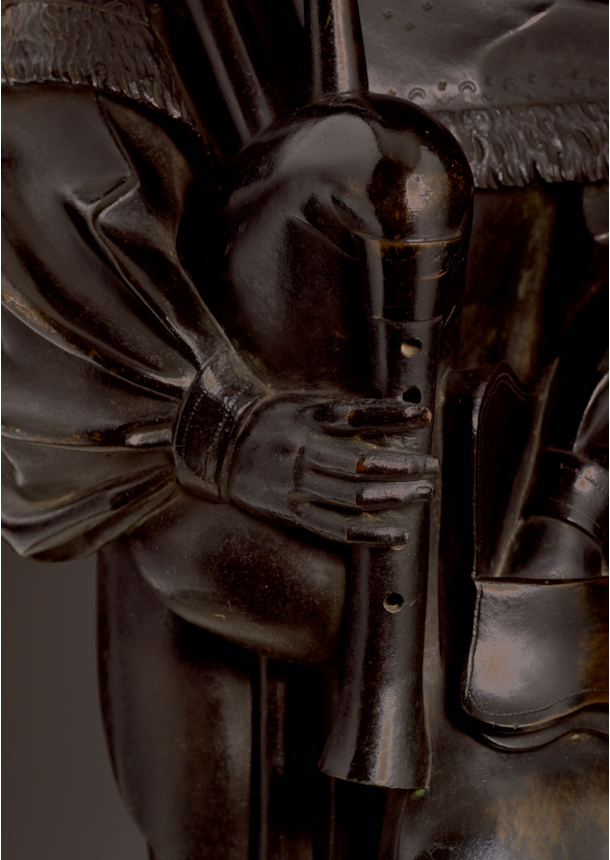
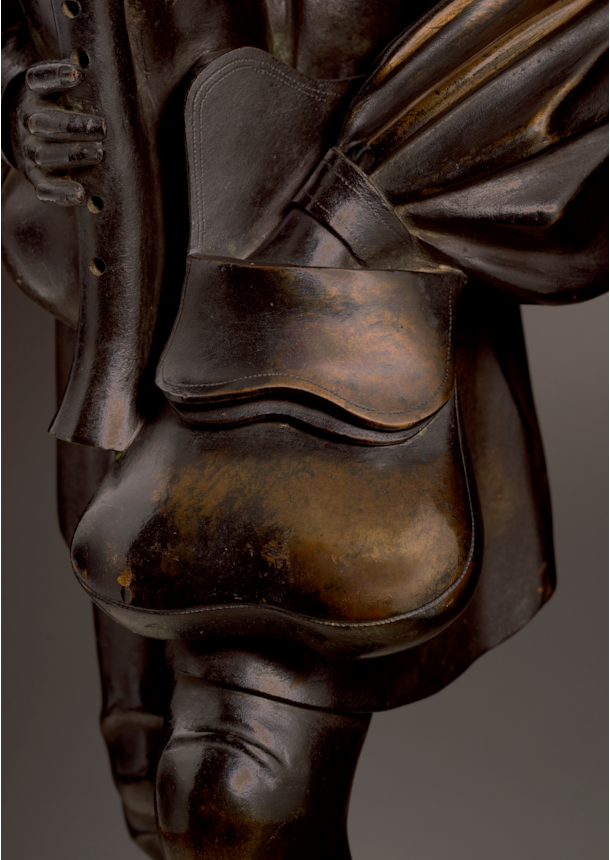
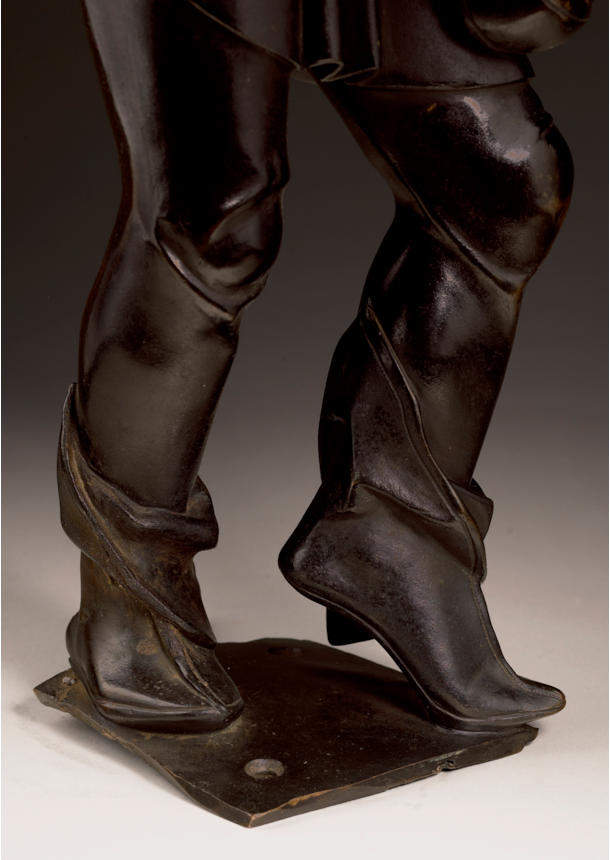
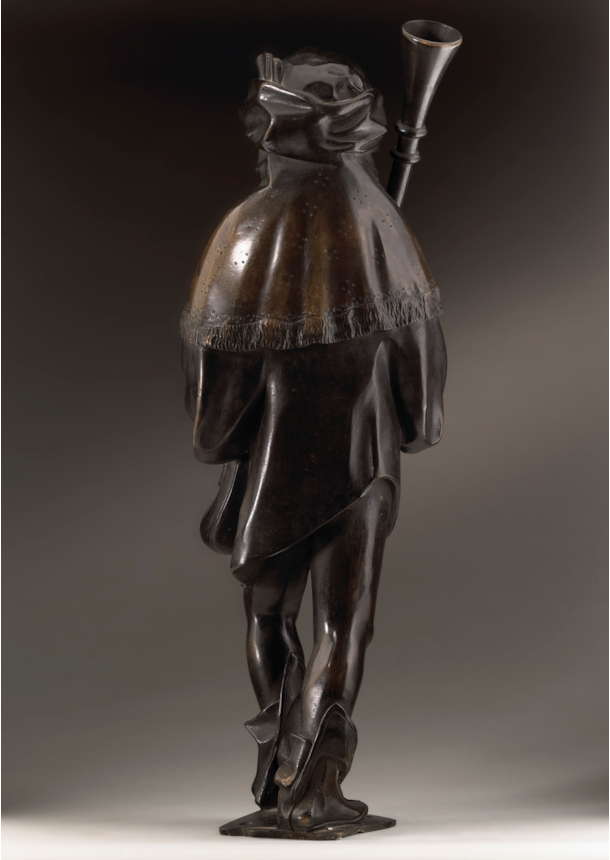
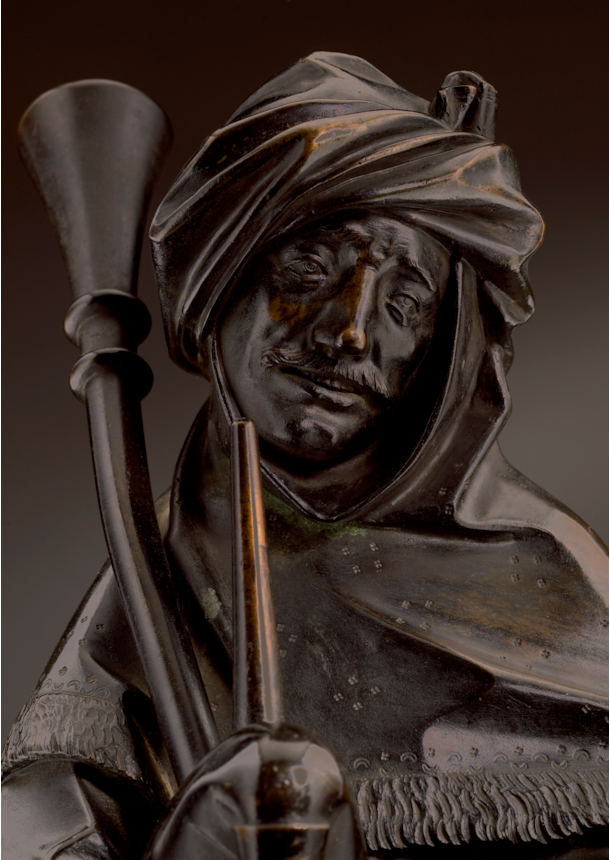
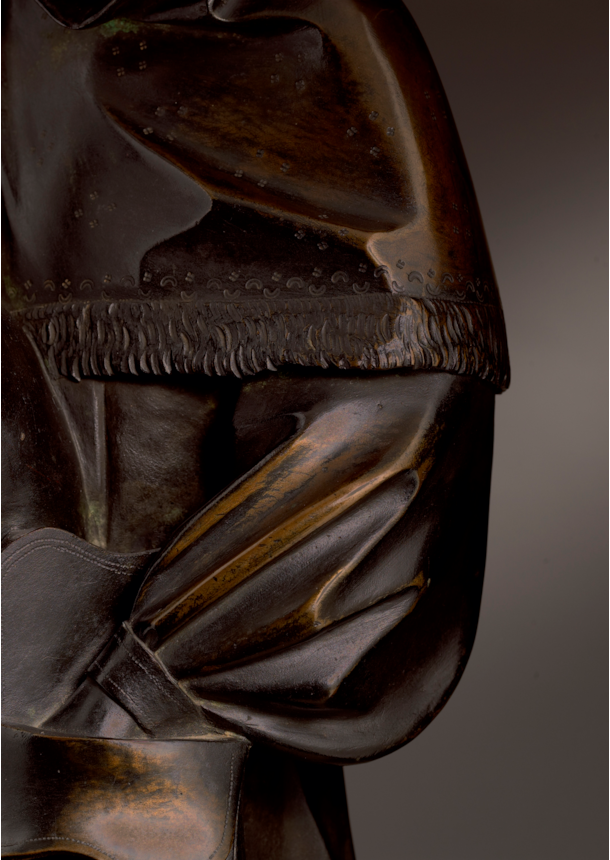
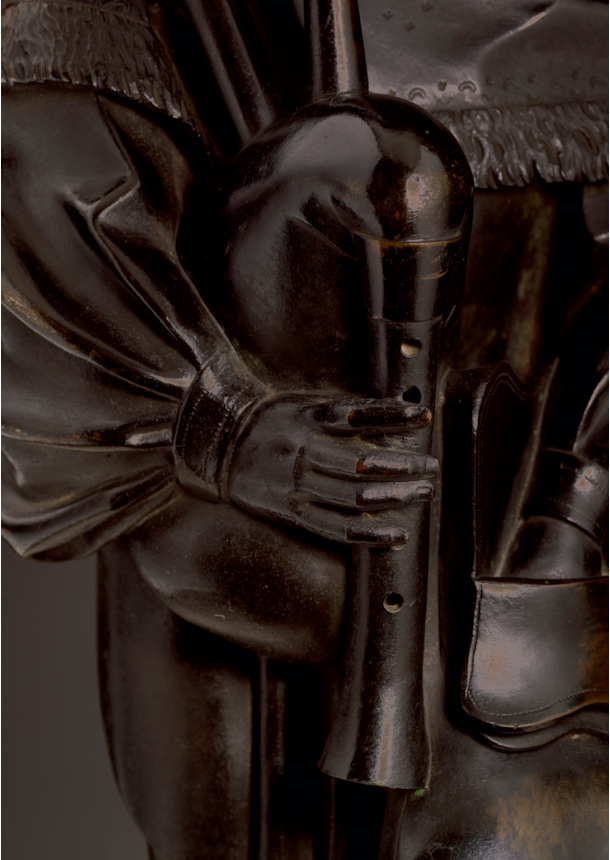
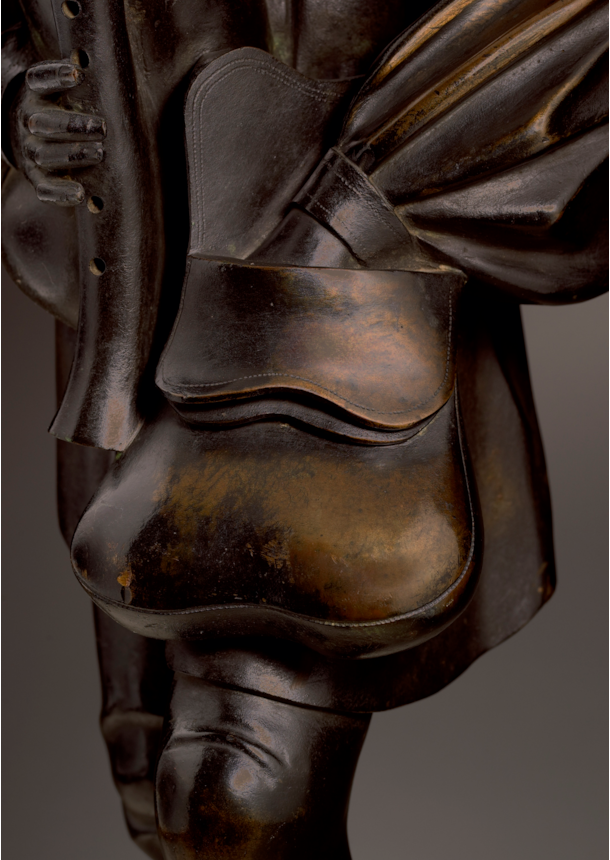
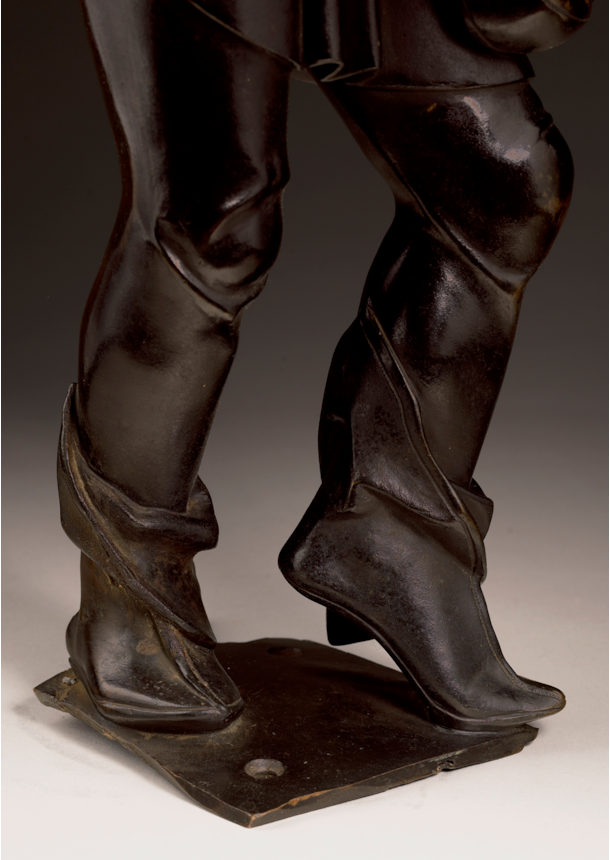
This finely cast bronze represents a standing bagpiper, in a gently animated pose, conveying both movement and character. The moustachioed musician inclines his head slightly, in a relaxed contrapposto stance, reaching into his leather bag with his left hand, whilst supporting the chanter of his instrument beneath his right arm. He is dressed in a short skirt without a belt, leggings, wide leather shoes, and a turban-like gugel (hood), the folds of which are modelled with a restrained yet confident handling of drapery. The overall effect is one of compact monumentality: the figure is conceived as a self-contained sculptural presence, combining lively observation with a strong and legible silhouette in the round.
Figures of bagpipers occupied a distinctive place within the visual culture of late medieval and early Renaissance southern Germany. The motif can be found mostly in graphic art, such as within the artistic milieu of Albrecht Dürer, whose 1514 engraving of a bagpiper was widely disseminated across the region. Such imagery combined elements of humour, rusticity, and moral ambivalence, the bagpiper often embodying popular stereotypes of folly or earthy vitality. Images of musicians with bagpipes were a popular type of figure in Southern Germany, particularly in Nuremberg where a story of a bagpiper was an infamous local legend.
The city of Nuremberg was struck by major waves of plague in 1348, 1437, 1491, 1522, 1562, 1585, and 1634. In the year of 1437, a legendary Nuremberg musician who had fallen asleep in a drunken stupor was mistaken for a victim of the epidemic and loaded onto a cart transporting bodies to burial grounds. Awakening amid the corpses, he is said to have sounded his bagpipes in panic to attract the undertaker’s attention. Completely shocked, the undertakers freed him from the pile of bodies, and the musician went on his way, narrowly escaping burial. Incidentally, variants of this story are known from other central European medieval cities, such as Vienna, where the folk singer Augustin suffered a similar fate. Whilst such legends cannot be securely linked to the genesis of the sculptural model, they contributed to the enduring cultural prominence of the bagpiper figure in urban memory. In any case, the motif’s wider diffusion is evidenced by similar figures adorning fountains in Basel and Bern in the mid-sixteenth century.
The present bronze is a contemporaneous bronze cast of a well-known wooden model housed in the Bode Museum, Berlin. Acquired by Wilhelm von Bode (1845-1929) in 1881 for the Royal Museum in Berlin, the wooden sculpture has traditionally been attributed to an anonymous Nuremberg sculptor active in the first quarter of the sixteenth century. Carved in limewood and bearing traces of multiple layers of polychromy, the wooden figure has long been understood as a preparatory model intended for bronze casts. Our bronze is of particular significance as the only known surviving bronze cast to be dated to the same early sixteenth century dating as the wooden model itself.
Although the wooden sculpture now lacks the drone (upwards pipe) and blowpipe, these had been missing prior to its publication in 1888, the present bronze preserves these features, confirming its casting from the model prior to their loss. Moreover, the correspondence between the cavity at the back of the wooden figure and the fitted panel on the reverse of the bronze strongly suggests a direct technical relationship between model and cast, indicating that the present work was produced from the original or from a mould taken from it.
In February 2026, Dr Arie Pappot of the Rijksmuseum, Amsterdam conducted XRF analyses of the present bronze. The sculpture is cast in a leaded bronze alloy containing a small proportion of zinc, with a trace element profile that corresponds closely with early sixteenth century Southern German bronze production. The alloy shows particularly strong affinities with documented compositions from Augsburg workshops, reflecting the sophisticated foundry practices characteristic of that centre. By contrast, bronze production in Nuremberg around 1500 relied predominantly on brass-based copper–zinc alloys, a practice that differs markedly from the metallurgical profile of the present work. The alloy of the present bronze is nearly identical to those found in works by Jörg Muskat (1450-1527) and Laux Zotmann. Whilst the iconography of the bagpiper is closely associated with Nuremberg’s graphic traditions, the technical evidence points decisively to Augsburg, the centre best equipped for the production of refined bronzes of this quality in the early sixteenth century.
Augsburg occupied a position of exceptional importance in the development of bronze casting in southern Germany during the late fifteenth and early sixteenth centuries. Benefiting from the city’s extraordinary economic prosperity, largely driven by the mercantile empires of families such as the Fuggers and Welsers, Augsburg fostered a highly sophisticated artistic environment in which metalworking traditions flourished. The city possessed a long-standing guild structure of goldsmiths, founders, and armourers whose technical expertise readily translated into the production of sculptural bronzes. By around 1500 Augsburg had become one of the principal centres north of the Alps for the casting of small-scale bronzes, reliefs, and decorative objects. Two notable examples can be found in the Kunsthistorisches Museum, Vienna; cast by Jörg Muskat himself in Augsburg between 1500-1510, Emperor Maximilian I (1469-1519) had commissioned two bronze busts, one of himself and one of his mother, Eleanor of Portugal (1434-1467).
The present bronze may therefore be understood as a rare and important example of artistic exchange between the two major centres of southern Germany. It stands at the intersection of popular visual culture, sculptural tradition, and early Renaissance bronze casting, preserving in metal a model whose origins lie in the dynamic circulation of designs between Nuremberg woodcarvers and Augsburg bronze founders.