





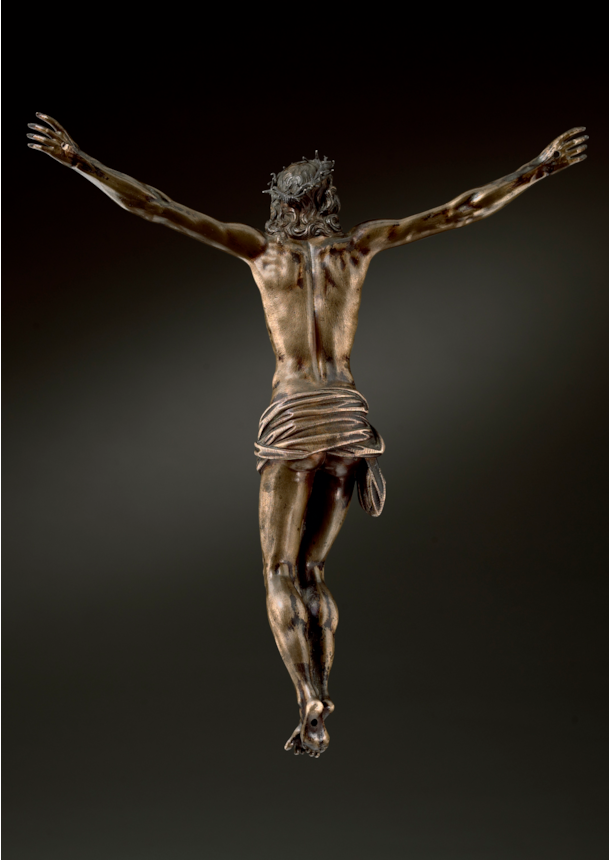
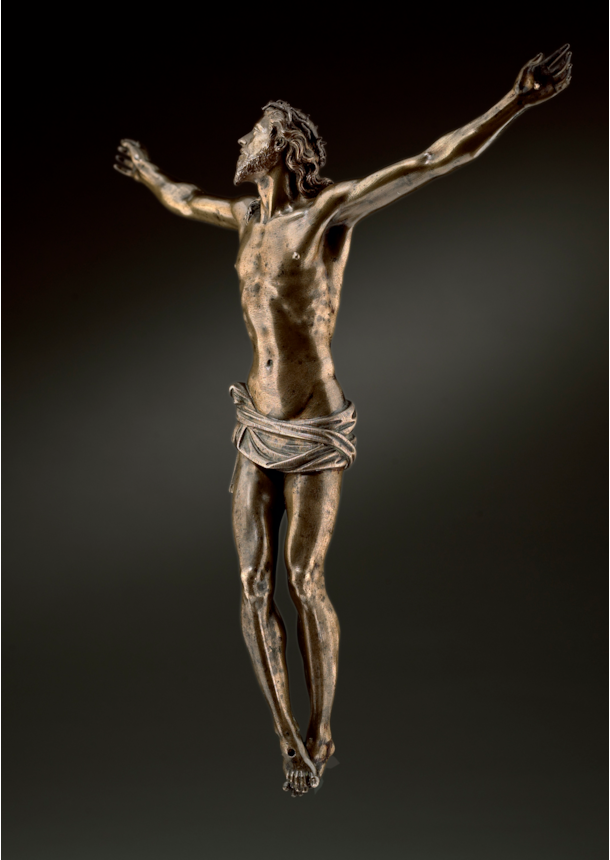
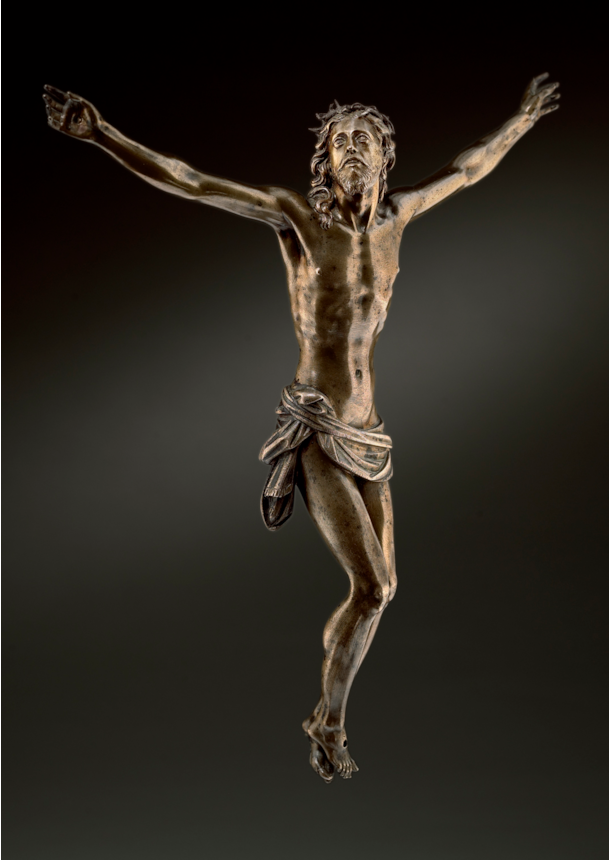
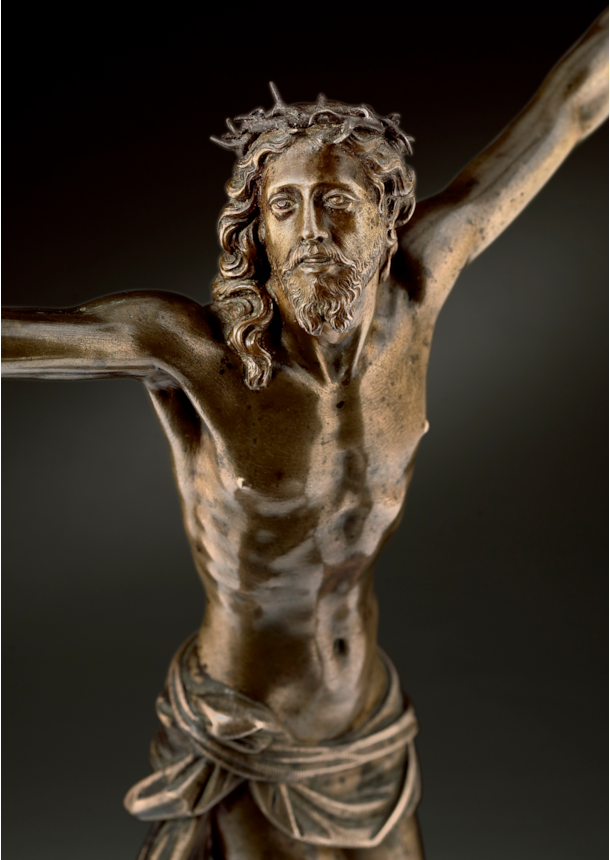
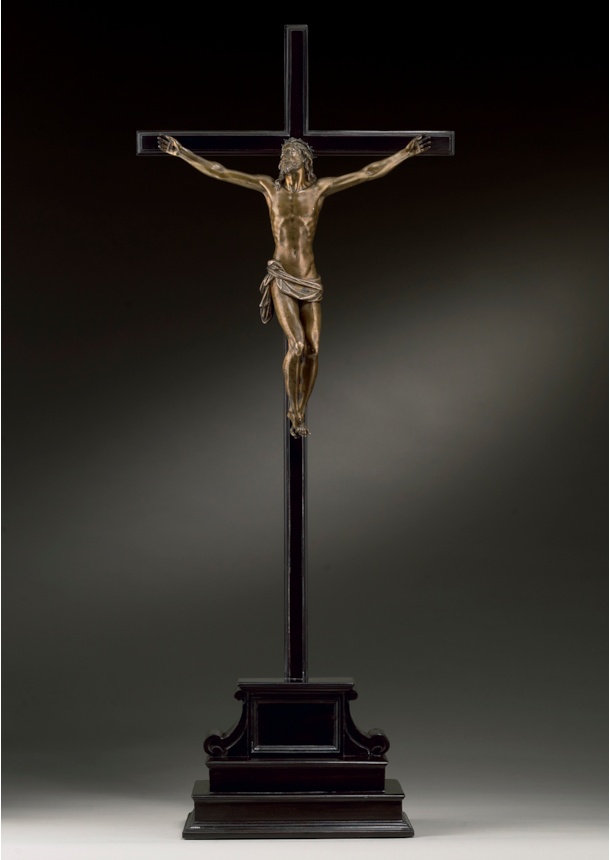



Antonio Susini (active 1574 – 1624)
6. Cristo Vivo
After a model by Giambologna (1529-1608)
Bronze, with silver crown of thorns
22.5 x 20.5 cm (8 ¾ x 8 in.)


C. Avery, Giambologna: An Exhibition of Sculpture by the Master and his Followers. From the Collection of Michael Hall Esq., New York, 1998.
E. Dhanens, Jean Boulogne: Giovanni Bologna Fiammingo, Brussels, 1956.
A. Luzio, La Gallerie dei Gonzaga Venduta all’Inghilterra nel 1627-28, Milan, 1913, p.270.
Although small crucifixes have not traditionally been accorded significant attention in scholarly discussions of Giambologna’s bronze sculpture, they were evidently produced in his workshop in some quantity and from a number of designs. Though the image of the crucified Christ appeared relatively late in Giambologna’s career, models dating as early as the 1570s seem to have served as preparatory studies for life-size crucifixes executed only in the 1590s.
Religious works, including crucifixes and reliefs of the passion constitute a notable departure from Giambologna’s predominantly secular subject matter and were presumably produced in response to requests from patrons such as Cardinal Ferdinando de’ Medici and Luca Grimaldi of Genoa. The inclusion of such works may also have been encouraged by ecclesiastical authorities in accordance with the prescriptions of the Council of Trent.
References to Giambologna’s crucifixes appear in contemporary correspondence concerning the artist. The earliest, and perhaps most significant, occurs in a letter of April 1583 from Simone Fortuna to the Duke of Urbino, written in the context of Fortuna’s efforts to secure several sculptures from Giambologna, including a large marble crucifix for the Duke. In this letter, Fortuna reports that the sculptor had executed four crucifixes in, ‘silver, bronze, or copper’, and that he had seen the models for these, which were a little less than two ‘palmi’ in size (c. 44cm). These crucifixes were intended for the King of Spain, Pope Pius V (1566-1572), the Grand Duke and the Grand Duchess (‘which went to Loreto’). Two additional works from the 1570s are documented: one presented by the sculptor to the handsome soldier of the Ginori family, who had posed for the marble group of the Rape of the Sabine in 1579, and one sent the year prior, in 1578 to Cardinal Ferdinando de’ Medici in Rome. Ferdinando had requested crucifixes from Giambologna since his time in Rome, and by the time of his accession as Grand Duke, such images were being produced with notable regularity. Both large and small crucifixes were subsequently dispatched by Ferdinando as diplomatic gifts, symbols of shared faith, to Roman Catholic rulers throughout Europe, including the Duke of Bavaria, the King of Spain or members of his court, and the Holy Roman Emperor. His son, Cosimo II continued his father’s practice of presenting such crucifixes as diplomatic offerings. In 1609, a silver crucifix ‘semi-vivo’ by Giambologna was sent to the Duke of Mantua in gratitude. Cosimo stipulated that the crucifix was not to be copied, noting that this particular model was highly esteemed by both his father and himself.
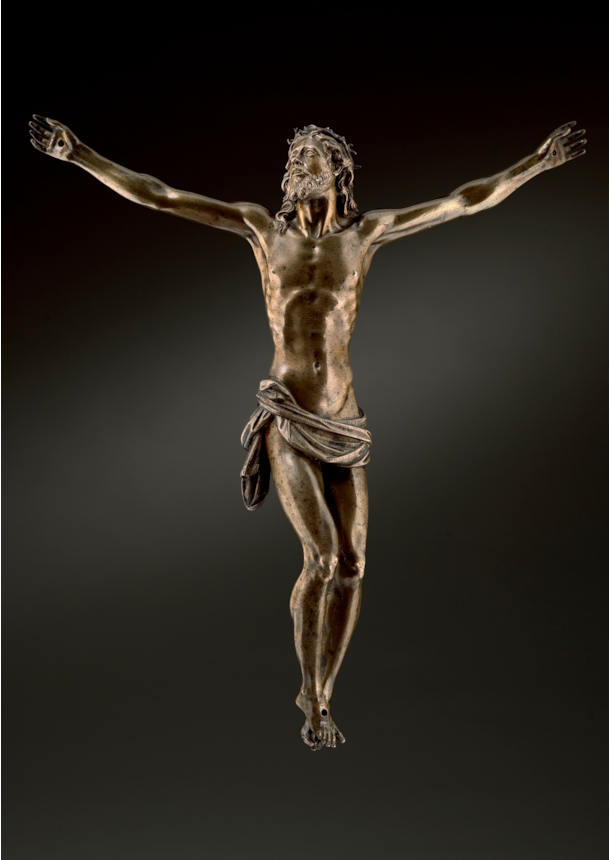
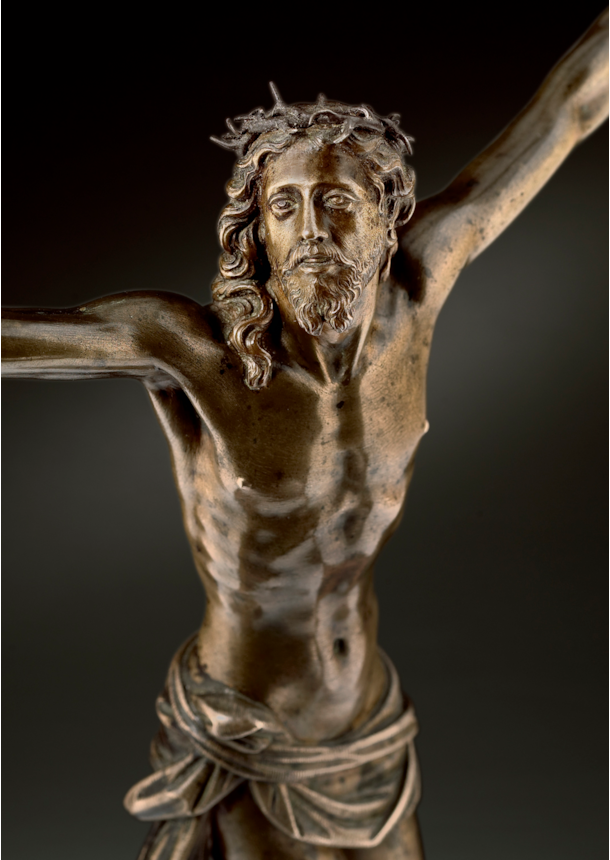
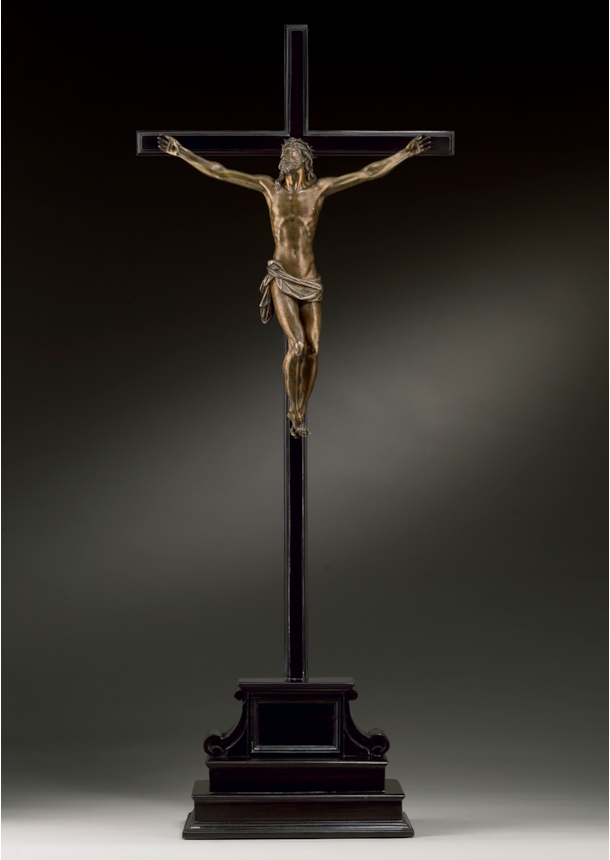
Giambologna’s crucifixes can be divided into two types. The first follows a more traditional composition, presenting Christ after his passing (‘morto’), with his head hanging and his eyes closed. The second type, such as the present work, depicts the living Christ (‘vivo’ or ‘semi-vivo’) his gaze lifted heavenwards as he utters his final words from the cross. This vivo type may be understood in relation to the religious climate of the Counter Reformation. The Council of Trent had a profound impact on artistic production, prompting artists to adapt their works in accordance with newly articulated devotional and doctrinal priorities. Amongst these was a renewed emphasis on the mystery of the incarnation and on the promise of eternal salvation made possible through Resurrection, which in turn called for new visual formulations to give these themes expressive form. In the present work, the son of God is represented free from physical suffering, offering himself to the will of his divine father, towards whom his gaze is directed, and sustained by the knowledge of his resurrection.
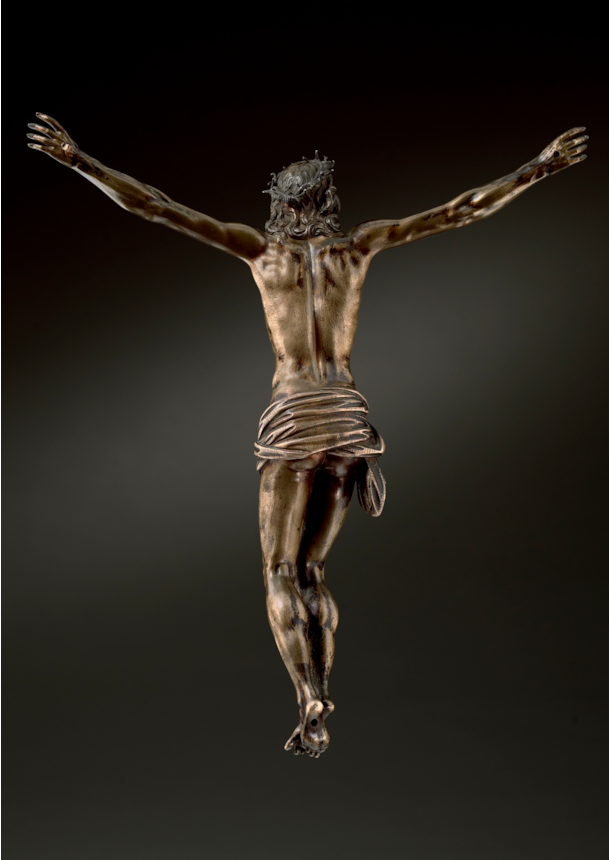
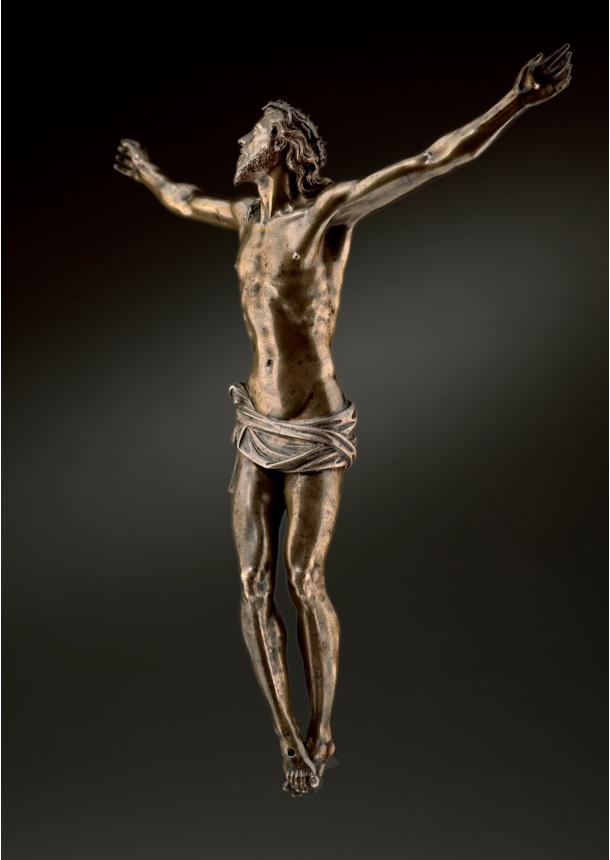
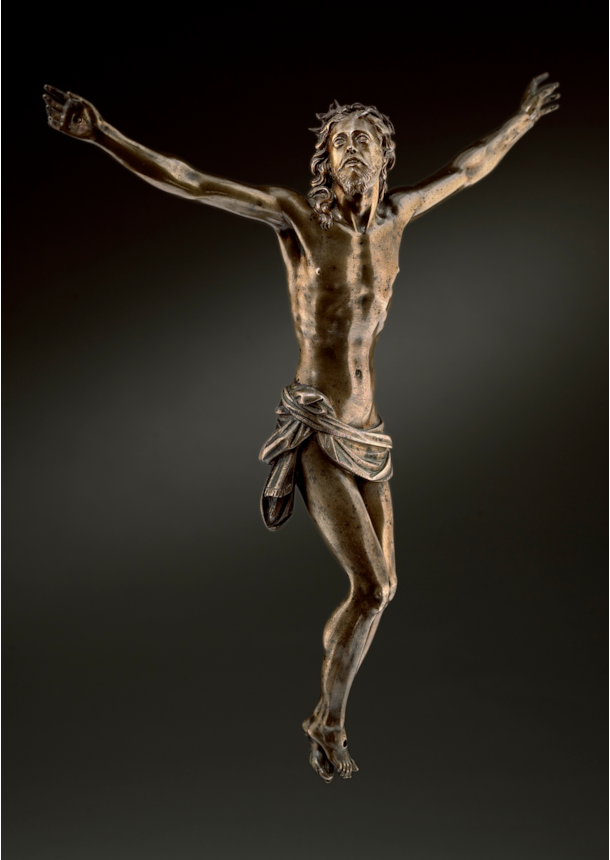
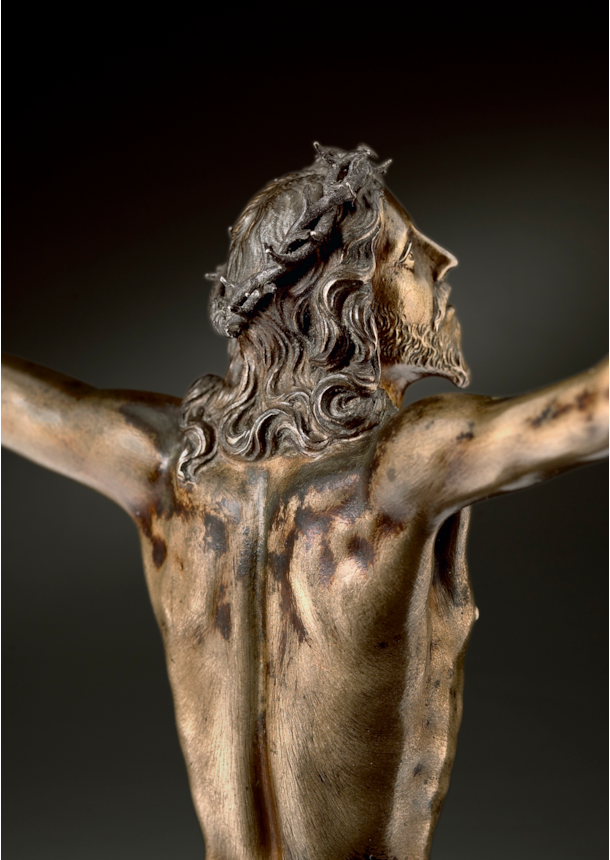
Giambologna’s representations of Christ, whether vivo or morto, are markedly idealised, in keeping with Italian sculptural conventions and in contrast to tendencies found elsewhere in Europe. The faces are serene, the features little marred by suffering, and there is an absence of gaping wounds or exaggerated, contorted musculature. Despite the prominence of the ribs, the torsion of the fatigued body, and the tension of the muscles, a palpable sense of calm emanates from the bronze. Stripped of overt signs of divinity and presented only as man, Christ is clothed only in the traditional perizonium, arranged in emphatic folds that leave one hip exposed.
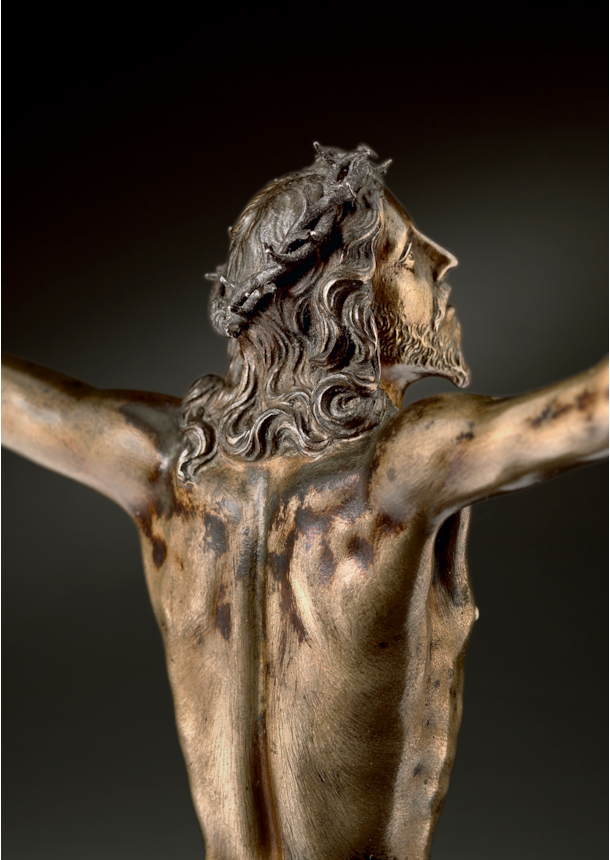
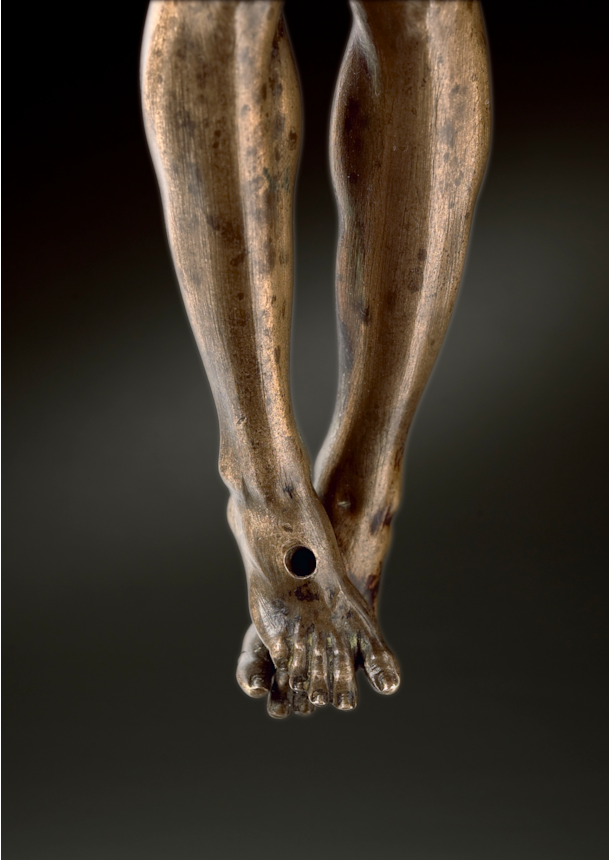
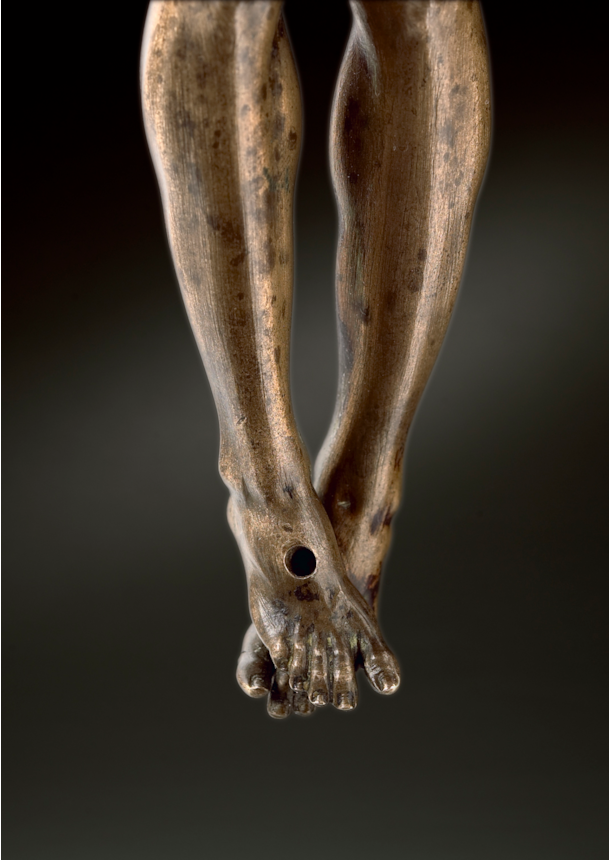
Particular attention is devoted to the exceptionally fine chiseling of the hair, beard, and facial features, which display a high degree of artistic sensitivity and may be associated with the hand of Antonio Susini, Giambologna’s most accomplished assistant. On this point it is important to note that the highly sophisticated level of finishing in the after-work of this mini masterpiece, is imbued by the exceptional work on the fingernails and toenails, which even on this small-scale, render the cuticles in high definition.
Whilst each type of crucifix exhibits slight variations in figural composition, what distinguishes the present example from other versions attributed to the artist’s oeuvre is its small scale (22.5 cm), in comparison with the crucifixes in Ss. Annunziata, Florence (29.5 cm and 29 cm), and that in the Smith College Museum of Art, Northampton, MA (inv. no. 1966:9, 28.2 cm). The present crucifix instead finds closer parallels with two examples formerly in the collection of Michael Hall, attributed to Antonio Susini.
From around 1590 onwards, bronze crucifixes were regularly cast in Giambologna’s workshop by his assistants in a range of sizes and materials. Even prior to this date, Giambologna appears to have personally finished relatively few works, and the marked contrasts in surface handling and patination between versions of the same composition, even in the same material and same size, indicates the variety of hands at work. Even in the production of the best-documented crucifix, that in Ss. Annunziata, Florence, Giambologna relied on the assistance of Antonio Susini.
In a well-documented event, the biographer Filippo Baldinucci informs us that Antonio “had in his room two chests for glasses, in which he used to keep all his finished works, and when prelates or laymen from all over the world called on him and asked him for a Crucifix of such and such a size, or some other figure, Susini very quietly got up from his work, went to the chest, took out the figure and showed it to them, telling them the price. If the priest or whoever else made a counteroffer, and it did not please him, you would see him take the little figure, wrap it in its covering, put it back in the chest and go back and sit down again at his work without saying anything”. Because of the exceptional quality of the present Cristo Vivo, one could easily imagine that it was one of the highly cherished Corpora mentioned in the above reference by Baldinucci.
Born in Florence, Antonio Susini (1558-1624) is widely regarded as the most significant sculptor and bronze-caster to have worked in Giambologna’s atelier, and alongside his master, he is considered one of the most emblematic figures of Italian mannerist sculpture. Training initially as a goldsmith, Susini was employed in Giambologna’s workshop in the casting of bronzes and the preparation of moulds, soon becoming his principal assistant. From around 1580, working in close collaboration with his master, Susini gained recognition for his remarkable ability to precisely realise Giambologna’s artistic models. The high esteem in which Giambologna held Susini is reflected in documentation of payments made directly to Susini for his creation of bronzes which were produced as a part of a commission that was given to Giambologna. By 1600, Susini had left his master’s workshop and begun his own studio in via de’ Pilastri, where he established himself as an independent bronze sculptor. Whilst he continued producing small bronzes after his former master’s models, such as the present work, Susini also achieved recognition for his own classically inspired compositions and for refined bronze reductions after ancient sculpture. These works were highly sought after for their exceptional quality, noted for the precision of their casting and the exquisite refinement of their chased surfaces. In this respect, the finish of Susini’s bronzes is often considered superior to those of his master.
Susini was particularly famed for his crucifixes, cast in moulds taken from Giambologna’s models. In 1622, he presented ten such works, five vivo and five morto, to the Duke of Mantua, who was to choose those he wished to acquire. Despite establishing his independence, Susini maintained both a close personal and professional relationship with Giambologna, who, in 1605, is recorded as having praised a number of his recently cast works.