



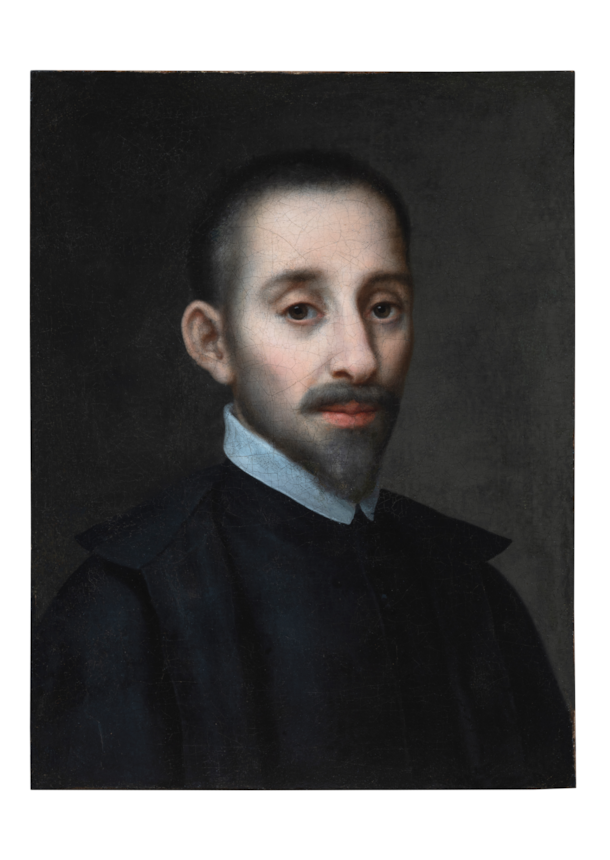



Agnes Dolci (1659-1731)
14. Portrait of a Prelate
Oil on canvas
24.7 x 18.5 cm (9 ¾ x 7 ¼ in.)


With dark eyes, short hair, and a neatly trimmed goatee tinged with gray, like his arched eyebrows, the prelate directs his gaze toward the viewer. His face, framed just below the neck, is sharply defined with a pointed chin.
Dressed in his traditional clerical attire, he wears a stiff white collar and a black cape draped over his shoulders. His high forehead, emphasised by a subtle play of light, is masterfully captured by Agnese Dolci. The daughter of Carlo Dolci, Agnese was deeply influenced by her father, from whom she inherited both technique and artistic sensibility. While Carlo Dolci has traditionally been regarded as the master of pictorial virtuosity in seventeenth-century Florence — renowned for an impeccable draftsmanship and technique that align seamlessly with the religious and pietistic subjects he most often pursued — Agnese, by contrast, infueses her works with a more sentimental tone, conveying what might be described as a “feminine” sensitivity.In the present portrait, for instance, the artist embraces a naturalistic approach, by depicting even the imperfection of a slightly protruding ear. Yet, her refined skill shines in the rendering of soft, lifelike flesh tones, reminiscent of her father’s ethereal figures.
Although Agnese Dolci’s known body of work remains limited, one of the most striking comparisons can be made with her Portrait of Stanislao Kostka, painted on zinc and housed in the Pinacoteca Crociani, Museo Civico in Montepulciano. The textured brushwork and delicate luminosity of the complexion—gracefully illuminating the alabaster-like neck—bear close stylistic similarities to this prelate’s portrait.
Among her most remarkable works is a Self-Portrait, which I identified in a private English collection over a decade ago. Sadly, many of the paintings attributed to her in historical records have been lost. Finally, this portrait also recalls certain sketches picturing a young girl, which are found in a notebook preserved at the Fitzwilliam Museum in Cambridge. Here, one can remark the same sensitivity and naturalistic approach to depicting the human figure.
Professor Francesca Baldassari, October 2024