



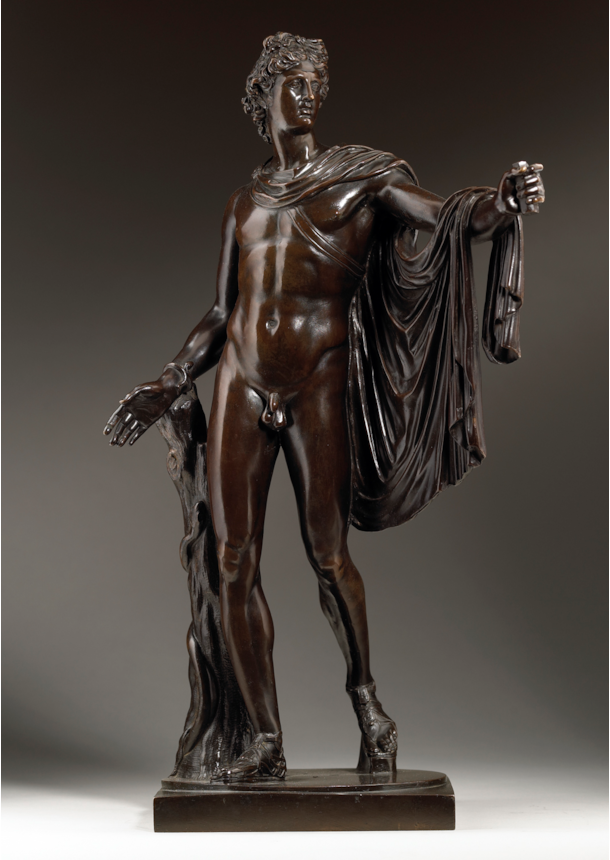
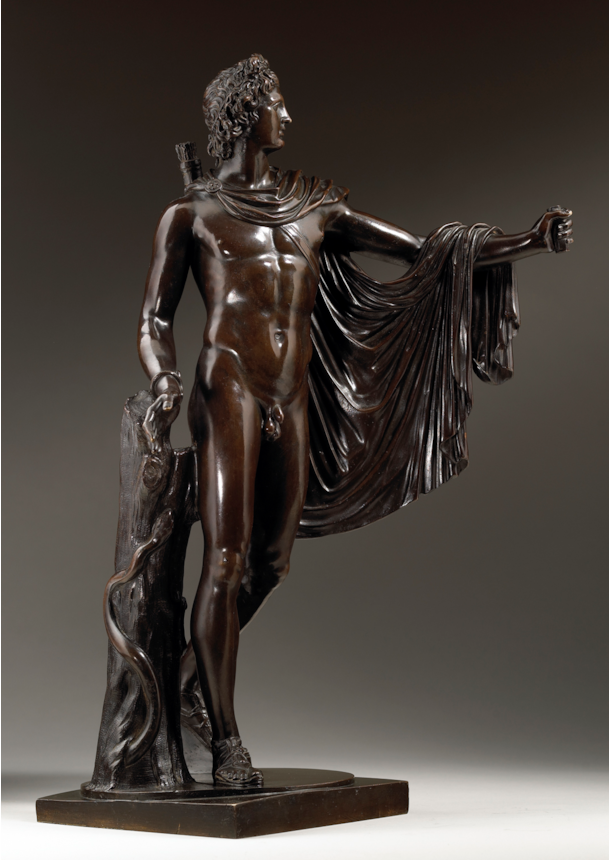
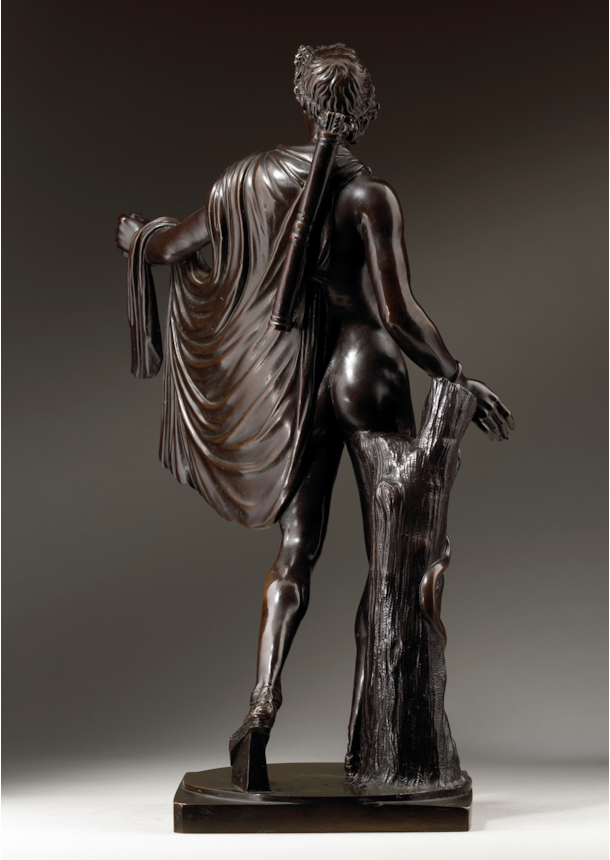
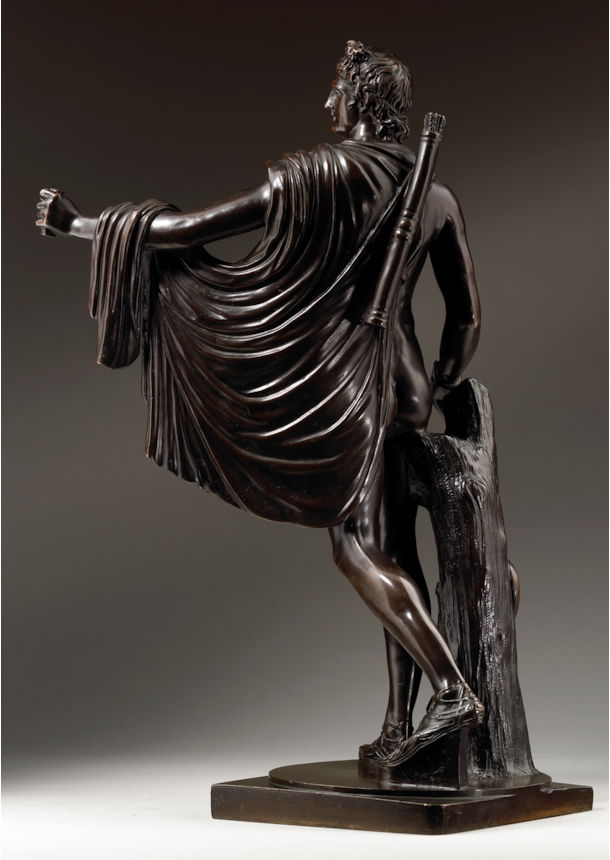





Franco / Italian, late 17th / early 18th century
17. Apollo Belvedere
After the Antique
57 cm (22 ½ in.) high, overall


F. Haskell and N. Penny, Taste and the Antique: The Lure of Classical Sculpture 1500 – 1900, Yale, 1981
H. Keutner, ‘Un modello del Bandinelli per il Nettuno della fontana di Piazza della Signoria a Firenze’ in Scritti di Storia dell’Arte in onore di Roberto Salvini, Florence, 1984, p.417 - 426
J. Warren, ‘Florence, Paris, Rome: Cultural crossing points’, in Beauty & Power: Renaissance and Baroque Bronzes from the Peter Marino Collection, exh. cat., Wallace Collection, London, 2010
M. de Chantelou, De journal du voyage du Cavalier Bernin en France, ed. L. Lalanne, Paris, 1885, p.147
R. Seelig-Teuwen, Barthélemy Prieur, in Paris 2008 / New York, 2008 – 09 pp. 102 - 103
R. Wenley, ‘The French Bronze Statuette to c.1815’, in Wenley, French Bronzes in the Wallace Collection, London, 2002
Exhibited: Lost Treasures of Strawberry Hill: Masterpieces from Horace Walpole's collection, Strawberry Hill House, London, 20 October 2018 – 24 February 2019
This beautifully modelled bronze statuette is a fine version of the famous antique marble in the Belvedere Courtyard of the Vatican museums, known as the Apollo Belvedere. Scholars have been divided on whether the work is a Greek original, or a Roman copy of a fourth century Greek bronze carved during the Hadrianic period. However, the Apollo remains one of the most celebrated statues surviving from ancient times and has received rapturous praise by connoisseurs since its placement in the Belvedere around 1511. When the work arrived in Paris in July 1798, after it was ceded by Pope Pius IV to the French under the ‘Treaty of Tolentino’, the Apollo was triumphantly processed through the streets of Paris in a case adorned with garlands. However, the work was returned to Rome as early as January 1816 (Penny and Haskell, 1981: 148 - 150). The history of casts of the Apollo Belvedere in France begins with the reign of Francois I (r. 1515-47), who between 1542 and 1545, instructed Primaticcio and Jacopo Vignola to make full-size bronze casts made of ten of the greatest antique sculptures in the Cortile del Belvedere, for his Palace at Fontainebleau, one of which included the Apollo (Warren, 2010: 21).
Due to the strong cultural and artistic exchange between Paris, Florence and Rome at this time, there are great similarities between the casts of bronzes modelled after the antique, during the late seventeenth and early eighteenth centuries. This bronze typifies the intense fascination with the ancient world, centred around Rome, that preoccupied artists and their patrons from all over Europe during the late seventeenth and eighteenth centuries. This work was perhaps made by the hand of a native Italian artist seeking inspiration in their local artistic heritage, or the work of an artist from outside Italy (likely France in this case), driven to discover and experience the treasures of the classical South.
The cultural and political links between Paris, Florence and Rome at this point in history were crucial to the development of the bronze statuette genre. Indeed, any young artist hoping to make his career in seventeenth - or eighteenth-century France needed to have spent some time in Italy, particularly, Rome (Warren, 2010: 21). A major development in the story of cultural relations and artistic exchange between Paris and Rome was the founding of the new French Academy in ‘the eternal city’, around 1666. This immediately followed Bernini’s visit to Paris in March 1665, where he advised the King that the best way for art students to learn was to go to Rome and study the antique examples that were held in the great collections there. According to Chantelou, Bernini explained to the King that Rome had produced more artists than France and Spain because of the great number of Greek statues and the fine antique busts which are to be seen there (Chantelou, 1885:147).
In conjunction with establishing an important branch of the French Academy in Rome, another great attempt to obtain copies of the most revered antiquities in Italy for the royal collections was begun relatively soon afterwards, in 1684. A number of sculptors, including Giovanni Battista Foggini, were charged with making fine bronze copies of roman antiquities, which included the Arrotino. Similarly, two full-size copies of the great Vatican river gods, the Nile and the Tiber, were executed in marble by Lorenzo Ottone and Pierre Bourdict between 1687 and 1692 (Warren, 2010: 33).