







Pietro Simoni Da Barga (active c. 1571 - 1589)
14. Bacchus, circa 1571-1589
Bronze
28 cm (11 in.) high
W.L. Hildburgh. ‘A Note on Some Small bronzes by Pietro da Barga’, The Burlington Magazine, vol. XXXVII, no. 209 August,1920, p.78 – 79 and 83
A.M. Massinelli, “I bronzi dello stipo di Cosimo I de’ Medici,” Antichità Viva, vol. 26, 1987
Le Collezioni del Museo Nazionale di Napoli, Rome, 1989, pp.174 – 75, figs.138-39
J. Pope-Hennessy, Italian Renaissance Sculpture, 4th edn, London, 1996


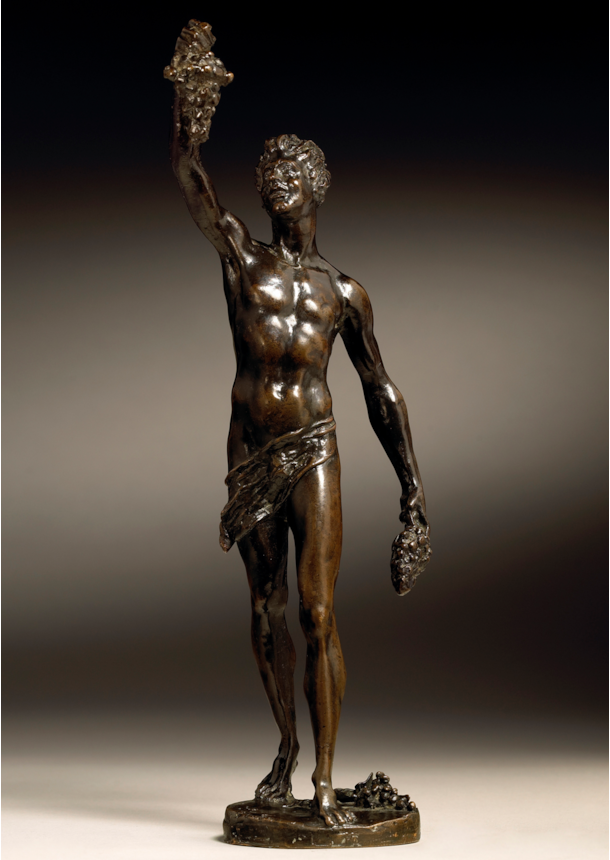
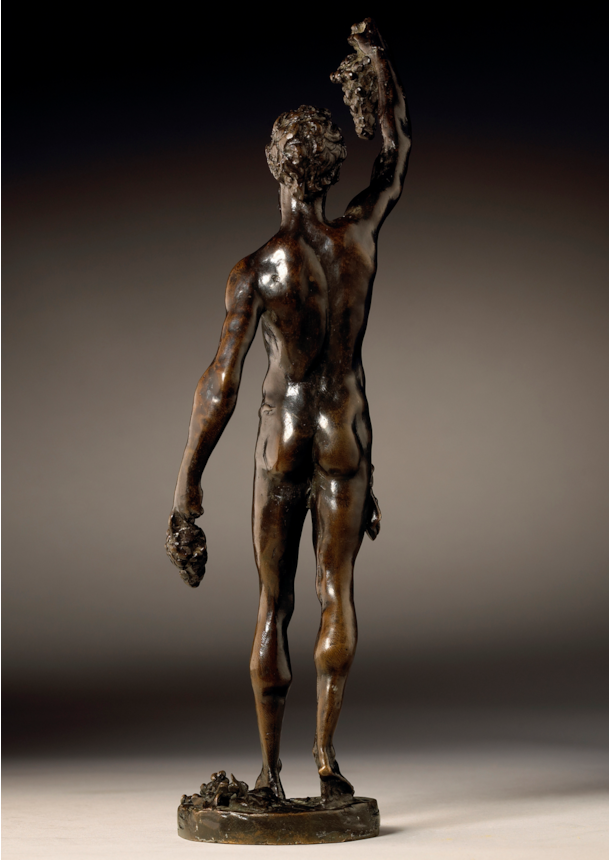
This bronze statuette depicts Bacchus, the Roman god of wine and ecstatic revelry, striding forward and reaching high to pull a large bunch of grapes from a vine. There is a balletic grace to Bacchus’ pose, which is amplified by his slender body and limbs and confers upon the work a great elegance of form. The surface of the bronze also possesses a wonderful tactility and sensuality, which seems generated by the loose and expressive modelling style for which Da Barga has become known.
The present bronze by Pietro Simoni Da Barga is a variant of another work by the sculptor in the Museo Nazionale de Bargello, Florence, representing Bacchus with two bunches of grapes, one held aloft and the other above a panther lying on the ground. Our version differs from the Bargello’s in the absence of a panther and the addition of a loincloth. Both casts could have derived from two antique satyr figures, now in the Museo Nazionale di Napoli (inv. nos. 6331, 6332), which stand on their tiptoes, holding bunches of grapes and tazzas. These were formerly in the Farnese collection, then in Rome, which is where Da Barga would have seen them. Yet there are marked differences between the present work and the Farnese models, so it is also entirely possible that Da Barga was inspired by a source that is now lost, or indeed produced this work from a conflation of other examples surviving from the ancient world (De Nicola, 1916, p. 370).
Contemporary sources refer to Da Barga as ‘Scultore di Sua Signoria Illustrissima’ - or Sculptor of his Eminence (De Nicola, 1916, p. 369). Indeed, the sculptor is largely known to connoisseurs of sixteenth-century sculpture as the artist who, between 1571 and 1588, made around 24 beautiful, small-scale bronze versions of revered ancient works for Cardinal Ferdinando I de Medici. These were to be displayed in a cabinet, or ‘Stipo’, that was commissioned by the Cardinal from the painter Jacopo Zucchi circa 1576. The cabinet did not survive the eighteenth century and 12 of the statuettes were subsequently transferred to Florence in 1769 (Massinelli, 1987, pp. 57 - 58). Ferdinando was a voracious collector of antiquities and incorporated the famous Della Valle-Capranica collections into his own. However, certain works, such as the Farnese Hercules and the Laocoon, were too famous and valuable even for the Cardinal to obtain. This may have been the factor that prompted Ferdinando to commission Da Barga to make a series of works after, and inspired by, his favourite antiquities that were not part of his collection. The works Da Barga made are all around 12 in. (30 cm) high and some of them are listed in the Medici ‘Inventari di Guardaroba’ of 1571 to 1588. His work for the Medici, making small-scale bronze sculpture inspired by the Antique, has prompted comparisons to the activity of Antico (Pier Jacopo Alari Bonacolsi; c. 1455–1528), who worked for the Gonzaga of Mantua in a similar capacity.
The bronze statuette genre was revived during the fifteenth century and became established as one of the most intimate art forms inherited from antiquity. An important example of the Romans’ appreciation of small-scale bronze statuary known to the Renaissance was the passage eulogizing a model of Hercules in the house of Novius Vindex penned by the first-century AD poet Publius Papinius Statius: “I fell deeply in love; nor, though long I gazed, were my eyes sated with it; such dignity had the work, such majesty, despite its narrow limits. A god was he…small to the eye, yet a giant to the mind! To think that so tiny a body should create the illusion of so great a fame. What precision of touch, what daring imagination the cunning master had, at once to model an ornament for the table and to conceive in his mind mighty colossal forms.” (Statius, Sylvae, IV, vi, 32-38, translation in D. Lewis, “On the Nature of Renaissance Bronzes”, in Renaissance Master Bronzes from the Collection of the Kunsthistorisches Museum, Vienna’, exh. cat., Smithsonian Institution Travelling Exhibition Service, Washington D.C., 1986, p. 23). It was in part due to such laudatory accounts surviving from ancient times that the artistic production of small bronze statuettes was revived in the Quattrocento and continued to be appreciated in the Cinquecento in terms akin to those outlined by Statius’ response. The aesthetic concept of a bronze statuette being ‘small to the eye’ but ‘giant to the mind’ – therefore giving the illusion of monumentality despite its size – is manifest in Da Barga’s work and central to understanding the essential beauty and technical achievements intrinsic to the creation of reduced bronze versions of the most revered ancient statues.
Other important examples of Da Barga’s work, outside the holdings of the Bargello, Florence, include those in the Metropolitan Museum of Art, New York, which possesses two masterful bronzes representing the Farnese Hercules and Neptune.