



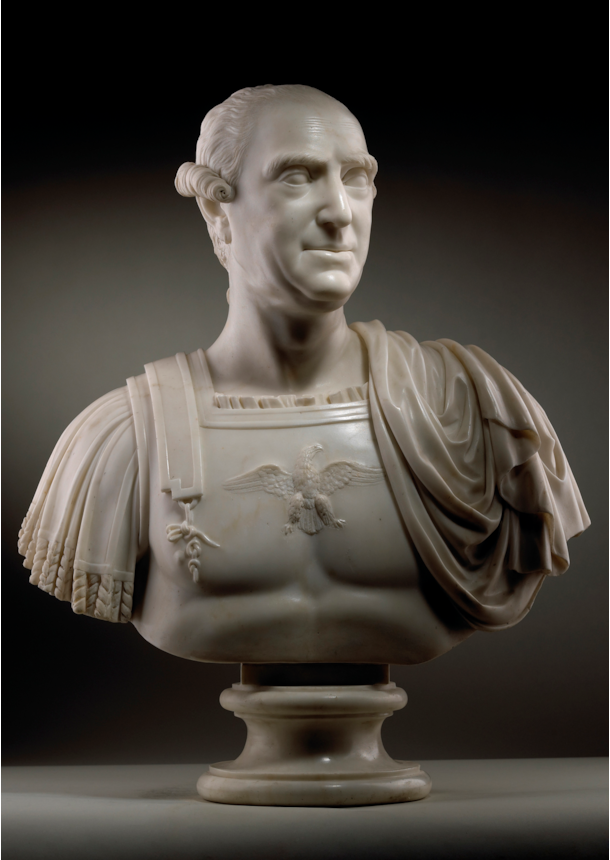
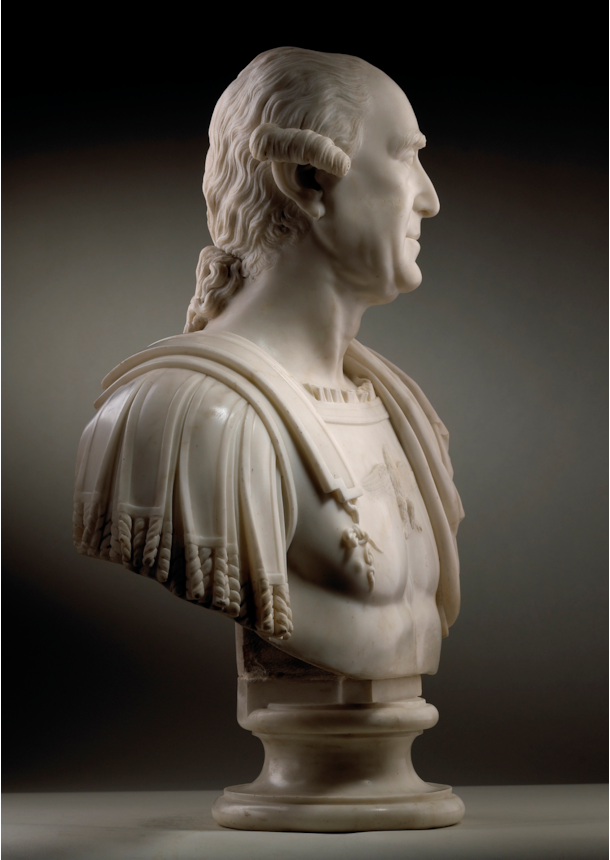
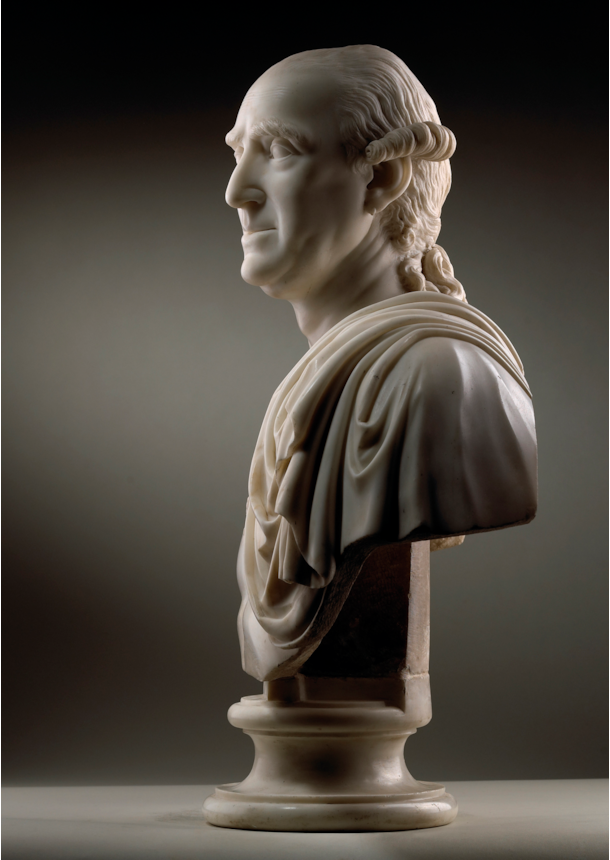
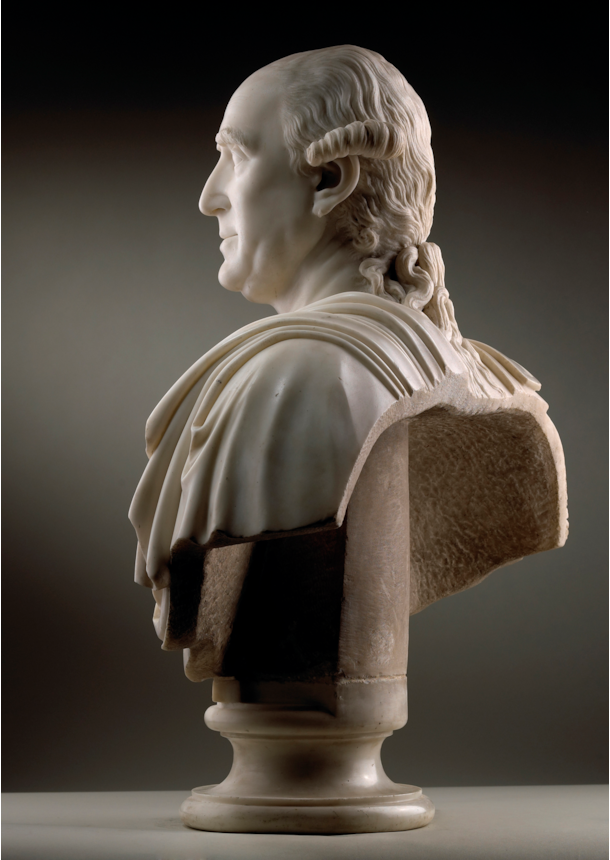




Christopher Hewetson (c.1737-1798)
21. Portrait Bust of Prince Francis Xavier of Saxony (1730-1806)
Dateable to the 1790s
White marble
75 cm (29 ½ in.) high
by descent to his daughter, Elisabeth Ursula Anna Cordula Xaveria, Duchess d'Esclignac (1768-1844);
by descent to her daughter, Marie Charlotte Xaverine, Baroness von Weissenbach (1788-1858);
by descent to her daughter, Johanna, Countess von Korff-Schmising Kerssenbrock (1829-1906);
by descent to her daughter, Maria Xaverina Louisa, Baroness de Weichs de Wenne, Castle Geijsteren,
Limburg (1854-1927);
certainly thence by family descent until 2014


B. de Breffny, “Christopher Hewetson (c.1737 – 1798)”, Irish Arts Review (1984 – 1987), Vol. 3, No.3 (Autumn, 1986), p.52 – 57
M. Baker in E. P. Bowron and J. J. Rishel (eds.), Art in Rome in the Eighteenth Century, exh. cat. Philadelphia Museum of Arts, Philadelphia, and MFA, Houston, 2000
E. Catani, ‘Note storico-artistiche sopra una coppia di busti marmorei raffiguranti il principe Francesco Saverio Augusto di Sassonia e la sua consorte la contessa Chiara Maria Rosa Spinucci di Fermo’, in Atti della 35. Tornata dello Studio Firmano per la storia dell'arte medica e della scienza: Fermo, 4-5-6 maggio 2001, Fermo, 2002, pp. 45-60
P. Coen, “Christopher Hewetson: nuovi documenti, nuove interpretazioni”, Bollettino d’Arte, XCVII – Series VII, July-September 2012, pp. 87-100
A. M. Suárez Huerta, “Will and Inventory of Christopher Hewetson (c.1737 – 1798)”, The British Art Journal, vol.15, no.2 (Winter 2014 / 2015), p. 3 – 17
Exhibited: On loan to Museum het Cuypershuis, Roermond, 1963 - 2014
The Irish sculptor Christopher Hewetson was amongst the most renowned and respected portrait sculptors in late eighteenth-century Rome. After studying in his native Kilkenny and later Dublin, Hewetson travelled to the Eternal City in 1765, and there remained for the rest of his career. He died in Naples in 1798.
Amongst Hewetson’s earliest works are portraits of wealthy Grand Tourists, such as collectors Charles Townley (marble, 1769), and Sir Watkin Williams-Wynn (terracotta, 1769), followed – in the 1770s – by those of other notable patrons, such as William Henry, Duke of Gloucester (in marble and terracotta, 1772) and Pope Clement XIV (whose effigy he carved repeatedly in marble from 1772). By the 1780s, Hewetson’s practice had become fully established and he received commissions from an increasing number of members of the European elites. During this period his sitters included: Herr and Frau von Kniphausen (1782 – 1783), Gavin Hamilton (1784), Sir William Hamilton (1797), Lady Hamilton (1797), Frederick Augustus Hervey, Bishop of Derry and 4th Earl of Bristol (1789), Empress Maria Feodorovna (1784) and Thomas Giffard of Chillington (1784). It was not unusual for such visitors to commission a portrait in marble or terracotta from Hewetson in conjunction with a portrait painted by Pompeo Batoni (1708-1787), and perhaps a profile engraved upon a cameo by Giovanni Pichler (1734-1791), as the aforementioned Duke of Gloucester did. Interestingly, one of Hewetson’s latest recorded works is a portrait of the celebrated Swiss-German painter Angelica Kauffmann (1796), now in the parish church of Schwarzenberg, Austria.
Hewetson had established a strong friendship with the English antiquities dealer Thomas Jenkins (1722 – 1798) and the painter Anton Rafael Mengs (1728 – 1779). All three had clients in common and likely promoted each other’s works through personal recommendation. For example, Jenkins enjoyed the favour of Clement XIV as the unofficial English representative to the Holy See, and it was likely through him that the Pope came to commission portraits from Hewetson. In another instance, the Spanish Ambassador Don José Nicolàs de Azara (1737-1798) had his portrait modelled by Hewetson under the direction of Mengs. This indicates that there was a significant degree of collaboration between the great taste-makers and artists of Rome during this period, and Hewetson, who enjoyed considerable commercial success, was very much at the centre of this phenomenon.
The present work corresponds closely in style and subject matter to the type of portrait bust Hewetson was renowned for. The sitter, Prince Francis Xavier of Saxony, was the second surviving son of Augustus III of Poland (1696–1763). From 1765 until 1768 he acted as Regent to his nephew, the infant Elector Frederick Augustus III of Saxony, performing in his name a formal renunciation of the Polish Crown in favour of Stanislaw Poniatowski, as was required by the treaty signed between Prussia and Russia on 11 April 1764. In the same period Francis Xavier secretly married Countess Maria Chiara Spinucci, former lady-in-waiting to his sister, the Dowager Electress Maria Antonia. The union was considered below his rank and only officialised some years later. After relinquishing his duties as Regent in 1768, the Prince moved his family to France – where in 1774 his younger sister’s son became king as Louis XVI (1754–1793) – and lived there for twenty years under the assumed title of Count of Lusatia. The family fled the country at the beginning of the French Revolution and moved to Rome. The Countess died there in 1792 and some years later Francis Xavier left the Eternal City to return to his native Saxony, where he died in 1806. This places him in Rome towards the very end of the 1780s and early 1790s, when Hewetson had just completed a monumental bust of the philosopher Leibniz for the city of Hanover in Germany (1789-90), and a portrait of the German-Italian artist Giovanni Pichler (1792), now in the Protomoteca Capitolina in Rome. It is possible that the German element of both these commissions was the trait d’union between Francis Xavier of Saxony and Hewetson, but there is also another possibility.
In November 1793, Francis Xavier journeyed to Fermo for his wife’s solemn burial. This planned visit had prompted the town’s authorities, the Priori, to commission a pair of busts of the couple (see D. Silvagni, La Corte e Società Romana nei secoli XVIII e XIX, Rome, 1883, II, p. 228). Already in January 1793 they had asked their patron Cardinal Borgia to commission two portrait busts of Maria Chiara and Francis Xavier, to be exhibited in the Palazzo Priorale’s main hall in time for the funeral. A nineteenth-century document states that the Cardinal entrusted the work to “Monti e Albicini”, who are presumably to be identified with the Roman sculptors Giovanni Monti and Carlo Albacini. Unfortunately, the bust of the Prince did not please the Priori, who decided to hide it in a cupboard throughout Francis Xavier’s stay in Fermo. They duly expressed their dissatisfaction to Borgia in a letter, noting the effigy looked nothing like the Prince and was also remarkably disproportionate in comparison with his wife’s much better executed counterpart (for a full account of the Priori’s commission, see Catani 2002). The unfortunate pair of busts are to this day in Fermo, in the town’s Biblioteca, but it is possible that, following the Priori’s complaints, Cardinal Borgia decided to commission another bust of the Prince, this time from an artist of unquestionable talent such as Hewetson. This the Priori must have refused to acquire, both because Francis Xavier would by then have left Fermo, and because of financial concerns (it appears the first pair of busts had cost them a considerable sum of money). In other words, there is a possibility that the present bust was originally executed by Hewetson for the Priori of Fermo, under the patronage of Cardinal Borgia, but ultimately given to the Prince instead. The portrait was inherited by the heirs of Maria Xaverina Louisa, Baroness de Weichs de Wenne (d. 1927) and her genealogy shows a direct matrilineal line down to one of the daughters of Francis Xavier of Saxony.
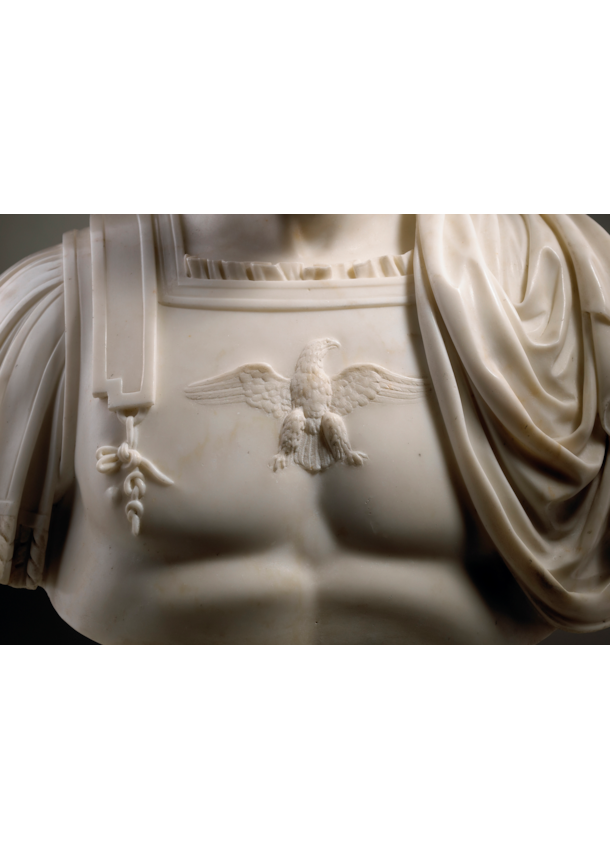
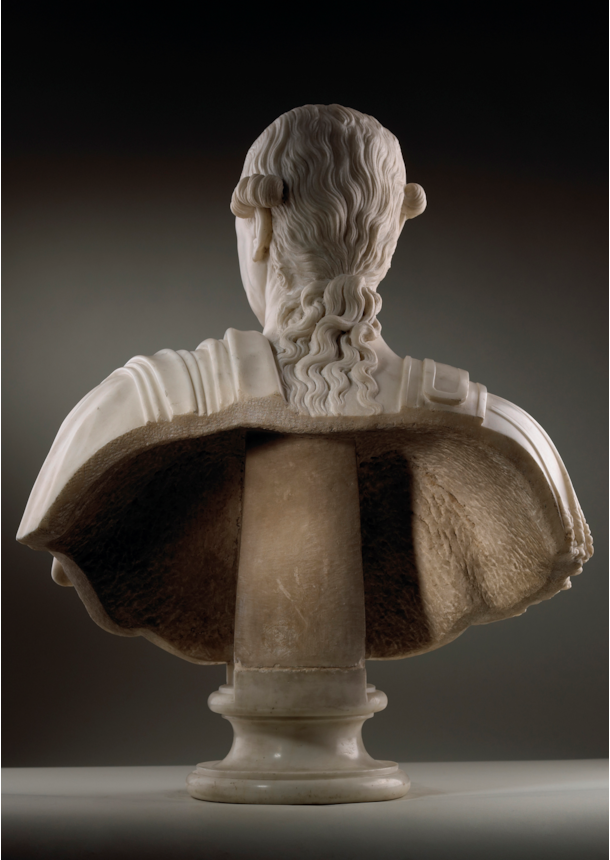
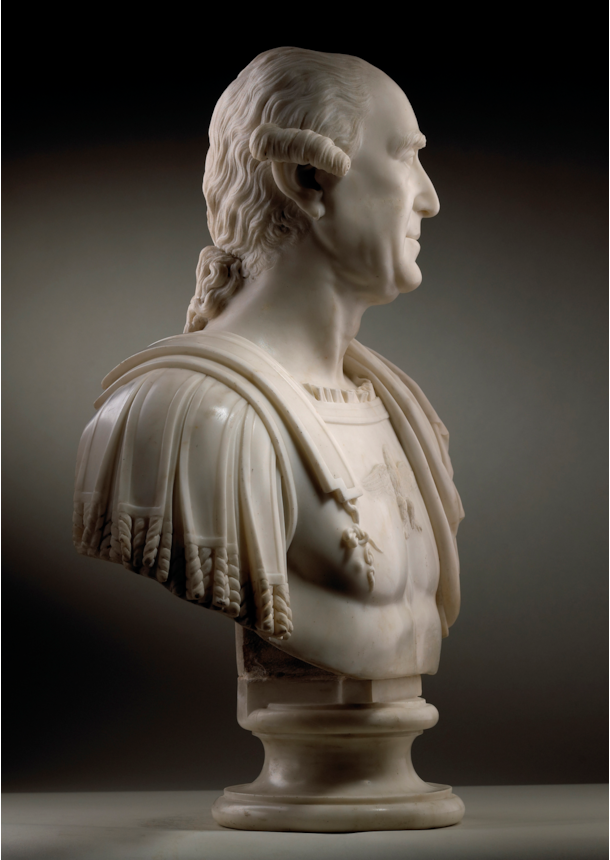
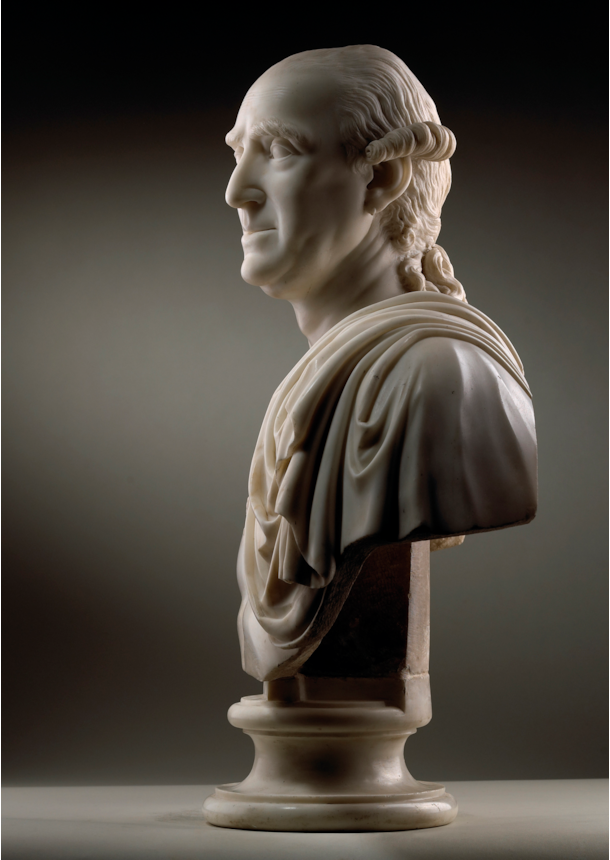
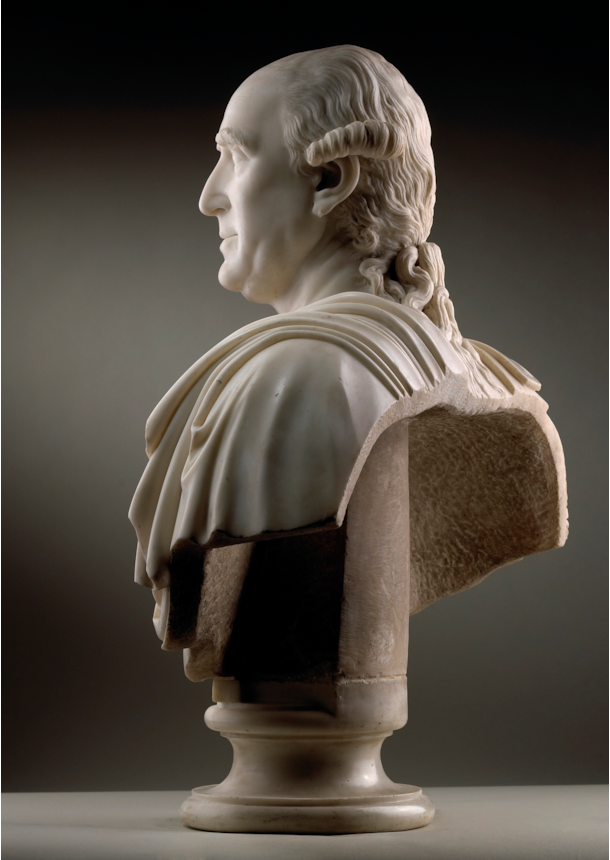
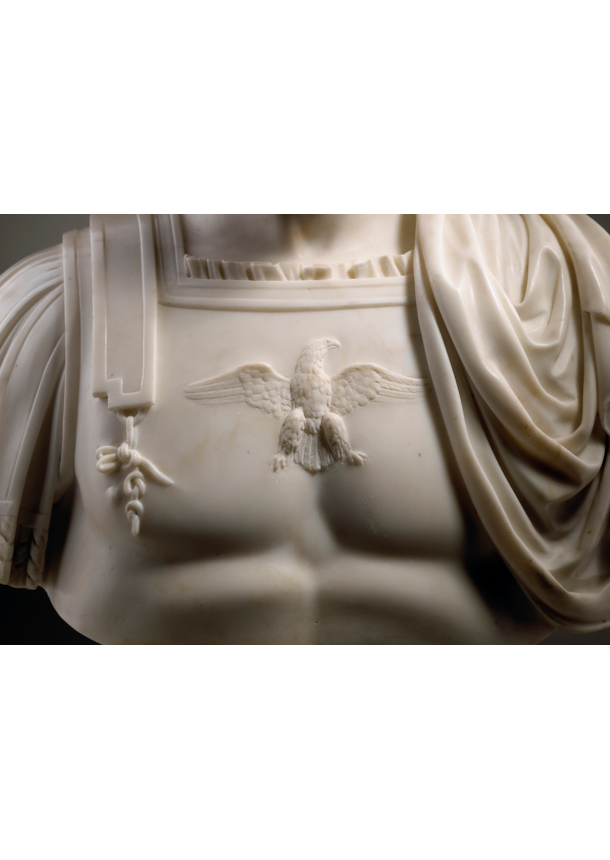
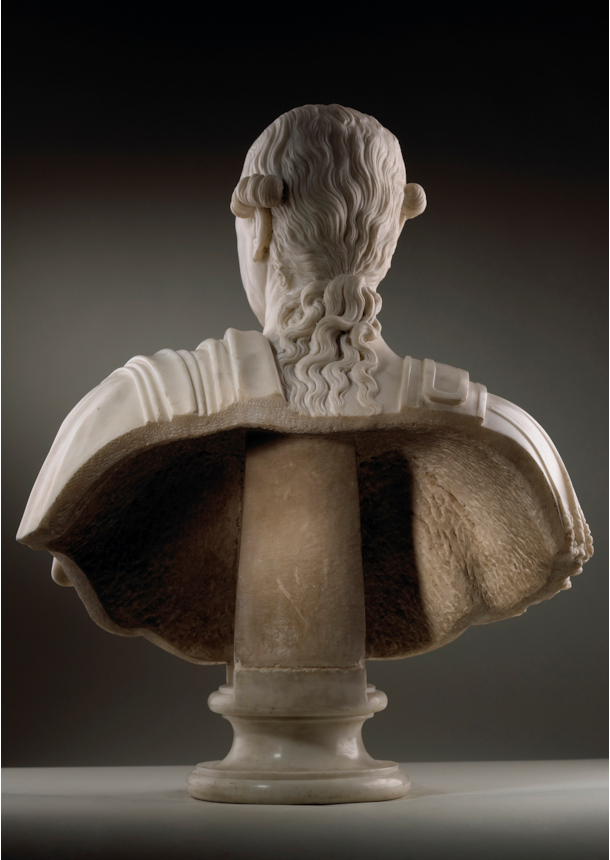
The composition perfectly represents the type of portrait that an aristocrat and statesman such as Francis Xavier would have appreciated, in the guise of a victorious Roman general yet with clearly recognizable facial features. There is no mistaking the sitter’s identity, given the aquiline nose, strong brow, and pursed lips, which appear prominently in the painted portrait of the Prince by Maurice Quentin de La Tour now in the Musée Antoine Lecuyer, St-Quentin. In terms of the attribution, Hewetson’s authorship is confirmed by the present bust’s parallels with the sculptor’s oeuvre. The shoulder-length bust format, with the head turning to one side, was a staple of Neoclassical portraiture and is often adopted by Hewetson. In addition, details such as the sitter’s eyebrows and hair – described through meticulous, fluent carving – and the manner in which the eyelids are outlined, are also typical of the Irish artist, as evidenced by comparison with his Pope Clement XIV now in the Victoria & Albert Museum, or his Anton Rafael Mengs in the Promoteca Capitolina. Similarly, the skin on Francis Xavier’s face, with its wrinkled forehead and lined cheeks, shows an attention to the material quality of flesh, even its weight, that are also visible in the Clement XIV and Mengs. As scholar Malcolm Baker has noted, Hewetston’s works betray a unique sensitivity in the depiction of facial phsyiognomy and, particularly, hair. A fascinating rediscovery, the present bust is therefore a major addition to the oeuvre of one of the foremost interpreters of Roman Neoclassicism, dating to the later part of his career. In the past, it was thought that in the last decade of his life Hewetson had been less active, to some extent overshadowed by the rising star of Antonio Canova. The publication of Hewetson’s will and of his studio’s posthumous inventory by Paolo Coen has revealed a very different picture. When he died in 1798, the sculptor was working on no less than fourteen portrait busts in marble, only three of which were described by his executors as finished, and a remarkable number of marble copies after famous antiquities (see Coen, pp. 96-98).
To conclude, one detail of interest in the present bust are the small earrings the Prince is wearing. A common accessory in male fashion since at least the late sixteenth century, earrings were also widely believed to be a remedy for sight problems. This theory is poignantly illustrated in a letter by Count Axel von Fersen (1755-1810, Marie Antoinette’s close confidant) dating to 1788, very close to the execution of our bust. Writing to his sister, the Count mentions how, for about eight days, he had been suffering from “a weariness in my eyes” and that “everybody has suggested I get my ears pierced. I shall do it. We will see whether it has any effect, but least even if it’s not beneficiary, it won’t hurt me either” (25 March 1788, in Swedish Regional Archives of Vadstena – Löfstad , SE/VALA/02249/BXXVa/8). Pierced ears appear in a number of male portraits from the same period, such as that of the architect Louis-François Petit Radel (1740-1818) by Joseph-Siffred Duplessis (1725-1802), sold at Christie’s New York (31st October 2017, lot 36); that of the Gilbert du Motier, Marquis de Lafayette (1757-1834) in the Harvard Art Museum, also attributed to Duplessis; that of Louis Philippe II Joseph d'Orleans, Duke of Chartres (1757-1793) by Michel Garnier (1753-1819), today in the Musée Condé; that of Jules-Hercule Mériadec de Rohan-Guéméné, Duke of Montbazon (1726-1788) by C J Borgnis (Artcurial, 15 February 2022, lot 34); and several others, predominantly of French origin, which suggests the Prince of Saxony picked up on the custom during the two decades he lived in France.
We are grateful to Stefano Grandesso for confirming the attribution to Christopher Hewetson.