



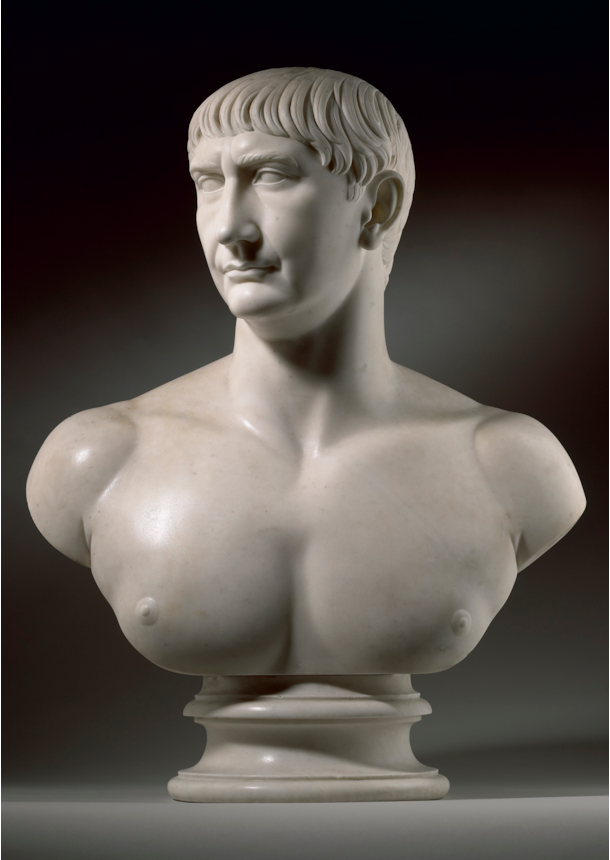
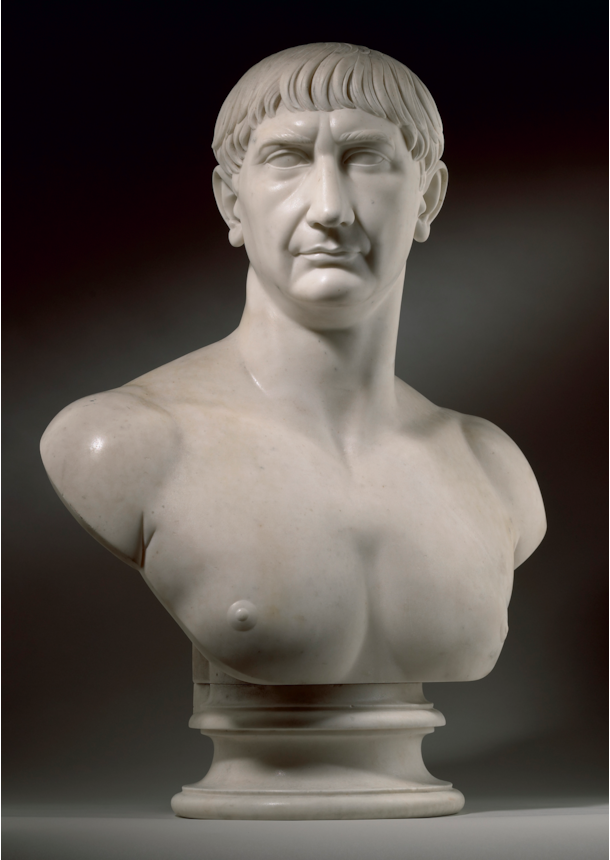
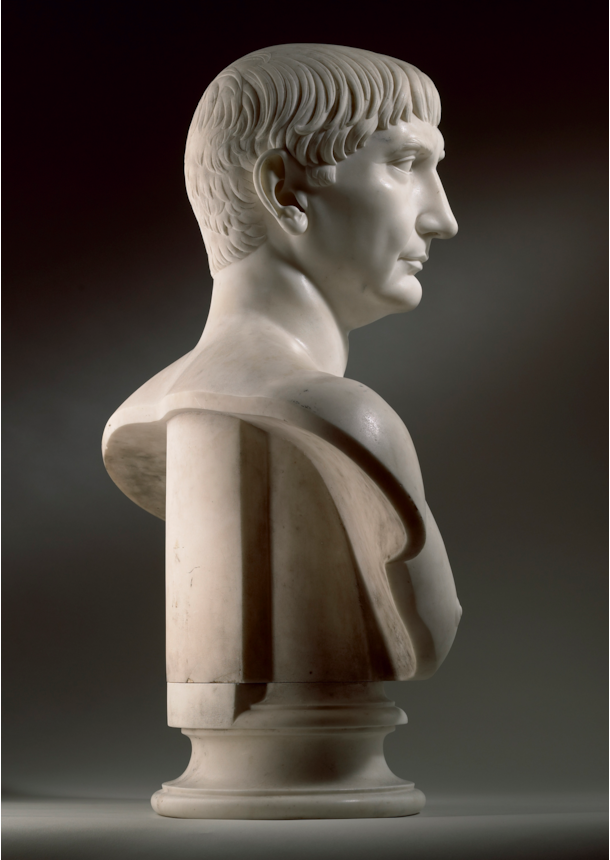
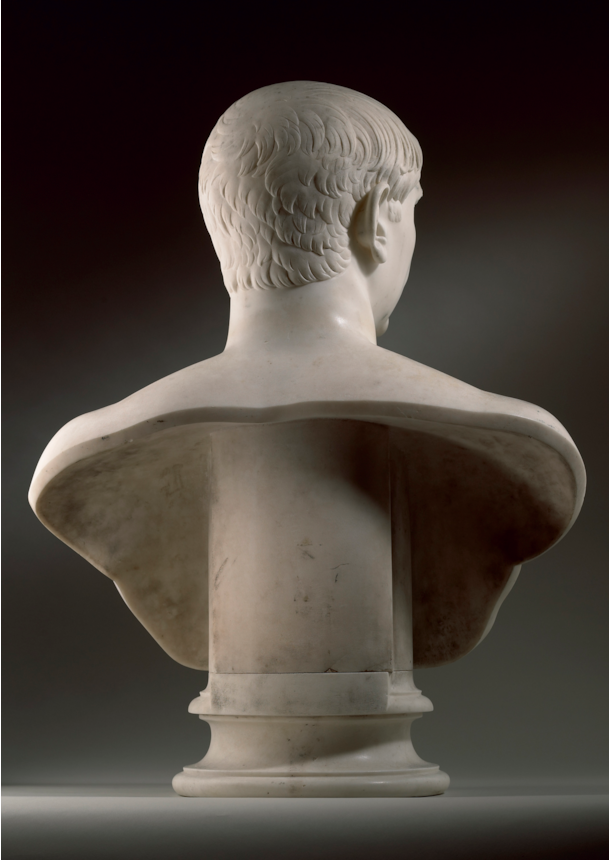


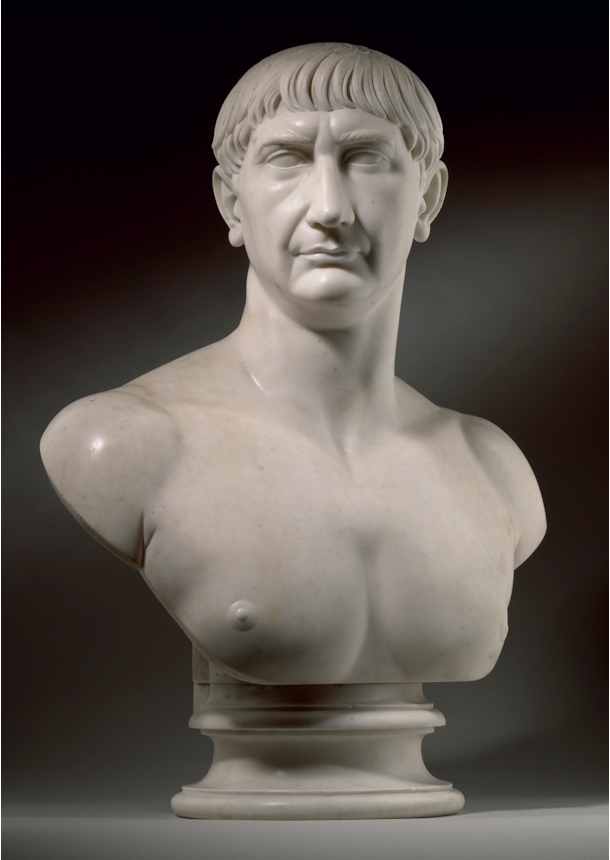
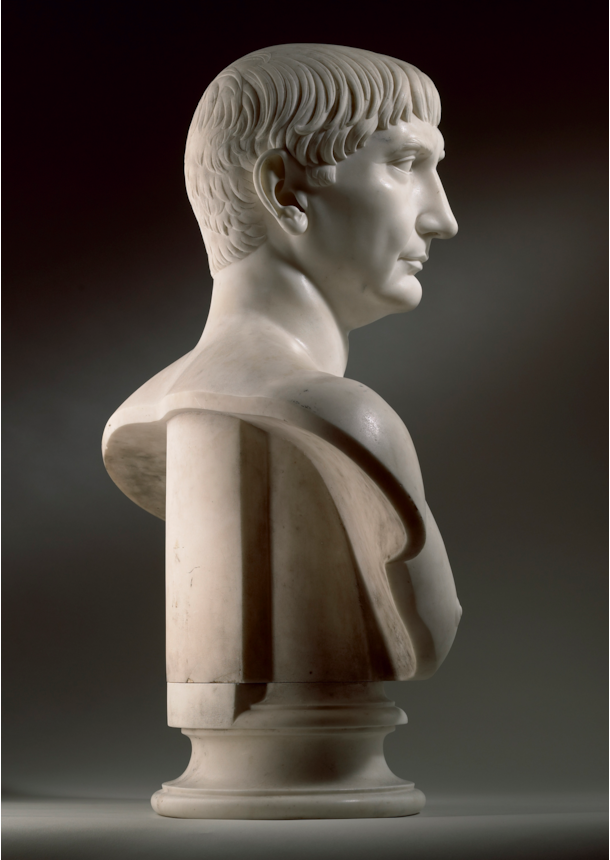
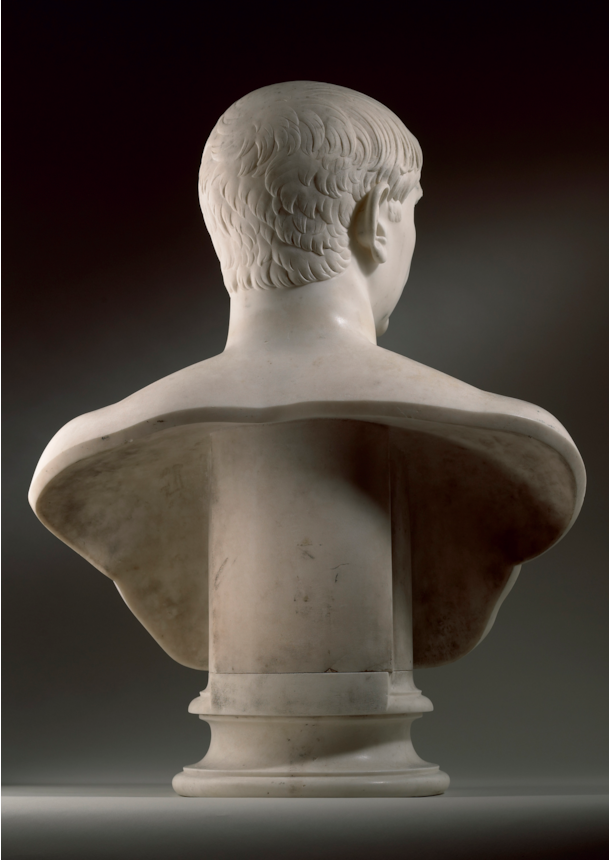


Roman, circa 1800
22. Bust of the Emperor Trajan (53 A.D. – 117 A.D.)
White marble
70 x 53 cm (27 ½ x 20 ⅞ in.)


Emperor Marcus Ulpius Traianus (53-117 A.D.), who reigned from 98 to 117 A.D., is widely regarded by historians as the second of the ‘Five Good Emperors’ of the Nerva-Antonine dynasty and as the ruler who brought Roman imperial governance to its peak. Born in the municipium of Italica in the province of Hispania Baetica (modern Andalusia, Spain), Trajan excelled as both a benevolent administrator and a formidable military strategist, leading the empire to its greatest territorial extent, from Britain in the west to Mesopotamia in the east. His contemporaries recognised his exceptional leadership, and the Senate honoured him with the title Optimus (‘the best’). Trajan’s rule combined military success with civic responsibility; he introduced the alimenta welfare system to support the poor, undertook ambitious building projects within the forum, and invested heavily in infrastructure across various Roman provinces. His reign embodied the ideal of the optimus princeps, balancing conquest with prosperity and social welfare at home. Following his death, the Senate and his successor Hadrian deified him, confirming his lasting place in Roman political and religious life. Modern historians continue to view his reign as a model of effective imperial administration, in which military achievement was matched by a commitment to the welfare of Roman society.
In artistic terms, Trajan is perhaps best remembered for his monumental column in Rome. Erected between 106 and 113 A.D., Trajan’s Column stands as a groundbreaking achievement in ancient art, an unprecedented fusion of artistic innovation and historical commemoration. Its spiral relief, a completely novel format, embodies the Roman impulse to preserve military triumphs in permanent, monumental form, transforming victory into an enduring legacy. The column’s artistic significance lies not only in its technical brilliance, with over 2,600 figures carved in low relief, employing shifting scales and perspectives, but also in its pioneering narrative structure. The continuous frieze winds chronologically around the shaft, creating the most sophisticated example of sustained historical storytelling in stone from the ancient world. As one of the most distinctive monuments to survive the fall of Rome, the column also set new standards for imperial commemoration, influencing Roman architecture through its helical stairway design, which introduced an ingenious, space-saving form later adopted across the empire.
The present bust is a neoclassical version of an ancient bust of the emperor now in the Capitoline Museum, Rome. It was sculpted at a time when demand for finely crafted reproductions of celebrated classical statues was at its peak in Europe. This surge of interest in antiquity followed the dramatic discoveries at sites such as Pompeii and Herculaneum in the eighteenth century, which inspired a new wave of enthusiasm for classical art. Wealthy European aristocrats on the Grand Tour were eager to acquire such works, and Italian sculptors, renowned for their skill and long tradition of carving marble after ancient models, produced these commissions to meet the growing demand.
Our bust was previously housed at Brocklesby Park, Lincolnshire. The estate, home to the Pelham (later Earls of Yarborough) since the sixteenth century, and has been noteworthy not only for its landscape and house but for a rich collection of sculptures and ancient inscriptions assembled from the late 18th century onward. Charles Anderson-Pelham (the first Lord Yarborough) and later family members formed a collection of antiquities that includes classical marbles and carved inscriptions. The most conspicuous sculptural monument in the park is the classical-style mausoleum designed by James Wyatt, explicitly modelled on the Temple of Vesta at Tivoli, with an interior and statuary that attracted artists such as J. M. W. Turner. In addition, several 18th– and 19th-century memorials and classical garden sculptures helped shape Brocklesby’s reputation as a country-house display of antiquities integrated into a designed landscape now recorded on the National Heritage List.