



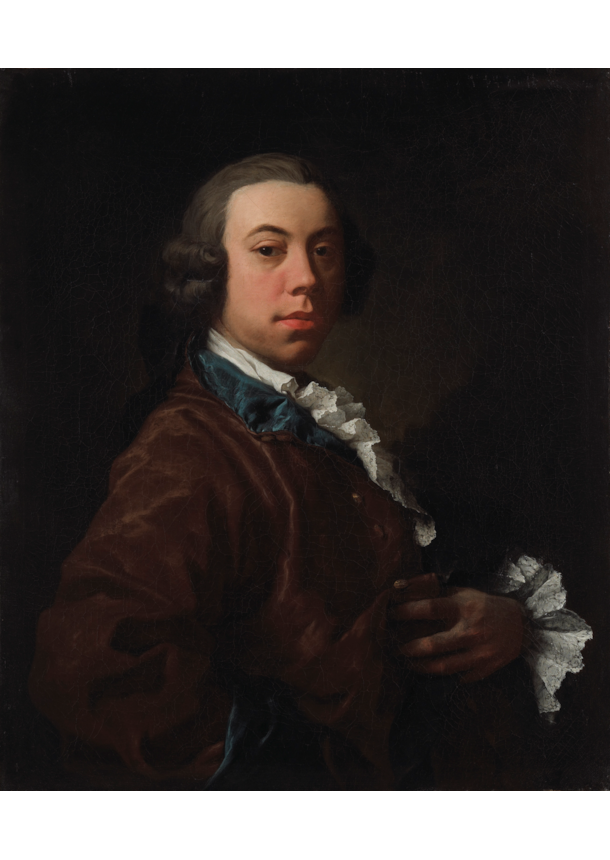


Gaspare Traversi (1722-1770)
Portrait of Sir Thomas Saunders Sebright, 5th Bart., of Beechwood and Besford
Oil on canvas, in an 18th century carved giltwood frame
Inscribed in an early hand on the reverse with the identity of the sitter
76 x 63.5 cm (30 x 25 in.), unframed


The attribution was confirmed with Nicola Spinosa (verbal communication, 2018).
Sir Thomas Sebright (11th May 1723 – 30th October 1761) was the son of the likenamed Sir Thomas Saunders Sebright, 4th Bart, and his wife Henrietta, daughter of Sir Samuel Dashwood, Lord Mayor of London. The family had been elevated to the baronetcy for their loyalty to the Crown by King Charles I in 1626 and had been heavily fined for their Royalist views in the Civil War.
The sitter was a “man of parts” who enjoyed an extensive Grand Tour of Italy after an education at Westminster School and Christ Church Oxford, where he was a not inconsiderable scholar much taken up with study of the Classics.
Sebright left for Italy in 1745, probably in June. He seems to have been travelling with John, Lord Hobart (1723-1793), an exact contemporary from Christchurch College, who arrived at Florence in May 1746 with letters of introduction from Horace Walpole, and who stayed at Lady Orford’s empty house there. He was in Venice before November 1746 where he met Sir James Gray, first secretary to the Embassy and British Resident at Venice (who promptly proposed him for membership of the Society of Dilettanti). In that month he was introduced by Horace Mann in Florence to Cardinal Albani in Rome. He travelled through more southerly parts of Italy, having joined up with William Douglas, 3rd Earl of March (1725-1810: perhaps best remembered as the lecherous “Old Q”), George Treby and Mr. Fane, visiting Naples. Here he was introduced to the Princess de Palma Reggio. The group seems to have stayed a considerable time, examining the ruins and pursuing amours: Hobart, for instance did not leave until after July 1747, “though he ought long since to have obeyed his father’s summons to return home” (Mann).