





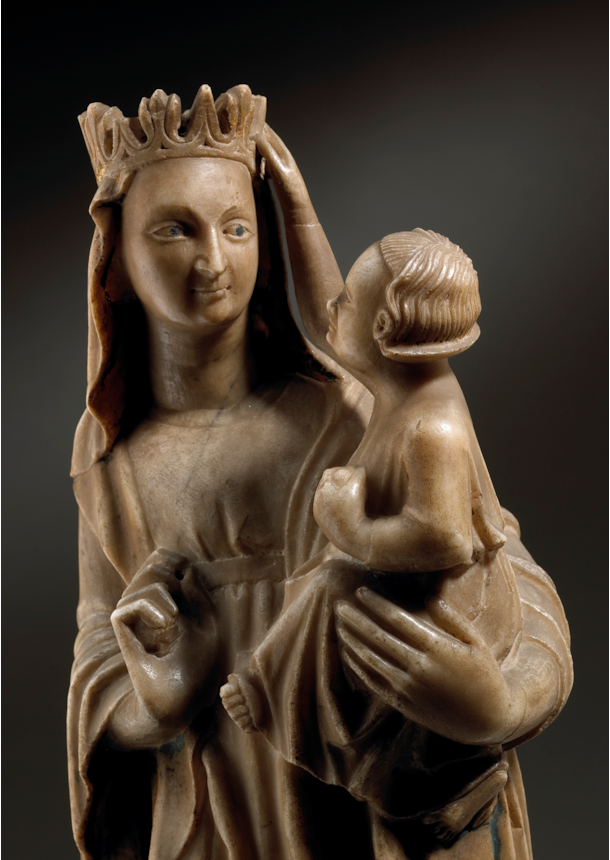


Giovanni di Balduccio (c.1290 – c.1339) (Circle of)
5. Madonna and Child
Marble, with lead inlay, and remnants of gilding and polychromy
57.5 cm (22 ½ in.) high
By descent to Mr Robert Ian MacDonald
Christie’s London Important Sculpture, Works of Art & Medieval Metalwork , 15th December 1982, lot 89
Private collection, Belgium


A. Fiderer Moskowitz, Nicola Pisano's Arca Di San Domenico and its legacy, Philadelphia, 1994, p.32
A. Fiderer Moskowitz, Italian Gothic sculpture c. 1250-c.1400 , Cambridge, 2001, pp. 203-210
J. Pope-Hennessy, Italian Gothic Sculpture , London, 1955
Exhibited: On loan to Brooklyn Museum 1934 – 1980, inv. no. 34.97L
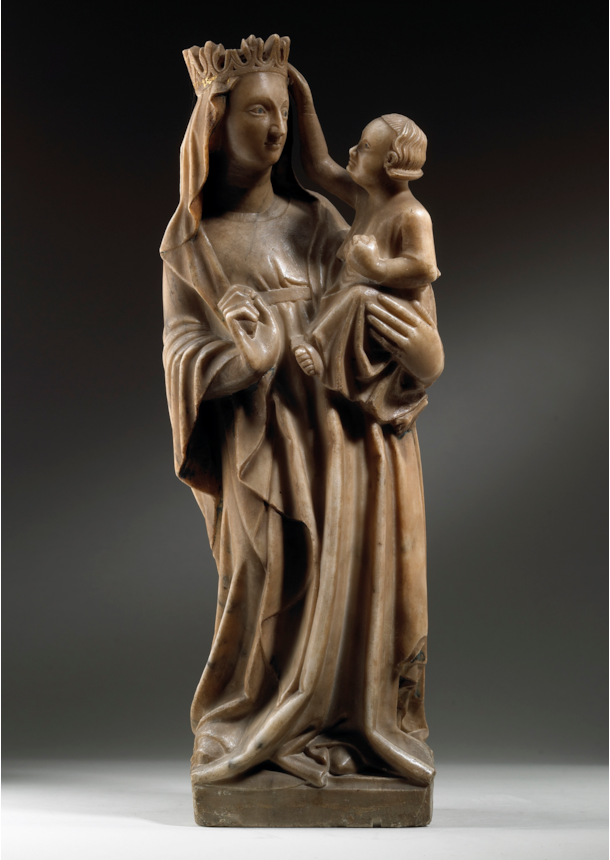
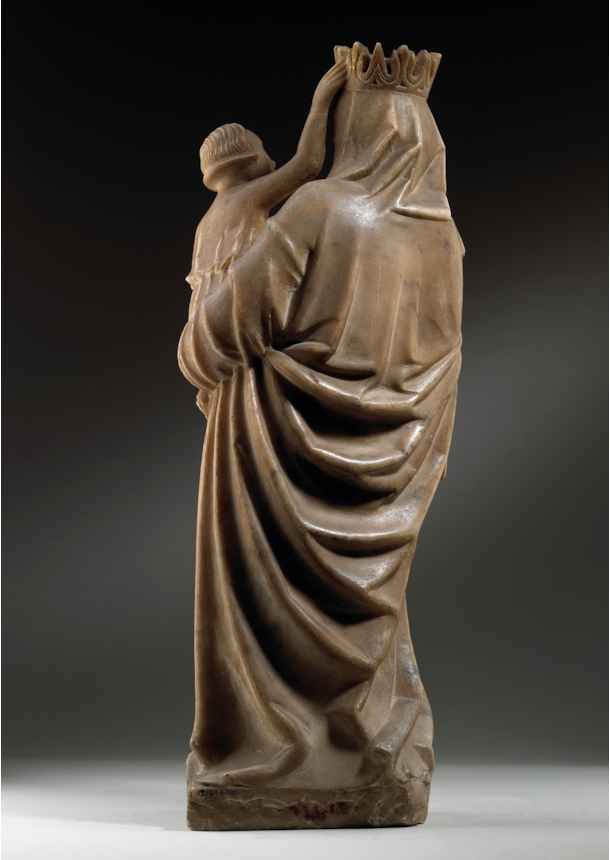
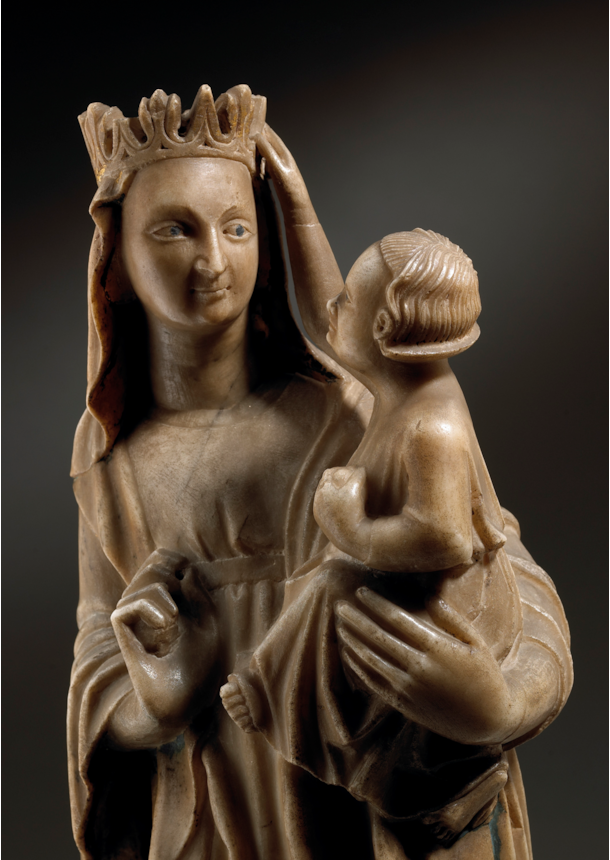
The present work is a finely crafted marble statuette of the Madonna and Child, attributed to an artist within the circle of Giovanni di Balduccio (c. 1290 – c. 1339). Although unpublished, this sculpture exhibits notable similarities to Balduccio’s documented works, particularly the figures found on the shrines of St. Peter Martyr in Sant’Eustorgio, Milan, and of St. Augustine in San Pietro in Ciel d’Oro, Pavia. The technique of filling the eyes with mastic, a characteristic feature of Balduccio’s artistic practice.
A particularly compelling aspect of this sculptural group is its nuanced portrayal of the relationship between the Virgin and Child. The Christ Child is depicted reaching toward the Queen of Heaven’s crown while holding a fruit in his left hand. This iconography aligns with a broader transformation in Tuscan sculpture, wherein representations of the Madonna and Child transitioned from austere, static imagery to compositions imbued with humanism and emotional depth. In this particular work, the reciprocal gazes between mother and child, as well as their delicate physical interaction, exemplify this evolution, reflecting a growing preference for intimate and expressive depictions within the Italian Gothic sculptural tradition.
Giovanni di Balduccio, trained in Pisa, played a pivotal role in disseminating Tuscan sculptural innovations throughout northern Italy. As a follower of Giovanni Pisano, Balduccio inherited a sculptural vocabulary characterized by dynamic expressiveness; however, under the influence of Sienese painting and the sculptural idiom of Tino di Camaino, he refined his approach into a more calligraphic and harmonious style. Whist Balduccio is best known for monumental tomb ensembles, such as the Arca di San Pietro Martire , he also executed individual sculptural compositions, including numerous depictions of the Madonna and Child.
Documented as early as 1317 or 1318 within the Pisa Cathedral workshop, Balduccio later relocated to Milan, where he received significant commissions. Around 1334, he was likely summoned to Milan by Azzone Visconti, a patron who had previously commissioned works from prominent contemporary artists such as Giotto. During his tenure in Milan, Balduccio designed a series of tabernacles featuring statues of the Madonna and various saints, intended to serve as protective guardians over the city’s gates. His distinctive sculptural idiom, which synthesized the volumetric solidity of Tuscan Gothic with the ornamental and linear qualities of Lombard traditions, profoundly influenced regional artistic developments.
The Madonna and Child group under discussion exemplifies the stylistic tendencies of Balduccio’s Lombard period. The statuette’s sharp facial features, inlaid eyes, and softened drapery closely recall the female figures adorning the roofline of the Arca di San Pietro Martire (1339) in Sant’Eustorgio, Milan. These figures are characterized by their slanted, inlaid eyes, sharply defined noses, and enlarged hands, distinctive traits that also appear in Balduccio’s attributed works, including the Tomb of Azzone Visconti in San Gottardo.