







Girolamo Da Carpi (1501-1556)
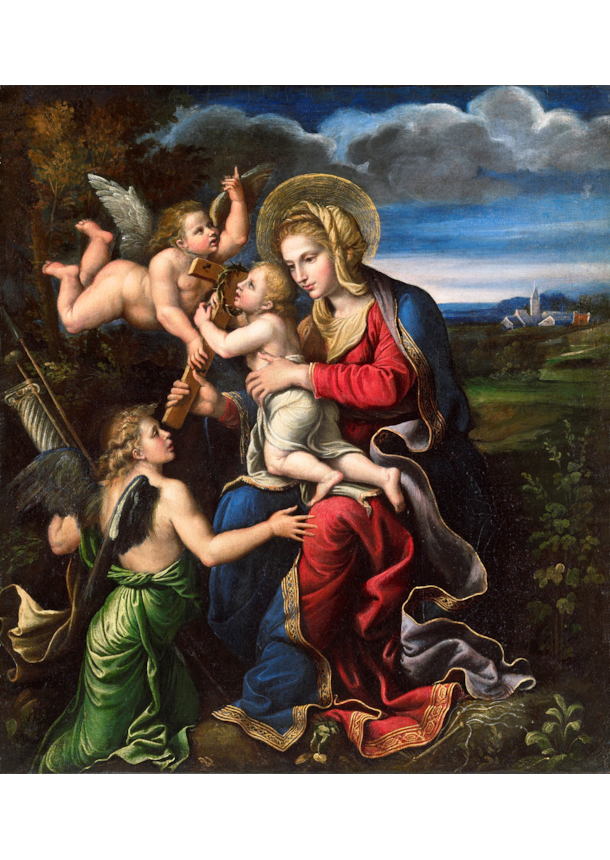
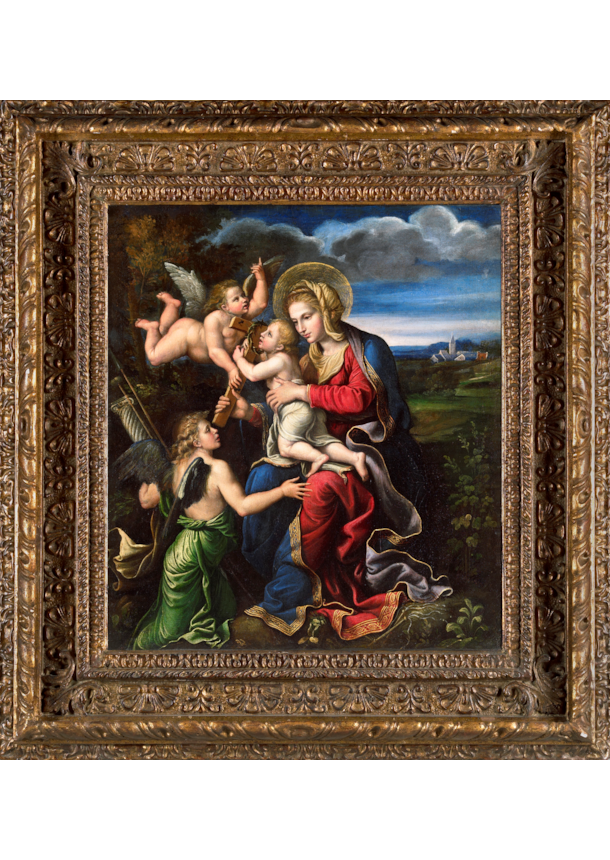
6. Madonna and Child with Angels Carrying the Instruments of the Passion
Oil on canvas
49.5 cm (19 ½ in.) high x 43.2 cm (17 in.) wide
Christie’s, London, 26th October 1956, lot 130, catalogued as Dossi.


While the painting was attributed to Dosso Dossi at the time of its sale in 1956, Philip Pouncey has reidentified the painting as a work by Girolamo da Carpi, echoing the manner of his Dresden cycle, and, at the same time, foretelling works like the Giacomelli Calvary in Florence, which allows the dating of the present painting to about the middle of the fifth decade.
Girolamo da Carpi, a court artist from Ferrara, was the son of a painter and decorator at the House of Este court. He began painting in Ferrara, by report, apprenticing to Benvenuto Tisi (il Garofalo), whose Ferrarese classicism was influenced by both Lorenzo Costa of Bologna and Raphael in Rome. Da Carpi was attracted to the grace and intellectual artificiality found in Italian Mannerist art, seen in the flowing Scurve of his subjects clothing and details like their delicate and attenuated fingers. By the age of twenty he had moved to Bologna and is considered to be a major figure of early Renaissance painting of the Bolognese School.
Carpi visited Rome in the early 1520s but was back in Bologna in 1525. There he developed a smooth, classical yet energetic and colorful style. He employed a more elegant, cooler Mannerist style for his portraits. By 1530 he was working in Ferrara while maintaining ties with patrons in Bologna. In Ferrara, Carpi regularly collaborated with Dosso Dossi and others on decorations for the d'Este family and their court, including frescoes, stage sets, and easel paintings. When a d'Este Cardinal called him to Rome in 1549 to excavate Hadrian's Villa at Tivoli, Carpi explored his interests in antiquity and architecture and designed some palace gardens. In 1550 he became architect to Pope Julius III, supervising modifications to the Vatican's Villa Belvedere. He returned to Ferrara in 1553.
In the present moving work, the Madonna is holding the child tightly as she gazes upon the instruments of the passion, seemingly focused on the terrifying events of the Crucifixion to come, from which there will be no escape.