







Giovanni Francesco Susini (1585 - c.1653)
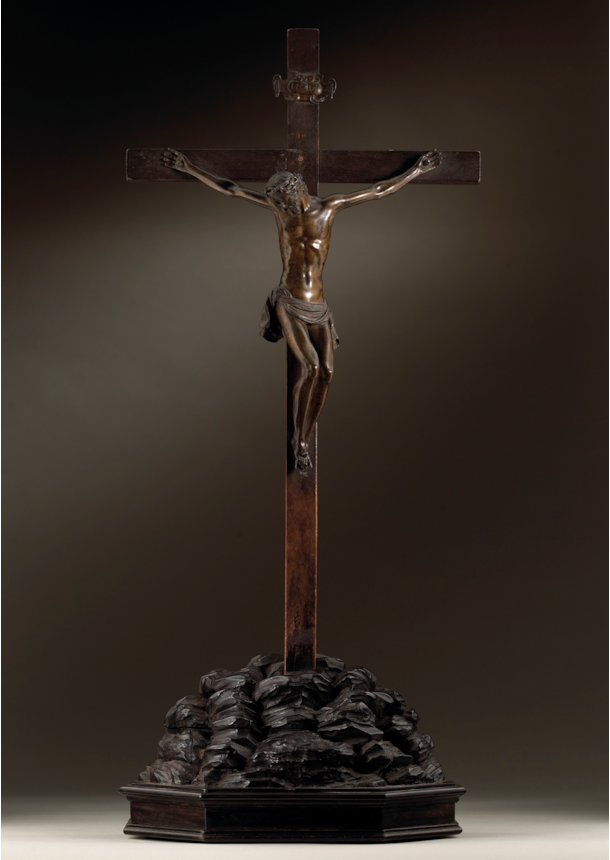
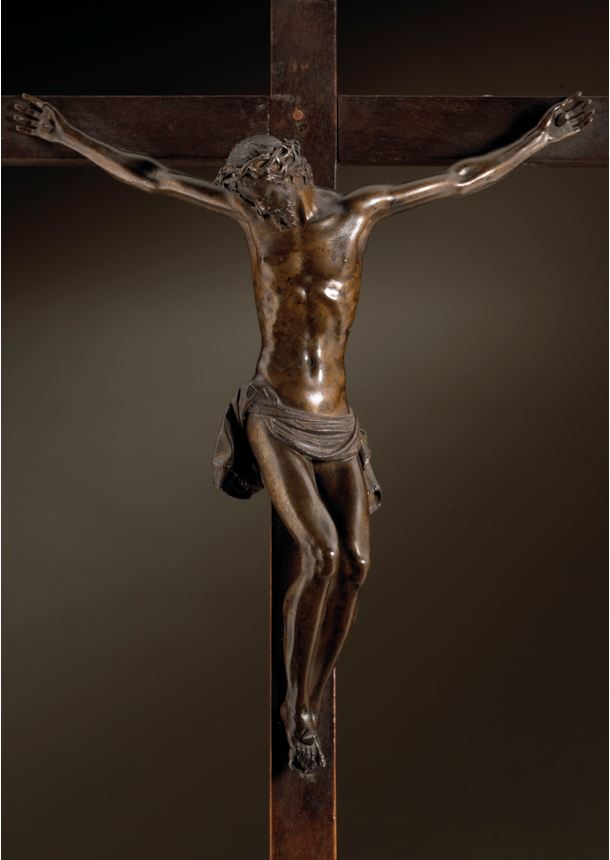
4. Cristo Morto, on original Golgotha base
Bronze and wood
21.5 cm (8 ½ in.) high, the Cristo Morto / 58.5 cm (23 in.) high, overall / 26 cm (10 ¼ in.) wide


This finely cast and chased bronze corpus belongs to the celebrated Cristo Morto type invented by Giambologna in Florence in the late 1580s and perpetuated over more than half a century by the master’s own workshop and, above all, by the two generations of the Susini family who ran it. Firstly, Antonio Susini, and, after his death in 1624, his nephew Giovanni Francesco (Gianfrancesco) Susini (c.1585-1653), who inherited his uncle’s moulds, models, and clientele and continued to produce variants of the same beloved compositions well into the 1640s.
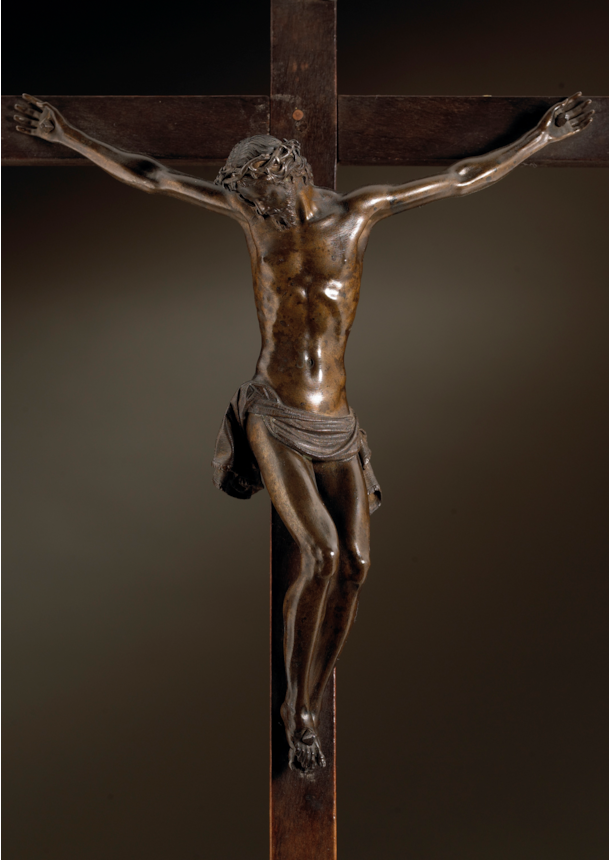
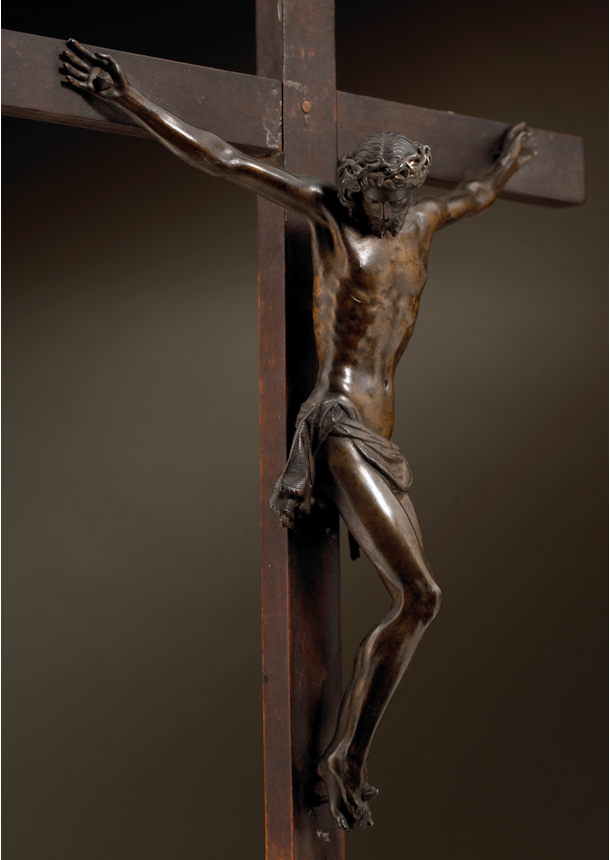
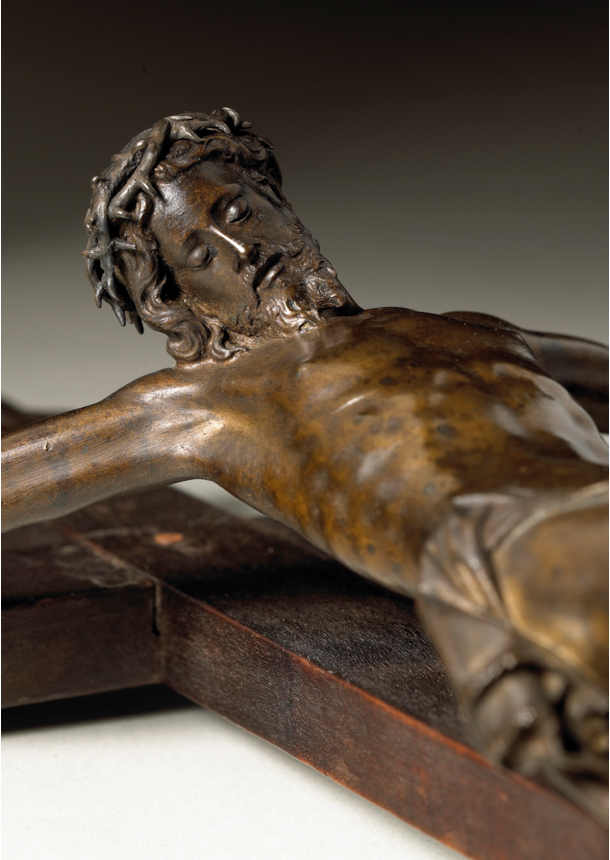
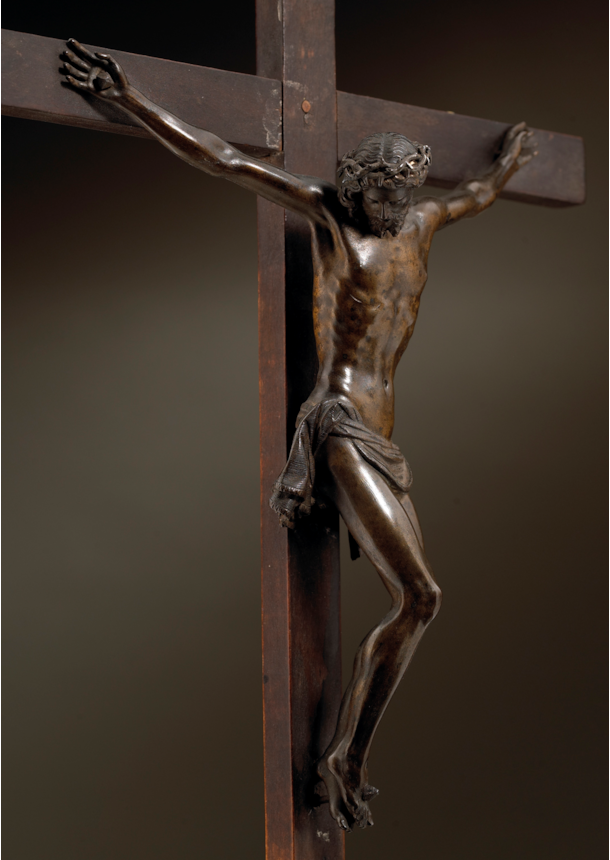
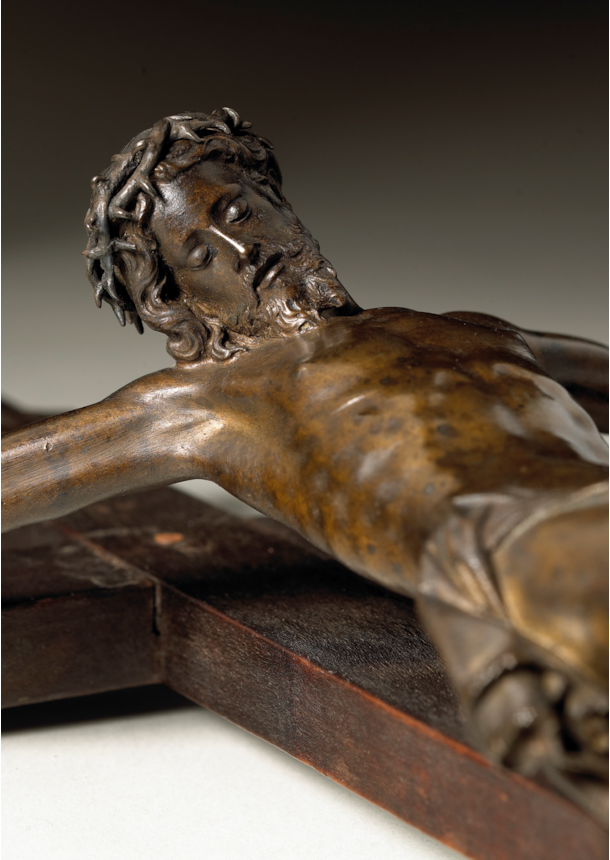
The figure conforms closely to the type as it was fixed by Giambologna and refined in the Susini workshop; in our model of Cristo Morto, the head falls forward and inclines towards Christ’s right shoulder, the crown of thorns rendered as a naturalistically twisted, briary wreath, rather than a schematic torus, the beard and hair worked in fine, separately articulated locks that catch the light across the drooping brow. The torso is elongated and softly modelled, the ribcage and sternum only gently indicated beneath skin that seems, in the manner of Susini, almost to yield under its own weight, whilst the arms, cast integrally, in one piece with the shoulders in the best examples of the workshop’s production, stretch taut along the cross-beam, the hands unclenched, the fingers loosely curled in the relaxation of His final moments. The perizonium is knotted high at the right hip, its deeply undercut, triangular fold falling free against the thigh in the distinctive striated drapery pattern that recurs, with only minor variation, across the whole family of Giambologna-Susini crucifixes; the legs bend and turn in toward one another at the shin in the manner particular to the Cristo Morto model, drawing the eye down to the crossed feet at the foot of the cross.
The bronze retains a rich, warm brown patina, deepening in the recesses of the drapery and hair and rubbed to a bright, golden-brown sheen across the projecting planes of the chest, knees, and shins, precisely where a devotional object of this kind would have been touched and venerated over generations of private use.
The model of the present corpus is a descendant from Giambologna’s original invention of the late 1580s, of which the two most celebrated examples are the gilt bronze corpus placed on the high altar of the convent church of San Marco, Florence, cast in 1589, and the related silver corpus made for the House of Savoy in Turin in 1592, both traditionally regarded as autograph works by the master himself. It was Antonio Susini, however, trained originally as a goldsmith, and together with Pietro Tacca, Giambologna’s principal assistant in the production of small bronzes, who translated the model into the succession of superbly finished statuette sized casts that made the Cristo Morto one of the most sought after devotional bronzes of the age. Susini is recorded in 1622, only two years before his death, presenting no fewer than ten such figures, five Cristo Morto and five Cristo Vivo, as a single gift to Duke Ferdinando Gonzaga of Mantua, a measure of the extraordinary demand these images commanded amongst princely and private patrons alike.
Following Antonio’s death, his nephew Gianfrancesco Susini took over the workshop, its foundry equipment, and, crucially, its stock of moulds and master models, continuing to cast the Cristo Morto and Cristo Vivo types for a clientele that spanned the length of the seventeenth century. Where Gianfrancesco’s own casts can be distinguished from his uncle’s, scholars have pointed to a slighyly softer, more pictorial handling of the flesh and a comparably refined by marginally less severe chasing of the hair and drapery than is found in Antonio’s most virtuoso autograph work, qualities entirely consistent with the treatment of the flesh and drapery seen in the present bronze, and with the continued high quality that kept the Susini workshop’s crucifixes in demand amongst collectors long after Giambologna’s own death in 1608.
Gianfrancesco Susini was born in Florence around 1585 and trained from an early age in the workshop of Giambologna, where his uncle Antonio Susini, himself a former goldsmith and Giambologna’s principal assistant, was already established as the master’s chief executant of small-scale bronzes. On Antonio’s death in 1624, Gianfrancesco inherited the workshop together with its moulds and models and continued to supply Florentine and international patrons with bronzes in the Giambolognesque tradition for the following three decades. So closely did his work follow his master’s manner that, as early as the seventeenth century, his sculptures were already being mistaken for Giambologna’s own. Amongst his documented independent works are the two bronze holy water stoups at the entrance to the Santissima Annunziata, Florence (1615), and a series of signed statuettes, including a Bacchus, now in the Louvre and an Abduction of Helen (1627) in the J. Paul Getty Museum, that attest to his continued activity as one of the leading Florentine bronze founders of the seventeenth century.