



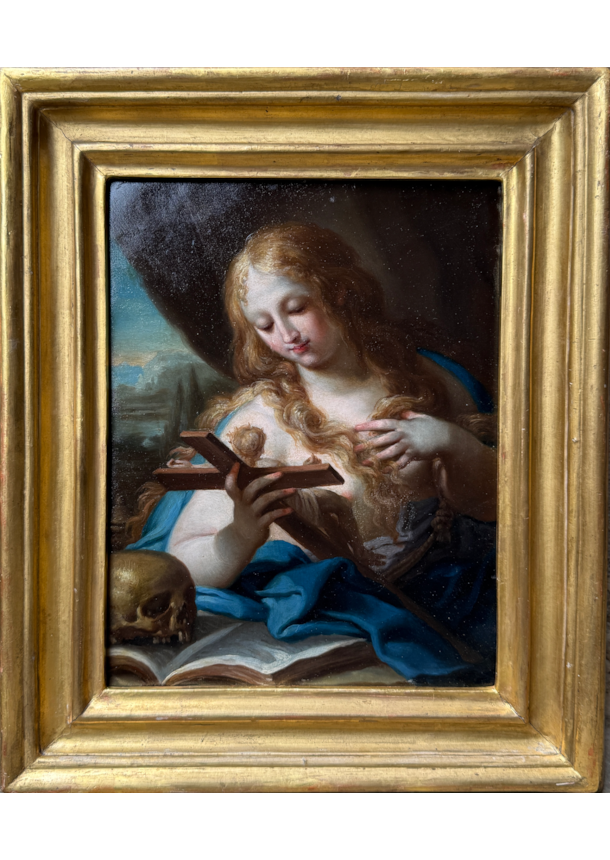


Sebastiano Conca (1680-1764)
9. The Penitent Magdalene
Oil on copper
41 cm (16 ⅛ in. high) x 34 cm (13 ⅜) wide


The present work is an intimately scaled, devotional painting of the Penitent Magdalene by Sebastiano Conca (1680-1764). A larger version, signed and dated 1732, can be found today in the Doria Pamphilj in Rome. In both versions, the saint is shown three-quarter length, her unbound auburn hair falling heavily in curls across her bared shoulders, as she gazes down in contemplation at a wooden crucifix held in her clasped hands. A skull rests beside an open book at the lower left, and drapery of deep cerulean blue is gathered across her lap, the traditional attributes of the Vanitas and of Magdalene’s penitence in the wilderness. The reduced format and the choice of a copper support, prized in this period for its jewel like finish and durability it lent to small devotional pictures, indicate that the present work was conceived not for public display in a chapel or gallery, but for private prayer, likely commissioned as a personal devotional object for a domestic oratory or study.
Alessandro Agresti has proposed a date for the related Doria Pamphilj composition, and by extension for reductions such as the present work, in the years around 1732, situating it between two of Conca’s most celebrated single figure female subjects: the Sybil in the Museum of Fine Arts, Boston dateable to the later 1720s, and the Allegory of Fame in the Accademia Nazionale di San Luca, Rome, from the later 1730s. The Magdalene thus belongs to a brief but significant phase in Conca’s career in which he turned his attention to intimate half-length devotional and allegorical female figures – a genre distinct from the large-scale narrative and ceiling decorations for which he was principally sought after by Roman and Piedmontese patrons of the period.
It is worth noting that the theme of the penitent Magdalene, though extraordinarily popular with Roman patrons and collectors in the early eighteenth century, and treated repeatedly by contemporaries such as Francesco Trevisani, whose numerous variants of the subject were widely disseminated and copied, was in fact only rarely tackled by Conca himself. The present picture and its Doria Pamphilj counterpart therefore represent something of an exception within his oeuvre and can be counted among his rare works of devotional easel painting on this theme.
Stylistically, the present work sits at an interesting crossroads. On one hand, the softly modelled flesh tones, the elegant, slightly elongated proportions of the figure, and the overall grace and lightness of touch, recall the refined classicism Conca inherited from his Emilian and Bolognese antecedents, filtered through his own more measured and lyrical sensibilities, qualities that would help open a new, less overtly triumphalist current within Roman painting of the 1720s and 1730s, in gently departure from the High Baroque idiom still dominant in the city. The composition itself, with its close-up, half-length format and devotional intimacy, also strongly recalls the innumerable variants of the same subject produced by Trevisani, of which the present picture might be considered an amplified or more monumental reworking.
On the other hand, the notably dark tonality of the picture, dominated by warm red-brown umbers and deep shadow, sits somewhat apart from the cooler, more silvery palette generally associated with Conca, and instead invites comparison with the work of Giacinto Brandi, a painter who, like Conca, may have hailed originally from Gaeta, and whose pictures have on occasion been confused with Conca’s own works. This tonal affinity, whether the result of a conscious archaism, workshop practice, or simply the particular demands of the copper support and its darker priming, adds a further layer of interest to the present picture’s place within the broader currents of early eighteenth-century Roman painting.
Sebastiano Conca (1680-1764) was born in Gaeta, then part of the Kingdom of Naples, and trained under Francesco Solimena. In 1706 he settled in Rome together with his brother and assistant, Giovanni. He initially devoted himself for several years exclusively to drawing in chalk in order to refine his technique. He came to the attention of Cardinal Ottoboni, who introduced him to Pope Clement XI; the pontiff’s commission of a Jeremiah for St John Lateran established Conca’s reputation in the city. He went on to paint an Assunta for the church of Santi Luca e Martina and collaborated with Carlo Maratta on the Coronation of Santa Cecilia (1721-1724) in Santa Cecilia in Trastevere.
Conca was elected to the Accademia di San Luca in 1718 and served as its Principe in 1729-1731 and again in 1739-1741 and was knighted by the pope. His style, shaped above all by the example of Luca Giordano, evolved into a distinctive, lightened form of late Baroque classicism that proved highly influential: his pupils included Pompeo Batoni, Corrado Giaquinto, Agostino Masucci, and Gaetano Lapis, amongst many others. He undertook major decorative campaigns for the House of Savoy in Turin, including work at the Venaria Reale and the Basilica di Superga, as well as frescoes for the Ospedale di Santa Maria della Scala in Siena and allegorical canvases for the Palazzo Lomellini-Doria in Genoa. In 1739 he published his treatise Ammonimenti , combining technical and moralistic counsel for young painters. Conca returned to Naples in 1752 under the patronage of Charles III, where he continued to work prolifically on fresco and altarpiece commissions until his death in 1764.