



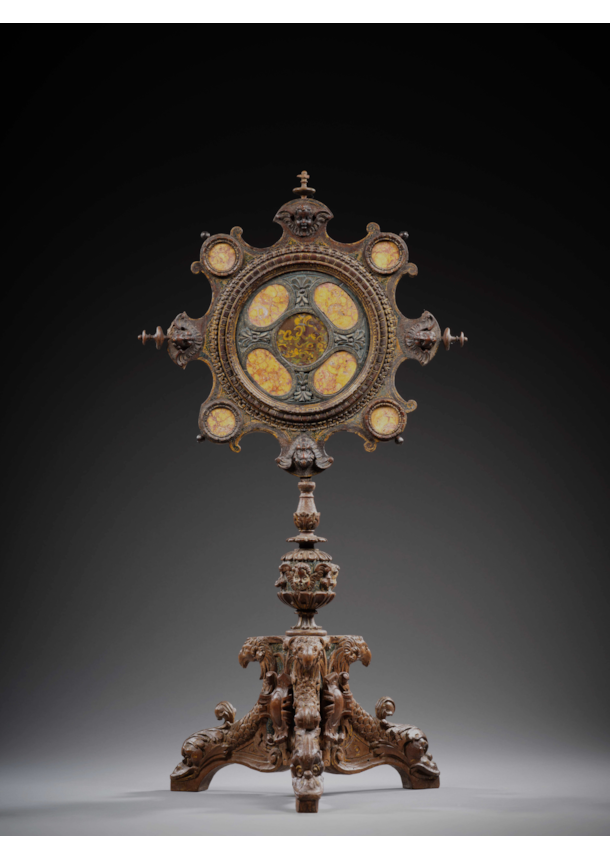


Italian, 16th century
11. Inlaid Table Mirror
Carved walnut, with gilt decoration, inlaid with Spanish Brocatelle marble
57 cm (22 ½ in.) high x 30 cm (11 ¾ in.) wide
This richly carved table mirror is a superb survival of a distinctively Italian Renaissance furnishing type: the specchio da tavolo , a free-standing table mirror designed to be set upon a table or credenza rather than hung upon a wall and closely associated with the ritual of toilette in a grand sixteenth century household.
The mirror frame itself takes the form of an eight lobed, star-like surround, its scrolling volutes terminating alternately in carved lion masks and turned finial drops. At the summit, a winged cherub mask presides over the whole composition beneath a further, now detached cresting element. The vestige of a carrying handle or decorative pediment typical of mirrors intended to be lifted and angled by hand. Set within the deeply moulded and beaded inner border are six overall cartouches and a central roundel, each inlaid with vividly veined Spanish Brocatelle marble, its warm ochre and rose toned matrix prized since the sixteenth century as one of the most sought after imported hardstones in Italian luxury cabinetmaking, quarried near Tortosa in Catalonia and shipped through Genoa to the workshops of Lombards and the Veneto. Traces of gilding survive within the carved crevices of the frame, indicating that the walnut ground was originally further enriched with parcel gilding, heightening the play of light across the carved scrollwork and marble insets alike, a combination of materials calculated to catch and multiply candlelight around the mirror place itself.
The two projecting lion mask terminals at the sides of the frame are pierced and mounted on turned pivot pins, allowing the mirrored roundel to gyrate within its socle, a refinement found on the finest Italian toilette mirrors of the period, enabling the sitter to adjust the angle of reflection at will. Below, a grotesque mask forms a bracket linking the mirror head to a finely turned baluster stem, itself interrupted by a small vase shaped node carved in low relief with confronted lion masks within a beaded cartouche, a passage of ornament that again recalls the vocabulary of North Italian, and in particular, Lombard and Genoese, decorative carving of the mid to late Cinquecento. The whole is raised on a robust tripod base, its three scrolling, acanthus clad legs each headed by a boldly carved ram’s mask and flanked by dolphins, terminating in scrolled feet, a combination of apotropaic and marine imagery (the ram for strength and fertility, the dolphin for good fortune and safe passage) entirely characteristic of the all‘antica repertoire favoured by North Italian carvers working in the wake of Sansovino and the sculptors of the Veneto.
Mirrors of this type were prestigious objects, produced not for utilitarian use but as luxury furnishings for the private apartments of the Italian nobility, typically forming part of a lady’s toilette service alongside carved caskets, combs, and jewellery boxes, or presented as part of a bride’s donora, the trousseau of fine furnishings assembled on the occasion of a patrician marriage. The scale and weight of the present mirror indicates that it would have stood upon a dressing table or credenza within a bedchamber, its turning plate allowing its owner, very probably a lady of rank within a Lombard, Genoese, or Venetian household, to arrange her hair, jewels, and dress, quite literally within a frame of allegorical and courtly ornament: the guardian lion masks, the fertile rams, the auspicious dolphins together forming a protective and celebratory setting for the most intimate moments of aristocratic self-preservation. The use of imported Spanish Brocatelle marble, at a period when such stones were still a costly rarity in Italy, further signals that this mirror was made for a patron of considerable means, for whom the object served as much as a declaration of status and taste as a practical instrument of the toilette.