







Massimiliano Soldani - Benzi (1656 - 1740)
12. Dancing Faun
Bronze
Florence, c.1695
30.5 cm (12 in.) high


C. Avery, Baroque Sculpture and Medals in the Art Gallery of Ontario , Ontario, 1988, pp. 46-48.
P. Fogelman and P. Fusco, with M. Cambareri, Italian and Spanish Sculpture. Catalogue of the J. Paul Getty Museum Collection , Los Angeles, 2002.
F. Haskell and N. Penny, Taste and the Antique: The Lure of Classical Sculpture 1500 –1900 , New Haven and London, 1981, pp. 205–08
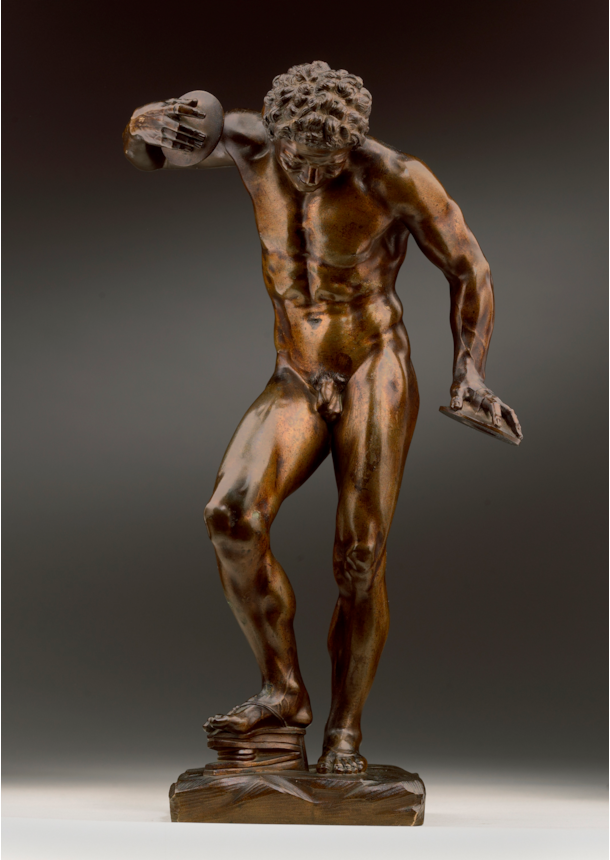
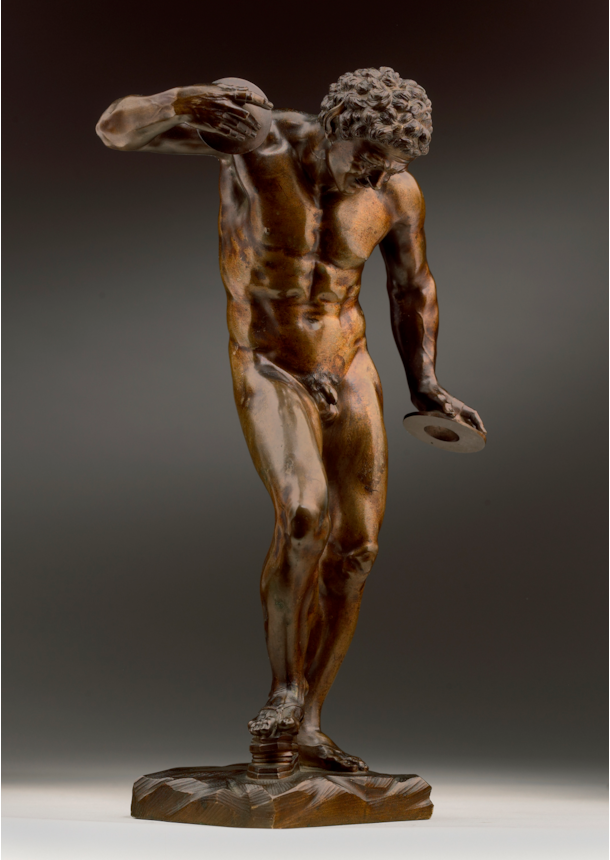
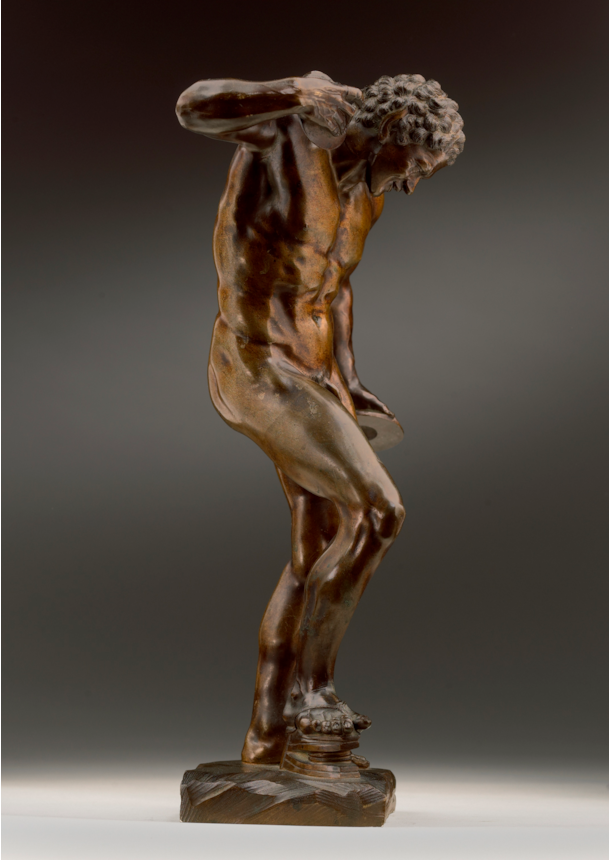
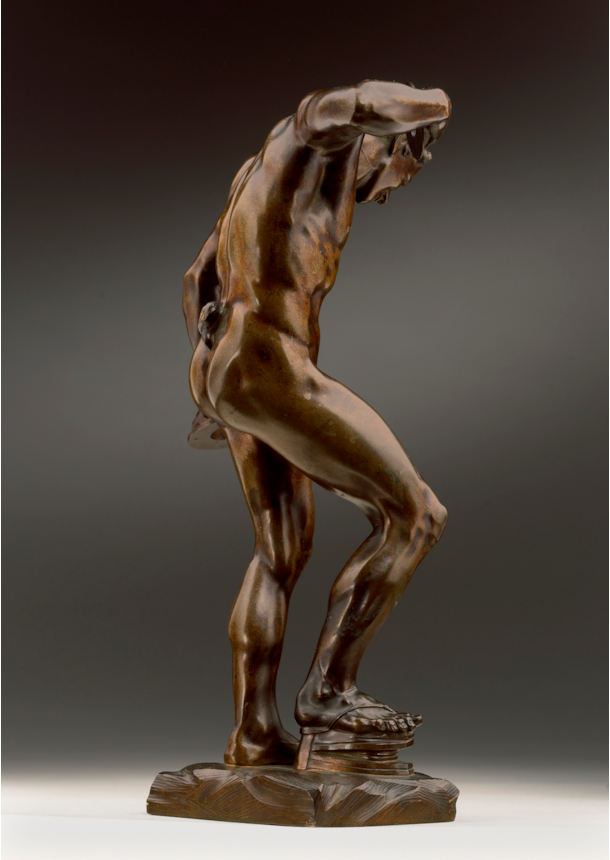
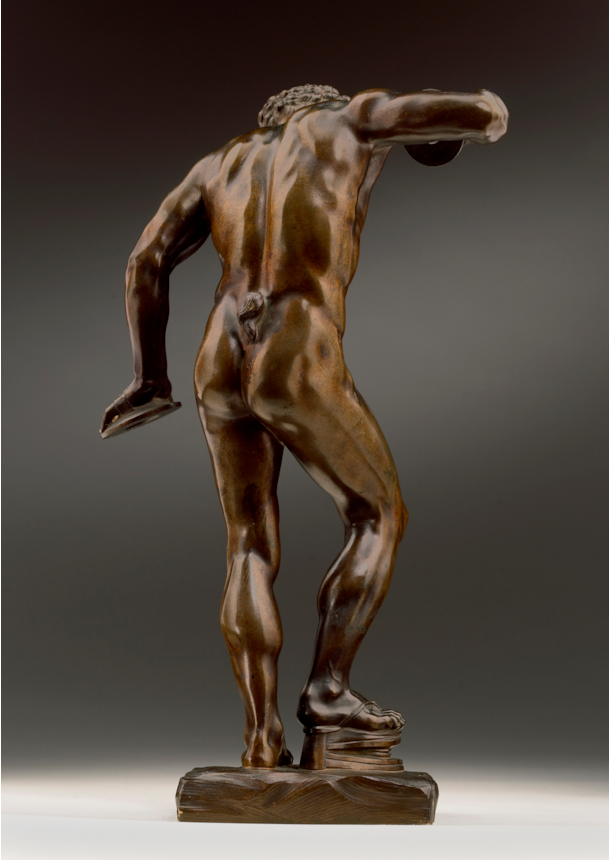
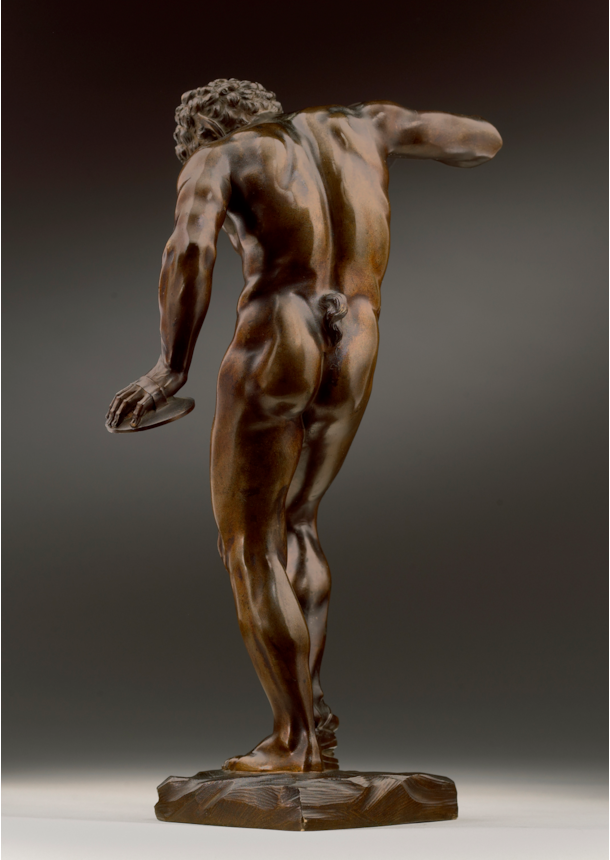
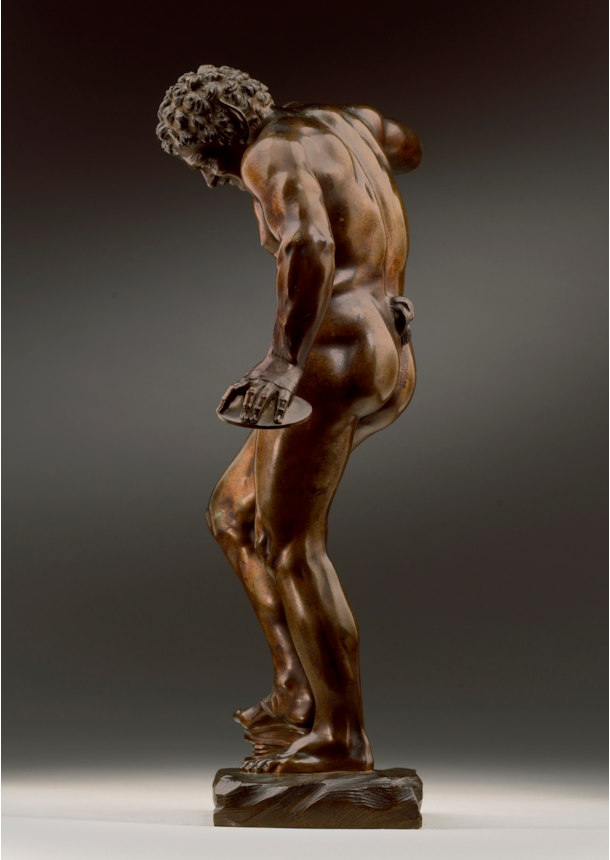
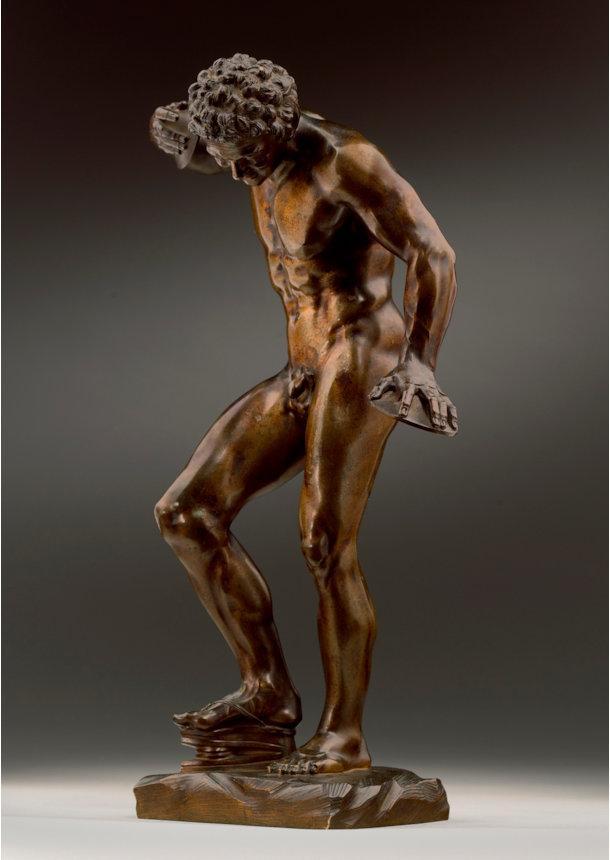
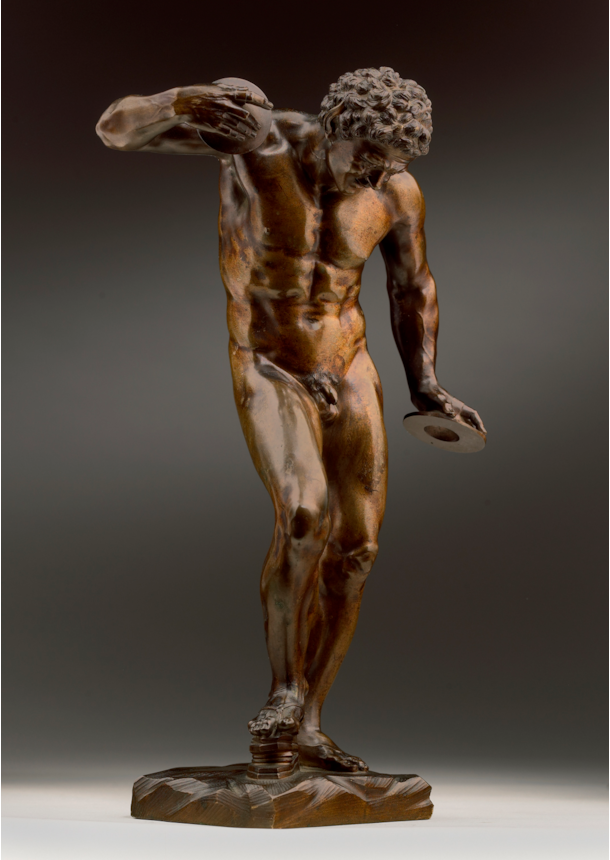
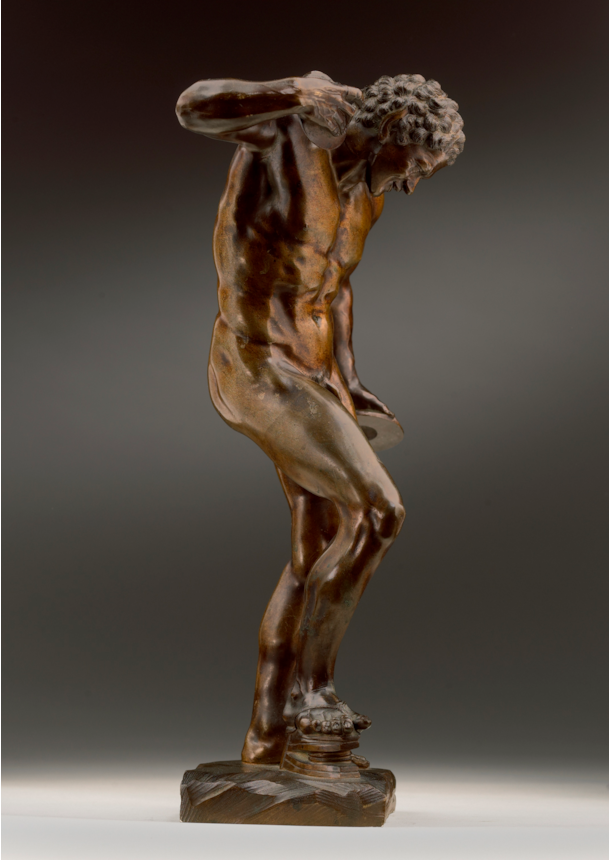
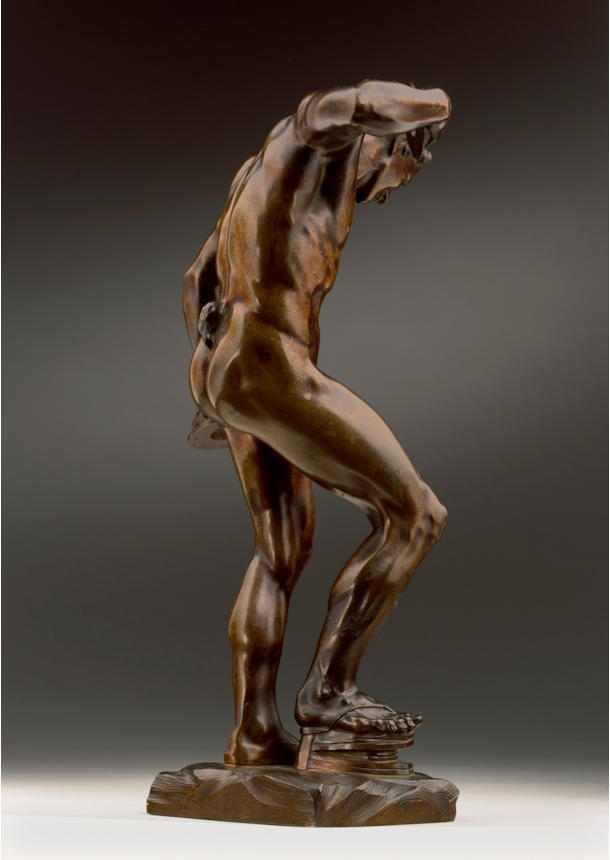
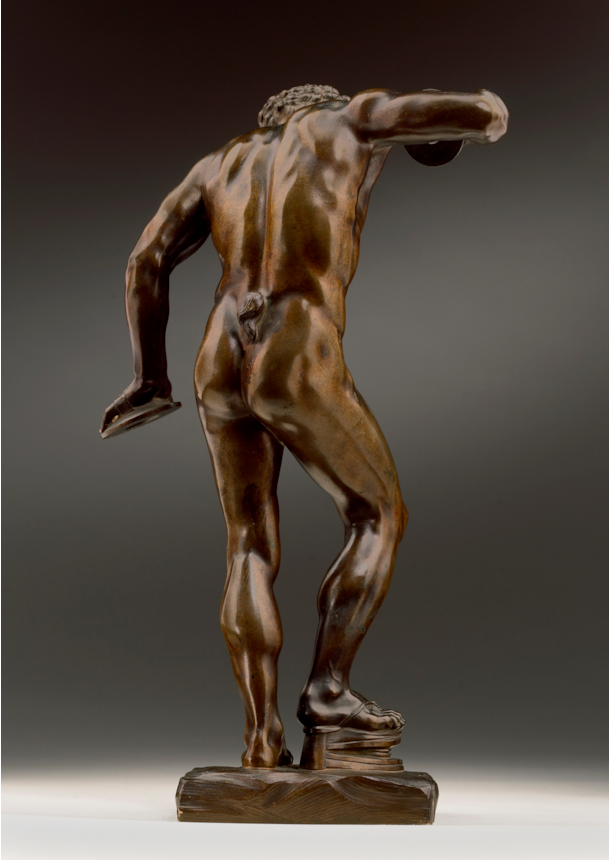
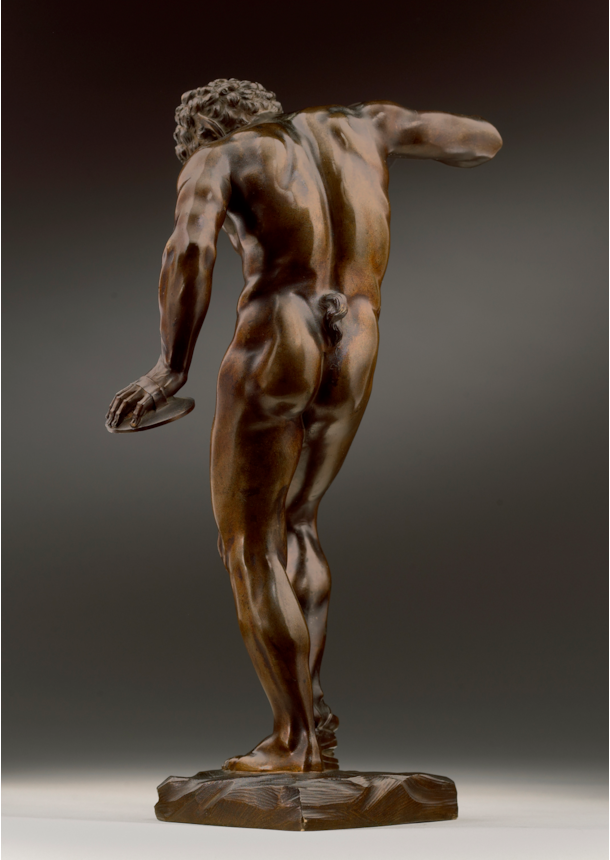
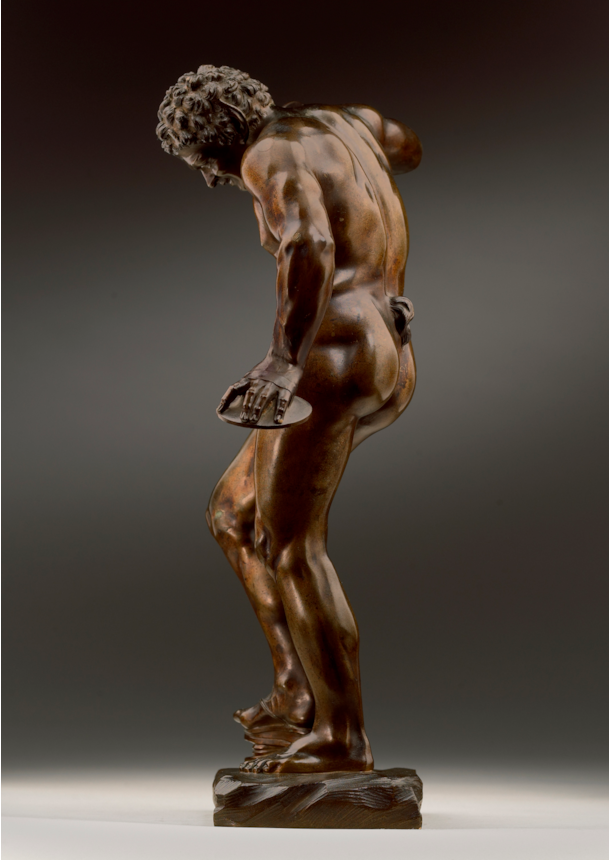
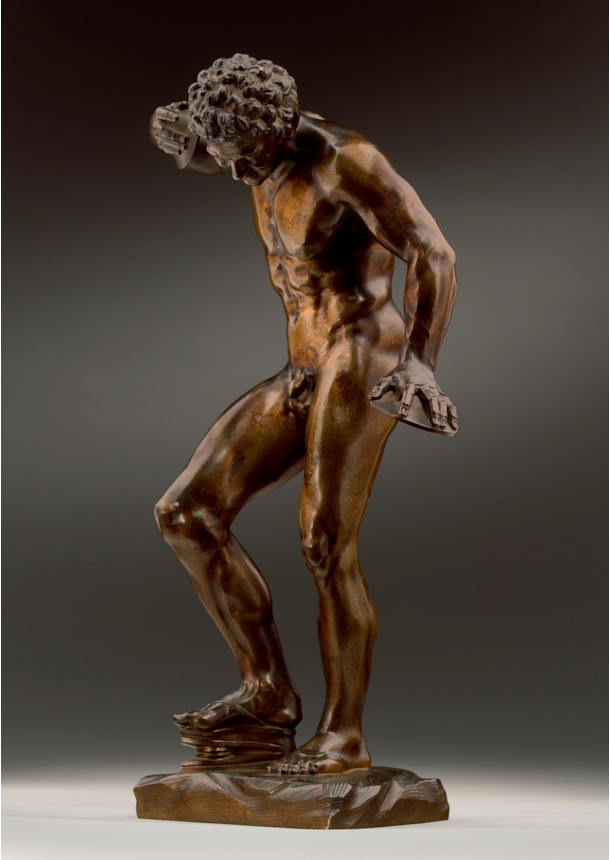
The present work is exemplary of the finest and highest quality of Florentine bronze casting and finishing. A beautifully modelled reduction of an ancient Hellenistic marble, the present bronze depicts the so-called Dancing Faun and is by the hand of the celebrated sculptor Massimiliano Soldani-Benzi (1656-1740).
The faun is represented as a nude youth of athletic build with characteristic horns on his forehead and pointed ears. He is posed frontally, his weight resting on the braced left leg, whilst his right foot works a clapper (kroupezion) which is set on the ground. This is attached to his foot by a thong running between the big toe and the other toes and fastened around the ball of the foot like a sandal. The faun’s right arm is raised to shoulder level, and the forearm is bent forward, while his left arm is lowered and held away from the body sideways and slightly backwards. In each hand, he holds a cymbal and the complementary gestures of his arms suggest that he has just clashed them together. He looks downwards with an expression of intense enjoyment on his satyr’s countenance.
The ancient sculpture after which the present work is modelled, has been in the Tribuna of the Galleria degli Uffizi, Florence, since at least 1688. Although it is uncertain as to when the sculpture became known, it was first recorded in an engraving by Rubens’ son, Albert, published in 1665. It can be identified with the ‘nude, standing Faun, who looks as if he is dancing, but the arms and head are modern’, described by Aldrovrandi in 1556. The Dancing Faun belonged to Eurialo Silvestri, a papal official whose collection passed to a branch of the Medici family. In 1684, it is documented in the ‘Cabinet de Son Altesse’, i.e. Grand Duke Cosimo III (1642-1723). Along with other treasures, in September 1800, it was sent to Palermo to avoid French seizure; however, it returned to the Tribuna in February 1803.
The sixteenth century restorations, which include the head, neck, and both arms, of the antique marble, were regarded as the most accomplished of any sculpture in the Medici collection. They were traditionally attributed to Michelangelo, a rumour that further increased the allure and fascination exerted by the statue.
Ever since its discovery, the captivating Dancing Faun enjoyed significant popularity amongst artists and collectors alike. The painter and art theorist Jonathan Richardson praised it highly in 1722, describing it as ‘the best in the Tribunal’, whilst the ultra-critical John Bell wrote in 1817 that it ‘is perhaps the most exquisite piece of art of all that remains of the ancients’. Models of the Dancing Faun have frequently been cast in bronze throughout its history. Notable examples include the expressive late seventeenth century model by Giovanni Battista Foggini (1652-1725) and the life-size cast by Pietro Cipriani (c.1680-before 1745), both conserved in the J. Paul Getty Museum in Los Angeles. A cast, now in the Quentin collection, was also made by the Florentine sculptor Massimiliano Soldani-Benzi (1656-1740), for whom it represented ‘the most beautiful statue to be seen’, as documented in his 1695 letter to Prince Johann Adam Andreas von Liechtenstein. Like his assistant, Pietro Cipriani, Soldani also cast a life-size version for the Duke of Marlborough in 1710, which remains at Blenheim Palace, Oxfordshire.
By the eighteenth century, the voracious desire for reduced bronze versions of the most important antique statues reached its peak, and they were enthusiastically commissioned and purchased by wealthy visitors to Rome and Florence whilst undertaking their Grand Tour. These bronzes were then usually displayed on their writing desks, atop fine marble chimneypieces or integrated into the decorative schemes of their prestigious country houses or metropolitan addresses.
Born to an aristocratic cavalry captain from Tuscany, Massimiliano Soldani-Benzi is considered to be the finest bronze caster in late seventeenth and early eighteenth-century Europe. Along with his contemporary Giovanni Battista Foggini, is considered the most significant proponent of the Florentine late Baroque style in sculpture. He first trained in Florence under the painter Volterrano, who encouraged him to attend the Accademia delle Arti del Disegno, and subsequently enrolled at the Medicean Academy in Rome in 1678. There he studied under the medallist Pietro Travani, the painter and sculptor Ciro Ferri, who had been a pupil of Pietro da Cortona, and the sculptor Ercole Ferrata, who had trained under both Alessandro Algardi and Gian Lorenzo Bernini. Soldani-Benzi excelled in the field of medal and coin making and soon received commissions from Pope Innocent XI, Queen Christina of Sweden and prominent members of the papal court.
Whilst perfecting his art in Paris, Soldani-Benzi attracted the attention of King Louis XIV and his entourage, but, at the behest of Cosimo III de’ Medici, he returned to Florence in 1682 and was named Director of the Grand Ducal Mint. Two years later he was appointed Professor of the Accademia del Disegno where he had once studied. His workshop was located in the heart of Florence, on the ground floor of the Galleria degli Uffizi. In his capacity as Director of the Mint, he oversaw the process of striking coins, but more importantly concentrated on the casting of large bronze medals, in which his skill gained him substantial recognition. Towards the end of the 1690s, Soldani-Benzi also began to dedicate himself to the production of reduced-scale bronzes, such as the present work.
Statuettes after the ancient and modern masters represent an important part of his production, one that he cultivated steadily from the turn of the eighteenth century until his death in 1740, and upon which his international renown rests to this day. By the end of his career, his patrons had included, in addition to those already mentioned, Gran Principe Ferdinando de’ Medici, Prince Johann Adam of Liechtenstein, the Elector Palatine, the Duke of Marlborough and the Earl of Burlington. Especially during the artist’s maturity, the British ‘milordi’ formed a substantial part of Soldani-Benzi’s patrons, as confirmed by the discovery of four hundred folios of correspondence between him and the intermediary Giovanni Giacomo Zamboni in London.
Further examples of the model by the hand of Soldani can be found in the Art Gallery of Ontario, and a larger scale work belonging to the Liechtenstein Princely Collections.