









Giovanni de Fondulis (1430/1437–1486/1491)
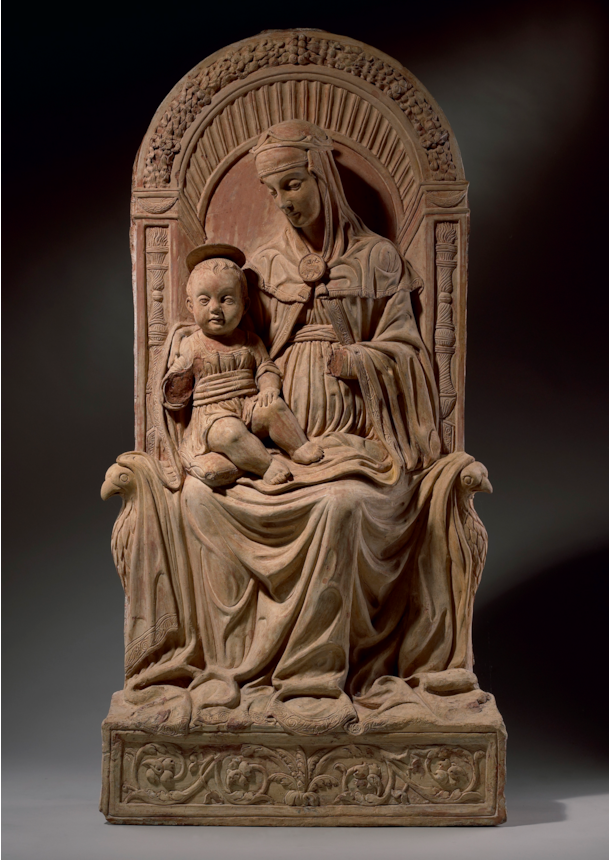
1. Madonna and Child
Terracotta
100 x 60 cm (39 ¼ x 23 ½ in.)


W. Arslan, Inventory of Italian Art Objects, Province of Padua. Municipality of Padua, vol. VII, Rome 1936, p. 126.
C. Avery, in Fingerprints of the Artist: European Terra-Cotta Sculpture from the Arthur M. Sackler Collections, exhibition catalogue (Washington, National Gallery of Art, 25 October 1979 - 5 October 1980; New York, Metropolitan Museum of Art, 21 March - 6 September 1981; Cambridge, Fogg Art Museum, autumn / winter 1981-1982), edited by L. Katz, Washington 1981, pp. 36–38 nn. 3–4.
F. Barbieri, in F. Barbieri, G. Menato, Pietra di Vicenza, Vicenza 1970, pp. 38-39.
F. Barbieri, Scultori a Vicenza dal XV al XVI secolo, Vicenza 1984, pp. 31-32.
A. Barbieri, P. Bosio, ‘The rediscovery of the Renaissance terracottas of the Duomo in the Civic Museum of Crema and Cremasco: construction site and artists’, in Cavallini G., Facchi M. (eds.), The Cathedral of Crema, original layouts and dispersed works, Milan, 2012, pp. 138-140.
F. Blacks Arnoldi, ‘An Exhibition of Italian Sculpture in London’, The Burlington Magazine DCCCXXXIV, 1972, p. 650.
W. Bode, ‘The sculptor Bartolomeo Bellano from Padua’, Archivio storico dell'arte IV, 1891, p. 409.
W. Bode, ‘Alte Kunst in den Vereinigten Staaten’, Die Woche L, 1911, p. 2100, p. 132.
J. Burckhardt, W. Bode, C. von Fabriczy (eds.), Der Cicero. Eine Anleitung zum Genuss der Kunstwerke Italiens, Leipzig 1898.
F. Caglioti, ‘Life of Donatello’, in Donatello, the Renaissance, exhibition catalogue (Florence, Palazzo Strozzi and Museo Nazionale del Bargello, 19 March - 31 July 2022), edited by F. Caglioti, Venice 2022, pp. 76-90.
A. Cambon de Lavalette, Sainte Catherine d'Alexandrie et Sainte Catherine de Sienne. Etude et restauration de deux bas-reliefs padouans en terre cuite de la seconde moitié du XVe siècle, Musée des Arts Décoratifs, Paris, mémoire de fin d'études, Institut national du patrimoine, Paris 2013.
P. Carpi, ‘New information and documents concerning Giovanni Minello and the art of his time’, Bulletin of the Civic Museum of Padua XXIII, 1930, pp. 40–91.
L. Cavazzini, A. Galli, Padua Crucial, in Mantegna, 1431–1506, exhibition catalogue (Paris, Musée du Louvre, 26 September 2008 - 5 January 2009), edited by G. Agosti and D. Thiébaut, Paris-Milan 2008.
R. Cevese, Arte nei Berici, in I Colli Berici natura e civiltà, edited by P. Mietto, Padua 1988, pp. 166 and 180, footnote 55.
J. Chloros, V. Talland et al., Italian Renaissance Polychrome Terracotta Sculpture in the Isabella Stewart Gardner Museum, in ICOM, Committee for Conservation in association with the Corning Museum of Glass, New York 2010, pp. 214–217.
J. D. Draper, European Terracottas from the Arthur M. Sackler Collections, exhibition catalogue (New York, Metropolitan Museum of Art, 21 March - 6 September 1981), New York 1981, p. 12 nn. 1–2.
J. D. Draper, in Donatello e i Suoi. Scultura fiorentina del primo Rinascimento, exhibition catalogue (Florence, Forte del Belvedere 15 June - 7 November 1986), edited by A. P. Darr, G. Bonsanti, Milan 1986, p. 257, cat. 107.
G. Ericani, ‘The second half of the fifteenth century between Padua and Lombardy’, in Sculpture in Vicenza, edited by C. Rigoni, Cinisello Balsamo 1999, pp. 45-79.
G. Ericani, in Sculpture at the time of Andrea Mantegna: between classicism and naturalism, exhibition catalogue (Mantua, Castello di San Giorgio - Palazzo San Sebastiano, 16 September 2006 - 14 January 2007), edited by V. Sgarbi, Milan 2006, pp. 92-94.
G. Ericani, ‘Giovanni de Fondulis. An important chapter in Renaissance sculpture in the Po Valley’, in Crema Renaissance: arts, masters and workshops between the 15th and 16th Centuries, edited by P. Venturelli, Milan 2015, pp. 69-81.
C. von Fabriczy, ‘Giovanni Minello, ein Paduaner Bildner vom Ausgang des Quattrocento’, Jahrbuch der Königlich Preußischen Kunstsammlungen XXVIII, 1907, p. 76.
M. Facchi, A. Galli, ‘News from the Western Front, the origins of Giovanni de Fondulis and terracotta sculpture in Crema in the mid-fifteenth century’, in In our image. Renaissance terracotta sculpture from Donatello to Riccio, exhibition catalogue (Padua, Diocesan Museum, 15 February - 27 September 2020) edited by A. Nante, C. Cavalli and A. Galli, Verona 2020, pp. 66-77.
A. Galli, ‘The master of the singing angels and the oldest Lombard terracotta sculptures’, Nuovi Studi 6, 1999, p. 18.
A. Galli, ‘Before Amadeo. Terracotta sculptures in Lombardy around the middle of the fifteenth century’, in Terracotta in the Duchy of Milan. Artists and Workshops of the early Renaissance, Proceedings of the conference (Milan - Certosa di Pavia, 17-18 October 2011), edited by M.G. Ottolenghi and L. Basso, Milan 2013, p. 5.
T. Gasparini, Nanto Vicentino. Appunti storici, Vicenza 1933, pp. 22-25 and 36.
G. Gentilini, in From the fourteenth to the seventeenth century: the arts in comparison, exhibition catalogue (Turin, Antichi Maestri Pittori, 2 October - 30 November 1991), edited by G. Romano, Turin 1991, p. 63.
Heim Gallery, Sculptures of the 15th & 16th Centuries, Summer Exhibition, London 1972, no. 25.
G. Gentilini, ‘An ancient-style bust by Riccio and some notes on terracotta sculpture in Padua between the fifteenth and sixteenth centuries’, Nuovi Studi I, 1996, pp. 36-37.
N. Ivanoff, ‘Sculptures and paintings from the fifteenth to the eighteenth century’, in Basilica of Santa Giustina. Art and history, edited by P.L. Zovatto, Castelfranco Veneto 1970, p. 167–345.
L. Magagnato, I taiapiera di Vicenza, in Prima mostra della pietra di Vicenza, Venice 1952, p. 20, fig. 18.
G. Mantese, La Chiesa Vicentina. Panorama storico, Vicenza 1962, p. 184.
A. de Nicolò Salmazo, A.M. Spiazzi, D. Toniolo, Andrea Mantegna and the masters of the Ovetari Chapel: virtual recomposition and restoration, Milan 2006.
M. Pizzo, in From the Middle Ages to Canova: sculptures from the Civic Museums of Padua from the fourteenth to the nineteenth century, edited by D. Banzato, F. Pellegrini, M. De Vincenti, Venice 2000, p. 121.
L. Planiscig, Venezianische Bildhauer der Renaissance, Wien 1921.
L. Planiscig, Andrea Riccio, Wien 1927.
M. Scansani, The sacred fire of Terracotta: Giovanni de Fondulis between Lombardy and Veneto, Mantua, 2024.
M. Scansani, ‘Giovanni de Fondulis in Padua’, in Our image. Renaissance terracotta sculpture from Donatello to Riccio, exhibition catalogue (Padua, Diocesan Museum, 15 February - 27 September 2020) edited by A. Nante, C. Cavalli and A. Galli, Verona 2020, pp. 79-89.
P. Schubring, Die italienische Plastik Des Quattrocento, Berlin 1919, p. 214.
C. Semenzato, ‘Sculture vicentine’, Arte Veneta XXV, 1971, pp. 306-307.
M. N. Simeone, ‘L'antica chiesa di Nanto e la sua comunità attraverso i secoli’, in Nanto. S. Maria Annunziata una chiesa tra ieri e oggi 1897-1997, pp. 43-48, 51.
Sotheby's, Important European Terracotta and Bronze Sculpture from the Arthur Sackler Collections Including Drawings Related to Sculpture, New York 29 January 2010, n. 419.
Sotheby's, European Sculpture & Works of Art, Medieval to Modern, London 4 December 2013, p. 64 n. 70.
Sotheby's, Old Master Sculpture & Works of Art, London 3 December 2014, n. 46.
A.M. Spiazzi, V. Fassina, F. Magani, The Ovetari Chapel, Milan 2009.
M. Verga Bandirali, A terracotta from Passarera, Crema, 1990, p. 50-51.
M. Verga Bandirali, ‘Contribution to the reconstruction of a phase of Crema in the path of Agostino Fondulo’, Arte Lombarda 92/93, 1990, p. 72.
C.C. Vermeule, Sculpture in the Isabella Stewart Gardner Museum, Boston 1977, pp. 134-136 n. 167.
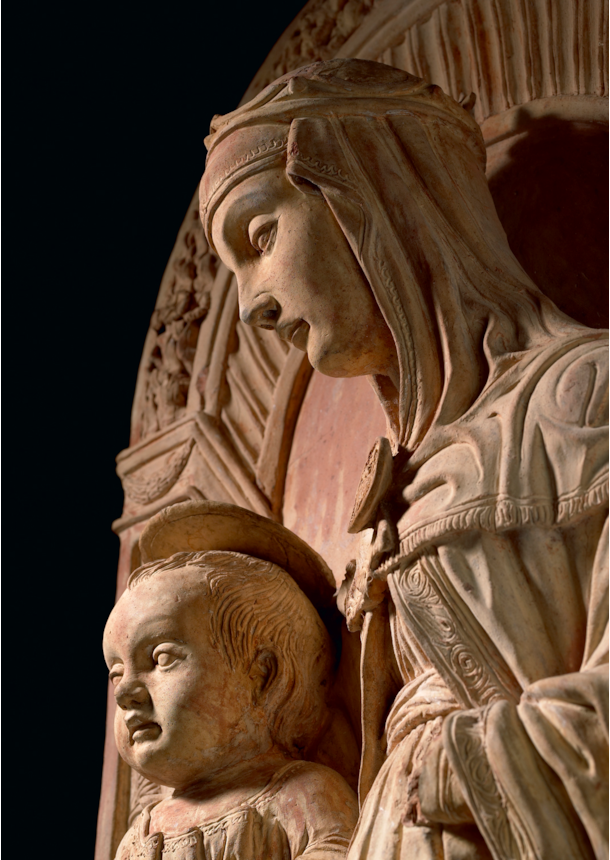
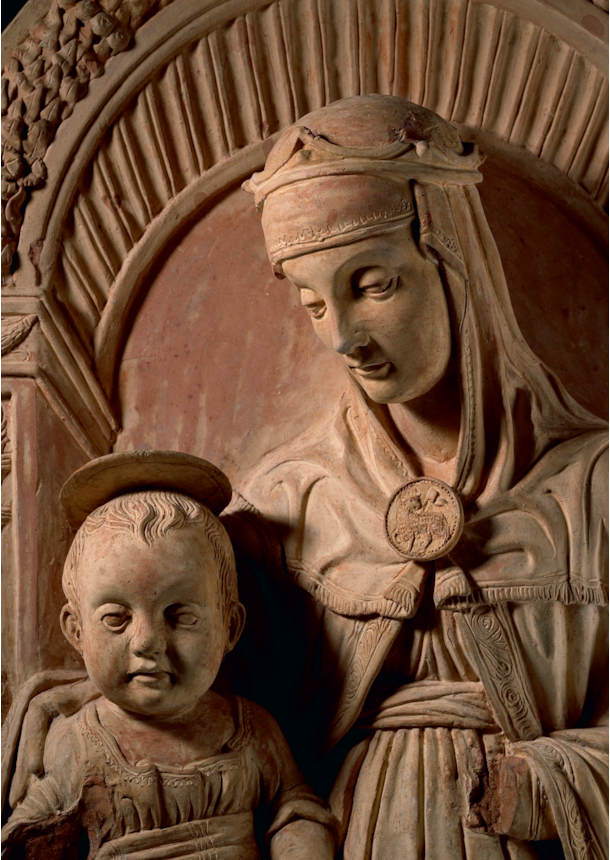
A rare testimony to the most restless and experimental season of northern Italian sculpture in the 15th century, this Madonna and Child is a work of uncommon scale and ambition, in which constructive intelligence and finesse of execution transcend the apparent simplicity of the material.
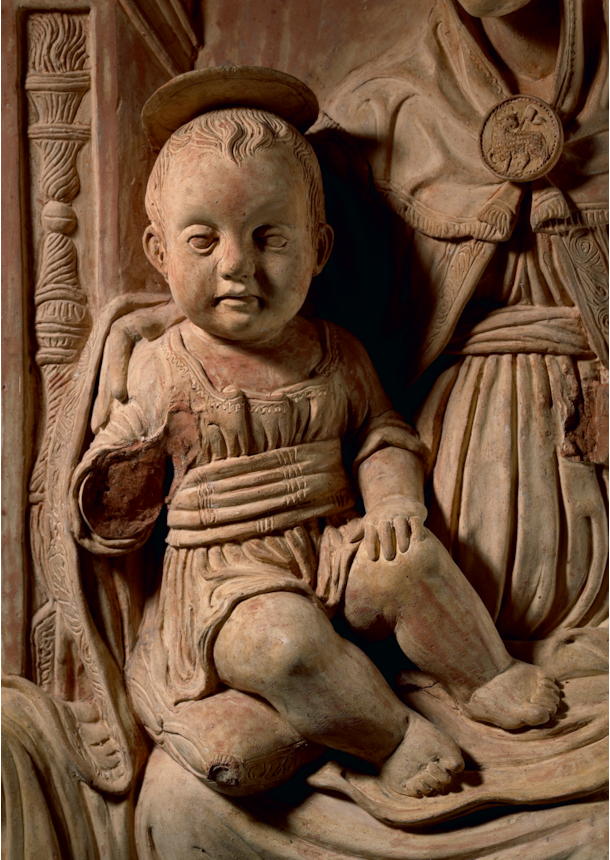
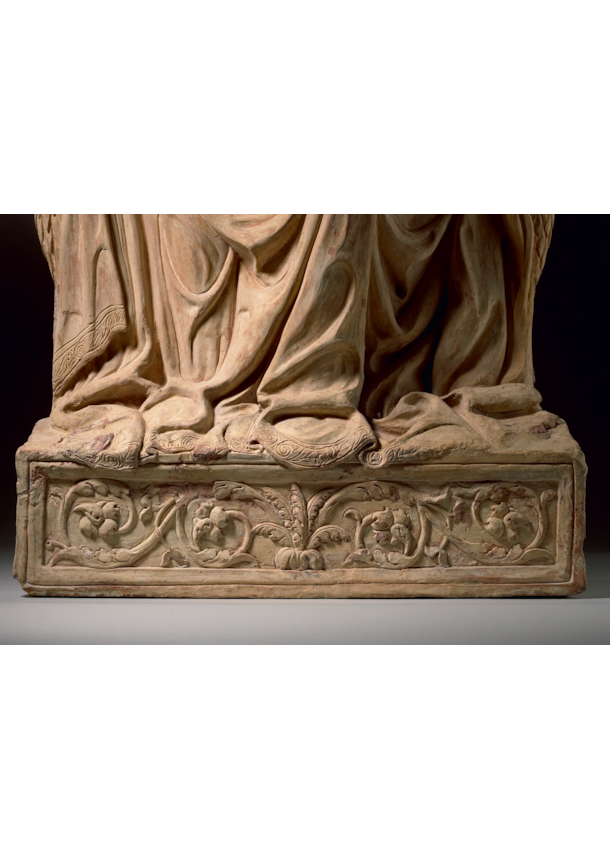
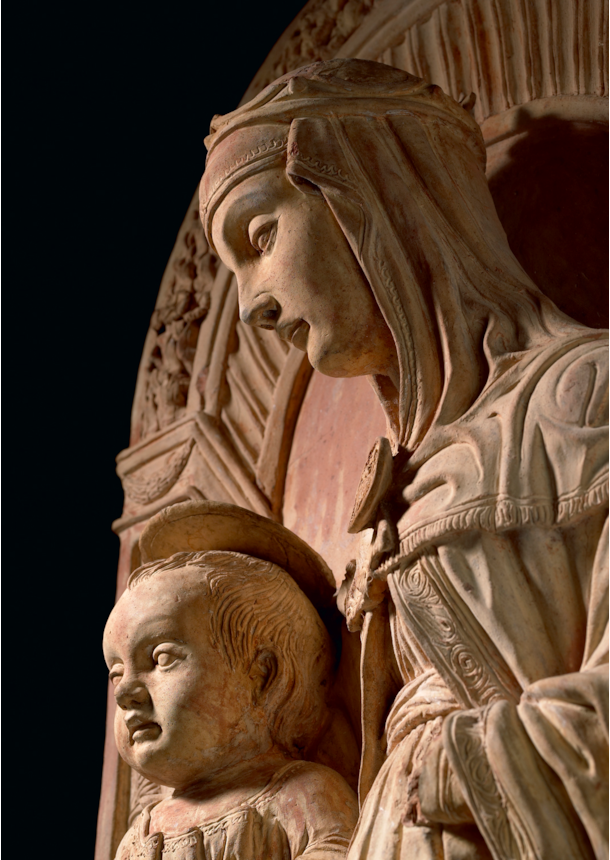
The spatial illusionism is mostly entrusted to a solemn a perspective of antique architecture, conceived as a real frame for the sacred image. A wide barrel vault, decorated on the front with a thick garland of leaves and fruit, frames the figure of the Madonna and Child and rests on two pillars decorated with finely modelled lit candelabras, which accentuate the vertical course of the composition. At the base, a rich phytomorphic decoration of acanthus leaves is articulated in racemes populated with leaves and flowers, in an ornamental swarming that accompanies the figure's ascent.
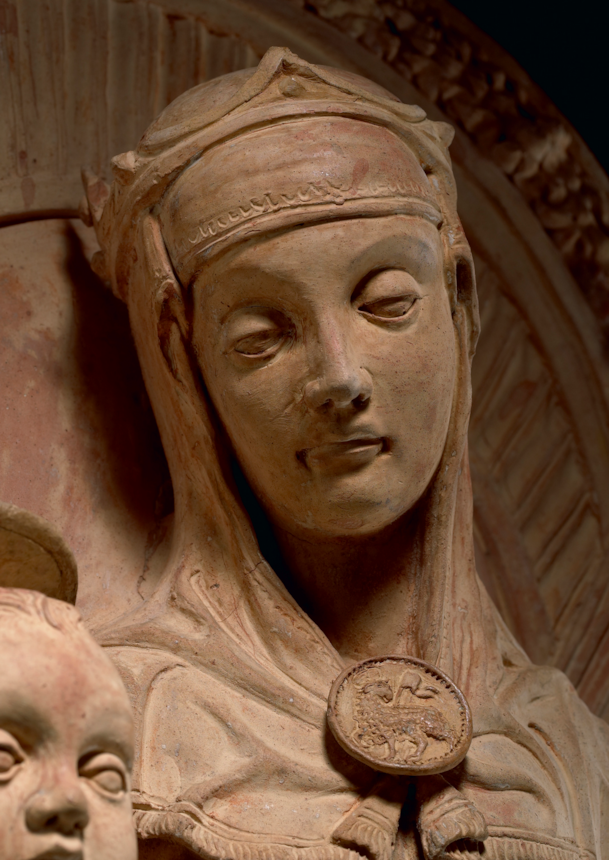
The state of conservation is excellent and allows us to fully appreciate the quality of modelling, the precision of the details and the complex spatial articulation of the composition, based on a carefully calibrated balance between architecture, figure and ornamentation.
The references that emerge most clearly point the work towards a decidedly Donatellian horizon, and more precisely towards the lexicon elaborated by the Florentine master during his long and extremely fruitful stay in northern Italy, starting in 1443, when Padua became the privileged workshop of a radical re-foundation of artistic language. In those years, the Tuscan master fielded a repertoire of astonishing inventions - formal vigour, incisive naturalism, expressive tension, illusory depth obtained by means of perspective, recovery of the antique as a contemporary grammar - that marked an irreversible watershed in the history of western sculpture.
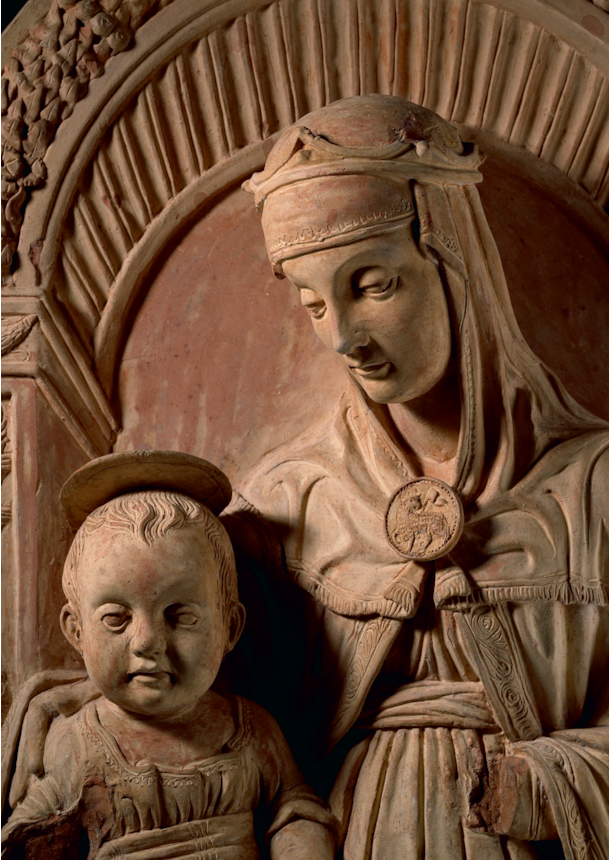
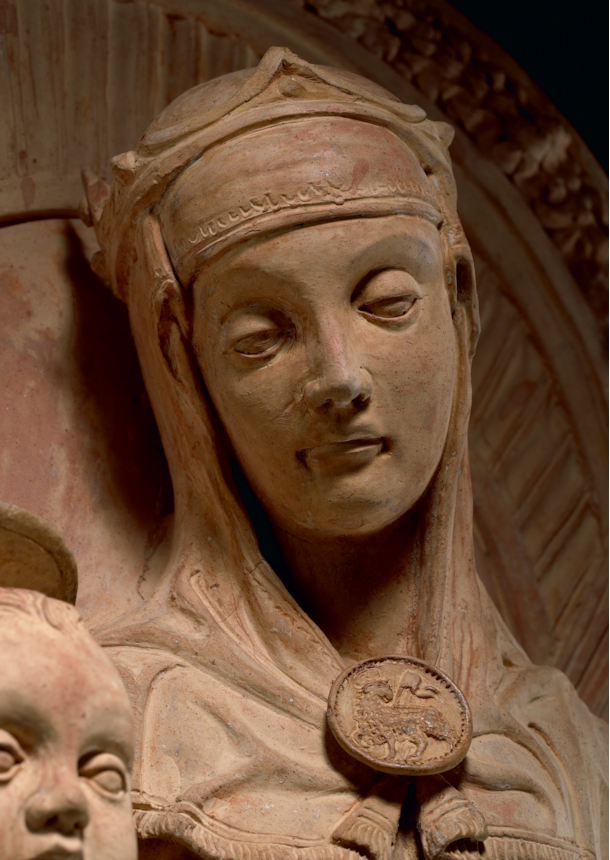
It is, however, in the mid-15th century Lombard area that certain features of the work find particularly strong parallels. In the face of the Madonna, which is almost geometrical, with lowered and swollen eyelids, and in the figure of the Child, with his slightly averted eyeballs, there are clear similarities with the work of a lively anonymous sculptor active between Crema, Brescia and Lodi, whose corpus has been reconstructed by Aldo Galli and brought together under the conventional name of Master of the Singing Angels (for two beautiful reliefs with this subject today in the Louvre and Pushkin Museum).12It is in this direction that those components of decorative taste and exuberant elegance can also be traced, vaguely Gothic residues that seem rather to reflect the influence of a Lombard tradition capable of mediating naturalism and formal measure. Certain solutions of the Master of the Singing Angels seem, in this sense, to have exercised a far from marginal attraction on the author of our terracotta.
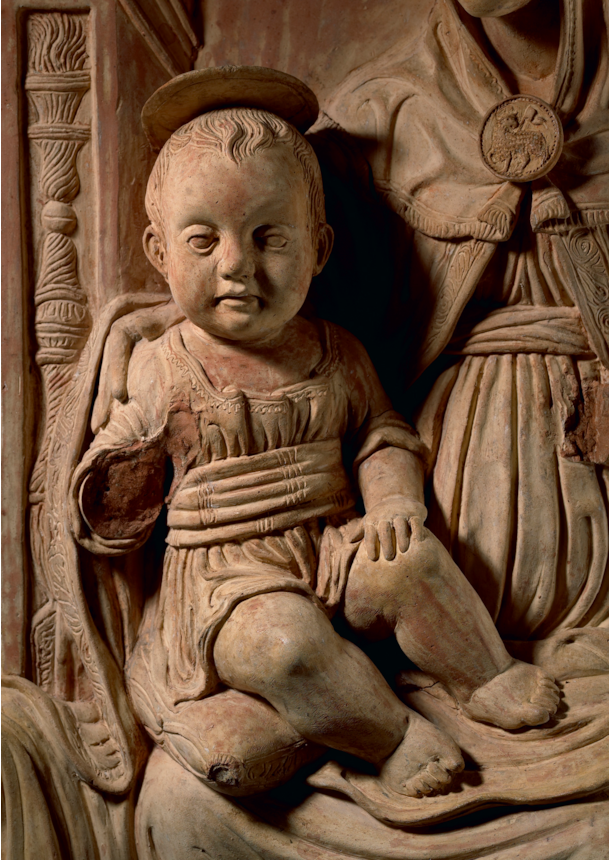
Particularly eloquent is the comparison with the angelic heads conserved in the Museo Civico in Crema, from the monumental terracotta altar dedicated to St. Mark, created in the 1450s for the city cathedral: the heavy eyelids, the large eyebrow arches, the elongated faces and the deeply incised wings of the nose find exact correspondences in the physiognomy of our Madonna. Similarly, the heavy Child of the terracotta examined here closely resembles the one depicted on the knees of a Madonna seated on a throne preserved in Rubbiano, near Crema, which can be traced back to the ambit of the same master.
In recent times I have proposed identifying this anonymous craftsman with Fondulino de Fondulis, a multifaceted figure recorded in the sources as a blacksmith, goldsmith and hydraulic engineer, also active as an altar decorator and organiser of ephemeral apparatuses for town festivals, as well as a municipal councillor, before taking hermit orders under the name of Fra Germano. Fondulino is also the father of Giovanni de Fondulis, one of the greatest sculptors of the Po Valley Renaissance, whose work reveals a profound dependence on the inventions of the so-called Master of the Singing Angels. It is within this family and cultural line, marked by a direct transmission of models, practices and formal solutions, that the relief examined here finds a particularly coherent place, and it is Giovanni de Fondulis himself who is the author of this exceptional sculpture, suspended in a subtle and conscious balance between the Lombard sculptural tradition and the bursting innovations of the Paduan Renaissance.
Giovanni was born in the 1430s and was initially trained in the family workshop, within that artisan and artistic milieu dominated by his father's strong personality. After Fondulino's religious turning point, Giovanni took up his legacy not only on an artistic level, but also in terms of civic commitment: he took a seat on Crema's city council and held various public offices.
In 1468 Giovanni de Fondulis moved definitively to Padua, launching an extraordinarily fertile career as a sculptor, destined to make him one of the leading figures of northern sculpture in the second half of the 15th century.
As soon as he arrived in the city, the artist began to receive major commissions. Among the first was the creation of no less than three altars in terracotta and Nanto stone, decorated in total with more than twenty-five figures, for the church of Santa Maria delle Grazie in Este. It was in this type of terracotta altarpieces crowded with sacred figures, conceived as real populated architectures, that Giovanni specialised throughout his career. The result was the production of statues of saints and devotional groups, today dispersed in the most important museum collections in Europe and the United States, that attest to a rare ability to combine monumentality, naturalism and a lively narrative sensibility.
In 1474, Giovanni also produced a large terracotta altarpiece depicting the Baptism of Christ for the high altar of the church of San Giovanni Battista in Bassano del Grappa, confirming his full integration into the artistic circuits of the Veneto. Although this part of his activity still remains partly unclear, it is now clear that Giovanni de Fondulis was also a first-class artist in bronze. So much so that he found himself competing with the greatest specialists of the time - such as Bertoldo di Giovanni and Bartolomeo Bellano - for the creation of the Old Testament stories destined to adorn the marble curtain of the altar of the Saint, designed by Donatello.
His activity brought him into contact with very high-profile commissions. In the 1480s, he worked for the heirs of James II of Lusignan, King of Cyprus in exile in Padua, and for the city's castellan Andrea Pesaro, for whom he created a Madonna and Child flanked by Saints Sebastian and Rochus, as well as a series of twenty antique-style heads. He also designed an imposing bronze monument dedicated to the jurists Paolo and Angelo da Castro for the church of Santa Maria dei Servi, which remained unfinished due to his death in 1491.
Once the authentic physiognomy of the Cremanese sculptor has been restored, also thanks to new documents, the complexity of his language emerges with greater clarity, played on a constant tension between formal discipline and plastic vitality, between Lombard memory and the critical assimilation of Donatello's vocabulary. It is within this unstable but consciously governed balance that the terracotta presented here finds a particularly convincing collocation: not as an isolated episode, but as an early expression of an artistic personality who had just come into contact with the most advanced Renaissance ideas in northern Italy.
This interpretation finds concrete confirmation within Giovanni de Fondulis' own production, where a series of timely and convincing comparisons can be made, useful both to reinforce the attribution and to clarify the chronological collocation. The first obligatory reference is constituted by the climbing Putti in the cloister of San Lanfranco, in which we find a fleshy fullness surprisingly akin to that of the Christ Child in our terracotta.
The comparison with the Madonna conserved in the abbey of Santa Giustina in Padua is eloquent, a work that could be placed among Giovanni's first realisations after his definitive move to the
Veneto.
It is difficult to imagine that this sophisticated elaboration of drapery matured exclusively within the Lombard plastic tradition. Evidently, Giovanni, who had just arrived in Padua - or perhaps already on the occasion of previous and occasional youthful incursions into the Venetian territories - must have been deeply impressed not only by Donatello's inventions and Giovanni da Pisa's terracottas, but also by contemporary painting, and in particular that of Andrea Mantegna. In the Ovetari Chapel at the Eremitani, Mantegna had in fact proposed (perhaps for the first time with such radicality), precisely this kind of intricate, contorted and highly plastic drapery, conceived as hard, angular volumes, capable of competing with sculpture on the terrain of formal construction. In this close dialogue between painting and sculpture, between relief and painted surface, the work presented here is therefore placed: not only as a reflection of a precise stylistic genealogy, but as evidence of the extraordinary permeability of artistic languages in Padua in the second half of the 15th century.
This openness towards a shared formal lexicon finds particularly concrete confirmation when we move from the level of models to that of works. It is in fact with two pairs of reliefs depicting saints that the comparison becomes more stringent and revealing: in this case, the analogy does not end in a generic stylistic consonance, but invests deeper aspects, such as the conception of the work as a fragment of a larger whole and the technical solutions adopted during modelling and firing.
The first dyad is now in the Musée des Arts Décoratifs in Paris, where it arrived in 1893 as a gift from the collector Jules Maciet, who had acquired it a few years earlier. The two reliefs depict St. Catherine of Alexandria (101.3 x 28.5 x 12 cm), easily identifiable thanks to her martyrdom palm and cogwheel, and a second saint in monastic dress, long indicated as Catherine of Siena but more plausibly recognisable as St. Clare of Assisi (103.9 x 26.8 x 11 cm), by virtue of the knot encircling her robe, typical of Franciscan iconography. Since their appearance on the market, the two terracottas have imposed themselves as problematic objects: not only because of the quality of the modelling, but above all because of their singular form, which cuts out the figures by following their profile, as if they had literally been 'contoured' from a larger whole.
At first, they were referred to the circle of Giovanni Minelli, on the basis of the opinions expressed by Fabriczy at the beginning of the 20th century; in 1968, André Chastel put forward a hypothesis of a connection with the school of Pietro Lombardo, albeit only orally. The discovery, in 1972, of another pair of stylistically similar reliefs - then exhibited at the Heim Gallery in London - reinforced the idea of a single complex provenance and led some scholars to attribute the entire group to Nicolò Pizzolo, considered at the time to be the author of the Ovetari Altarpiece. However, discordant voices were not lacking: Francesco Negri Arnoldi was quick to point out the profound differences between these reliefs and the Paduan work, correctly assigned to Giovanni da Pisa.
It is only in more recent times that the Parisian pair has been traced with greater conviction to the sphere of Giovanni de Fondulis, placing them in the seventh decade of the 15th century. A proposal further strengthened by precise analyses that have related the faces of the saints to other Venetian works in the Fondulian sphere, without however completely excluding a possible participation of the Master of the Singing Angels (Fondulino de Fondulis?).
The second pair of reliefs - formerly in the Sackler collection and now in a private collection - depicts a St. Francis and a saint traditionally identified as Clare, but who, in light of the attribute of the cross, is more plausibly recognised as St. Helena. Here, too, the collector's provenance and critical fortune tell a complex story. First published with an attribution to Pizzolo, the two reliefs were later compared to the Parisian terracottas and considered part of the same dismembered altar. The differences in size and the unusual iconographic juxtaposition between a Franciscan and the mother of Constantine do not prevent one from recognising a substantial unity of conception, based on technical, typological and formal affinities. In 2010, following their appearance on the antiquarian market, these reliefs were also traced back to the sphere of Giovanni de Fondulis, with a similar dating to that of the Parisian saints.
The correspondences between the Madonna and Child and these four figures are so profound - in style, technique and even size - as to legitimise the hypothesis that all or part of them originally belonged to a single sculptural complex. In some cases, the shaped profiles even seem to fit together: the Saint Helen and the Saint Francis seem to fit naturally on either side of the Madonna's throne, while the Saint Catherine seems perfect to flank the Saint with the cross. The vertical curvilinear cuts, made before firing along the contours of the figures, are also found in certain and later works by Giovanni de Fondulis, suggesting a technical practice that is anything but episodic, one thinks for example of the Deposition in the Isabella Steward Gardner Museum in Boston.
To this nucleus of dispersed Fondulian fragments could perhaps be added a terracotta of more problematic interpretation, the current location of which I do not know and which is only known to me through a photograph in the photo library of the Museo Nazionale del Bargello in Florence. As far as it is possible to judge on the basis of the photograph, it would seem to be another Madonna seated on the throne with Child, updated on the inventions of Donatello and Giovanni da Pisa and probably traceable to the Fondulian sphere, although it shows an overall inferior quality compared to the work examined here, particularly in the drapery - especially those that fall over the shoulders and along the sleeve. However, there are significant similarities in the construction of the faces, especially in the rendering of the eyelids, nose and mouth, as well as in the physiognomy of the Child.
In this sense, the present work represents not only a rare survival, but a true first; a fundamental piece in the reconstruction of the career of one of the most original protagonists of North Italian Renaissance sculpture, and, at the same time, an invitation to rethink with a fresh look, the fortune, diffusion and material destiny of an entire artistic season.
Marco Scansani, 2026