









An Important Work of the International Gothic Period
3. Carved Figure of a Kneeling Donor
French Royal Court Sculptor
Marble
Ile-de-France, c. 1380 - 1400
39 cm. (15 in.) high
Fernand Robert, Paris until 1906
Acquired by William Waldorf Astor, Viscount Astor of Hever (1848 – 1919), Hever Castle, Kent on 7th December 1906
Lord Gavin Astor, 2nd Baron Astor of Hever (1926-1984)
Christie’s London, Lord Astor of Hever: Hever Castle, Kent, 21st April 1982, lot 147
Sotheby’s New York, European Works of Art, Arms and Armour, Furniture and Tapestries, 20th May 1988, lot 13
Private Collection, England


F. Baron, Les Fastes du gothique, le siècle de Charles V, cat. exp. (Paris, Galeries nationales du Grand-Palais, 9 octobre 1981 - 1er février 1982), Paris, Réunion des musées nationaux, 1981.
F. Baron, Le maître-autel de l'abbaye de Maubuisson au XIVe siècle, Monuments et mémoires de la Fondation Eugène Piot, 1971, p. 538-544, p. 129-151.
Le Siècle de Charles V, Réunion des musées nationaux - Grand Palais, Paris cedex 12, France (October 10, 1981-February 1, 1982).
M. Beaulieu et V. Beyer, Dictionnaire des sculpteurs français du Moyen-Age, Paris, 1992, p. 215.
S. Jugie, The mourners, Tomb Sculptures from the Court of Burgundy, The French Regional American Museum exchange, Yale University press, 2010.
S. Jugie, Les pleurants des Tombeaux des Ducs de Bourgogne, Ed. Lannoo, Tielt, 2012.
S. Jugie, L’Art à la cour de Bourgogne : Le mécénat de Philippe le Hardi et de Jean sans Peur
(1364‑1419), publié à l’occasion de l’exposition du Musée des Beaux‑Arts de Dijon (28 mai – 15 septembre 2004) et présentée ensuite au Cleveland Museum of Art (24 octobre 2004 – 9 janvier 2005).
H. A. Klein, Sacred Gifts and Worldly Treasures: Medieval Masterworks from the Cleveland Museum of Art, 2007, pp. 208-9.
P-Y. le Pogam, Les pleurants du tombeau de Jean de France, duc de Berry, un deuil, apaisé, La revue des musées de France, 2020, n°3, pp. 41-53.
P-Y. Le Pogam, Un manifeste politique à Saint-Denis : le tombeau de Charles V et de Jeanne de Bourbon ? dans Coden, Fabio (dir.), Sepolture medievali (IV-XV secolo) : Spazi, opere, scriture = Medieval burials (4th-15th centuries) : spaces, artworks, writings, II, Milano, Silvana Editoriale, (Collana / Series "Minima medievalia"), 2024.
S. Nash, No Equal in Any Land, André Beauneveu, Artist to the Courts of France and Flanders, London, 2007.
G. Viard, B. Decron & Fang-Cheng Wu, La Cathédrale Saint-Mammès de Langres, Histoire – Architecture – Décor, D. Guéniot, 1994, pp. 91-93.
P. Vitry, Catalogue des sculptures du Moyen Âge, de la Renaissance et des Temps modernes. Première partie, Moyen Âge et Renaissance ; deuxième partie, Temps modernes, I et II, Paris, 1922.
W. D. Wixom, Medieval Sculpture of the Metropolitan Museum of Art, The Bulletin of the Metropolitan Museum of art, 2005, p. 38.
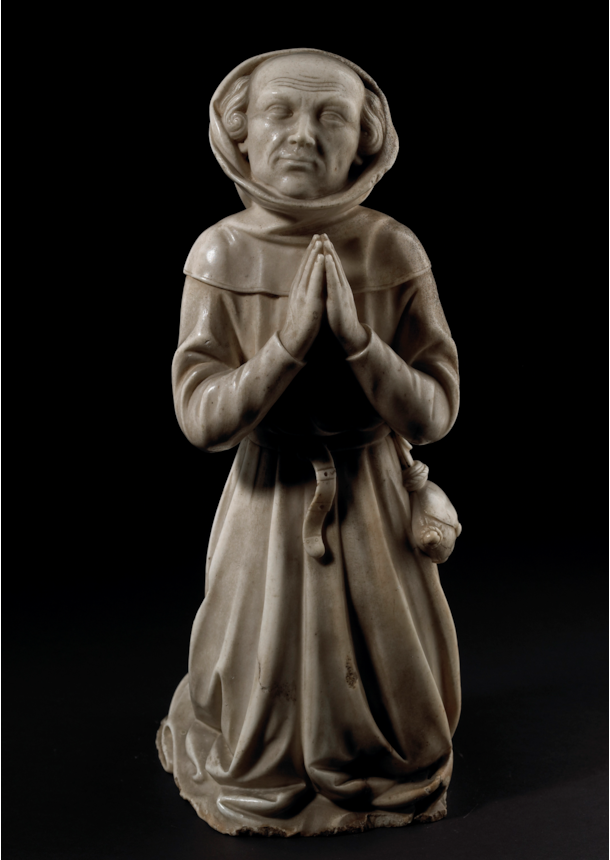
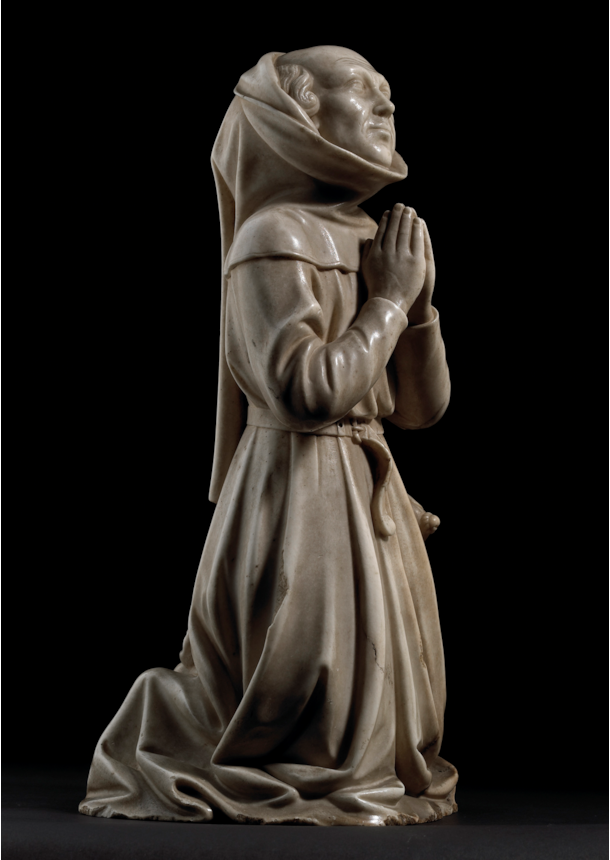
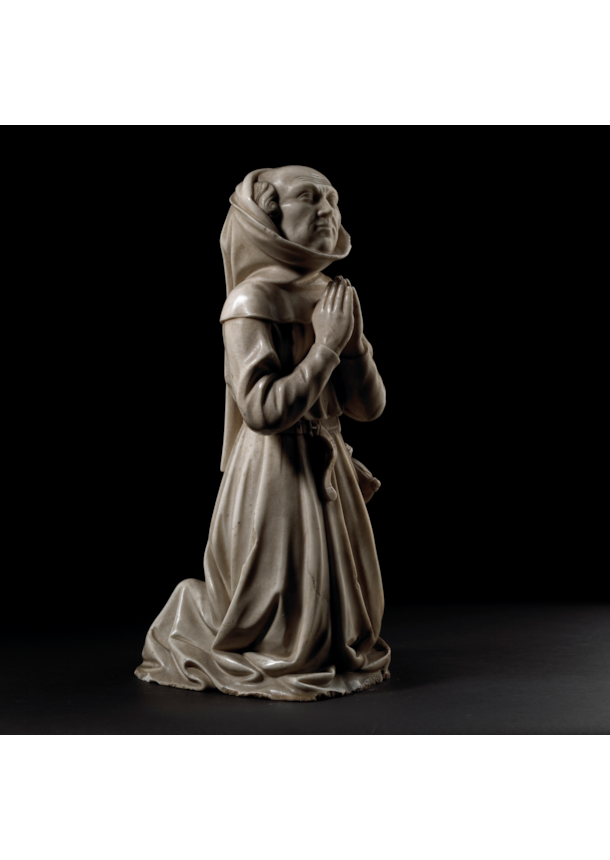
Our sculpture is part of the international Gothic style, with marked naturalism and inner expressiveness. The precise treatment of the features, costume, and drapery reveal the hand of a finely skilled marble sculptor. The face, individualized without excessive idealization, suggests a commemorative function like the princely effigies of the late 14th and early 15th centuries. Although the identity of the figure and the sculptor remain uncertain, the work can be linked to artists in the service of Charles V and his successors. It embodies a layman aware of his social and spiritual position, humble before God. Documented since the early twentieth century, in excellent condition and of high quality, this sculpture is a major testimony to the spirituality and sculpture of the International Gothic period, and its appearance on the art market is an important event for historians and collectors.
Historical Context – International Gothic
International Gothic, which flourished between the late fourteenth and early fifteenth centuries (c. 1380-1430), is characterized by the combination of extreme formal refinement and an increased pursuit of realism. Described as “international” because of its diffusion across numerous European artistic centres such as Paris, Avignon, Bruges, Cologne, Milan and Prague, this style reflects a shared sensibility that transcended political divisions. Its spread was fostered by the intense circulation of princes, ecclesiastical dignitaries, merchants, and artists.
In France, Gothic sculpture of this period exemplifies the two essential aspects of the international style. Sculpted figures are distinguished by their graceful elongation, fluid and undulating drapery, and meticulous attention to ornamental detail, expressing a taste for formal preciousness. At the same time, a heightened concern for realism appears in the rendering of volumes, gestures, and facial expressions, revealing careful observation of nature and human behaviour. Sculptures in French cathedrals and churches from this era also demonstrate a renewed sense of composition and spatial depth, giving figures a more vivid and expressive presence. Meanwhile, the role of donors within artistic works became increasingly significant, as the high aristocracy and sovereign rulers emerged alongside the Church as principal patrons. The culture of display that animated European courts encouraged these patrons to have
themselves represented in religious works, typically kneeling in prayer in votive portraits, intended to secure their salvation. The presence of donors in sculpture, (often subtly integrated into architectural settings), reflects both a desire for social prestige and a concern for personal devotion, underscoring the close interaction between power, religion, and art in the Gothic period. The marble figure of a donor presented here belongs fully within this artistic tradition.
Description of the Donor
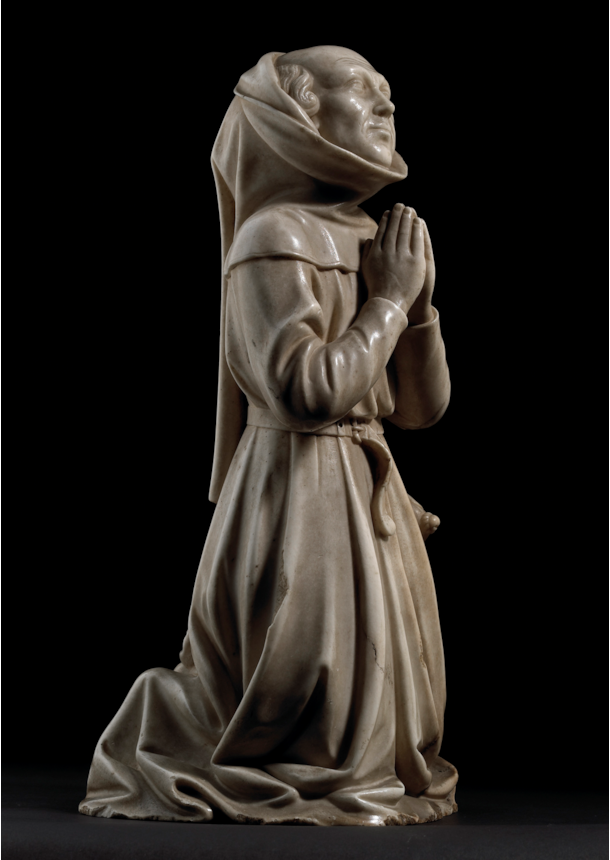
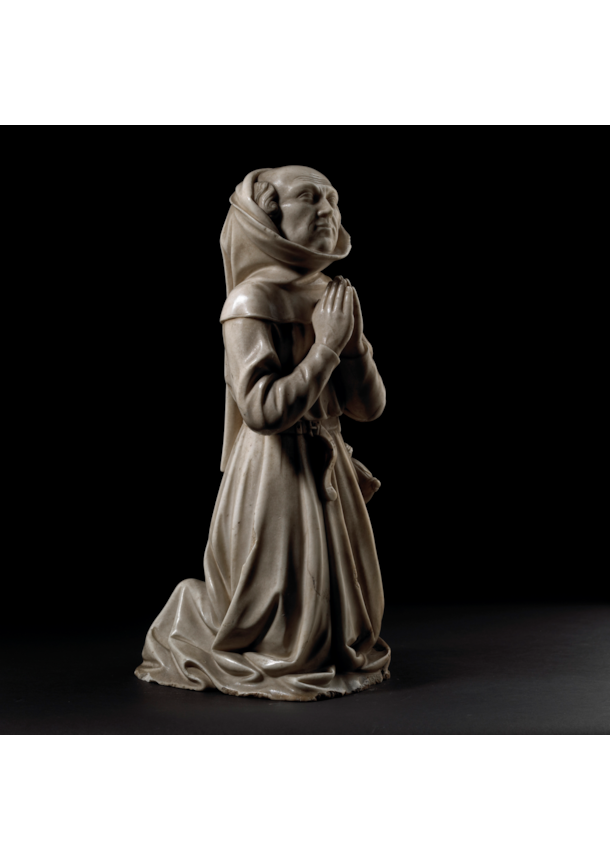
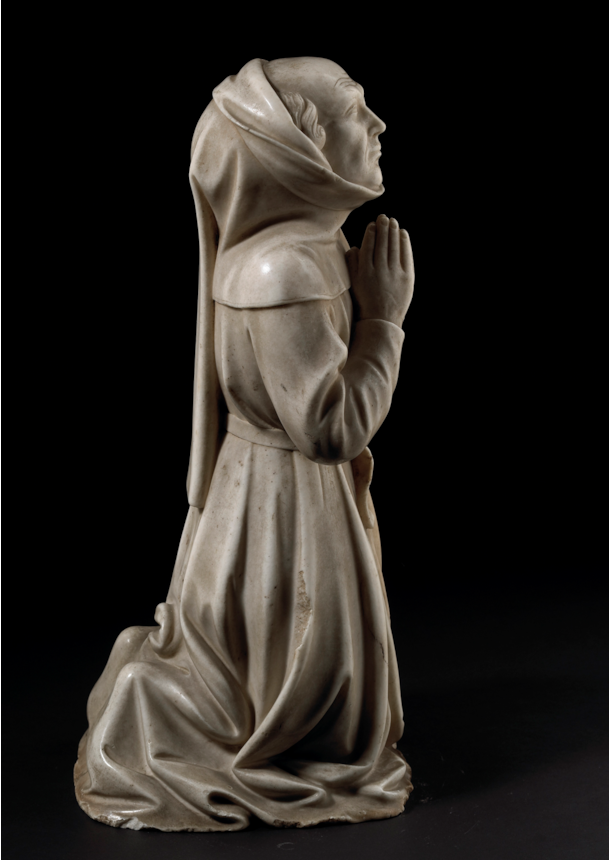
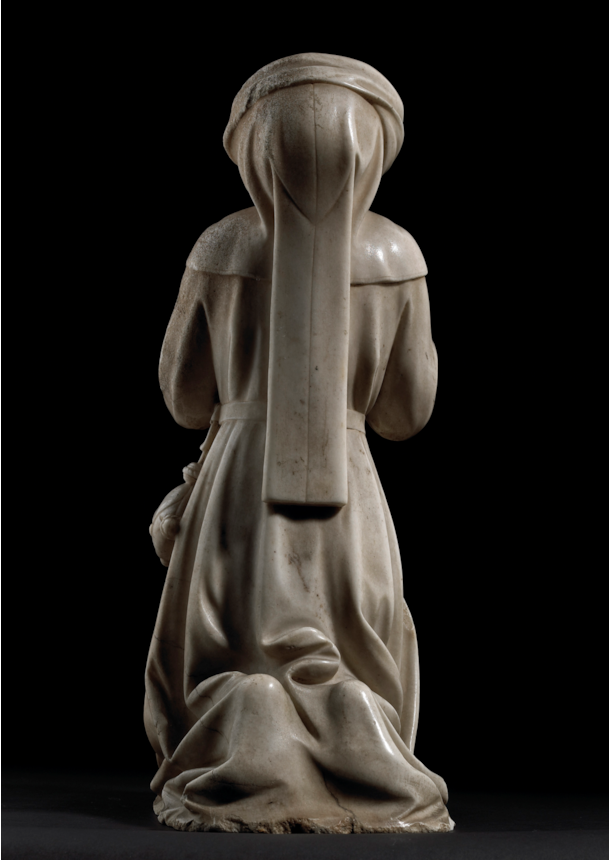
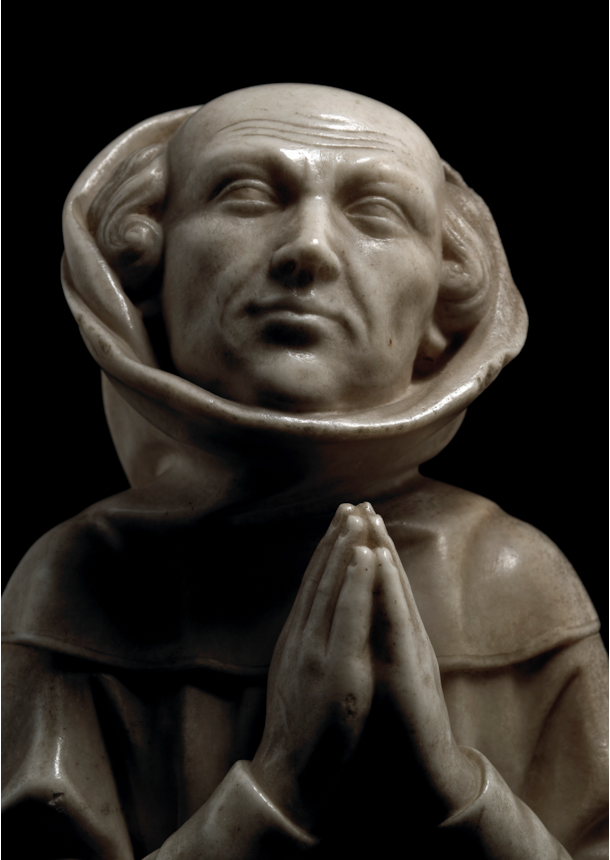
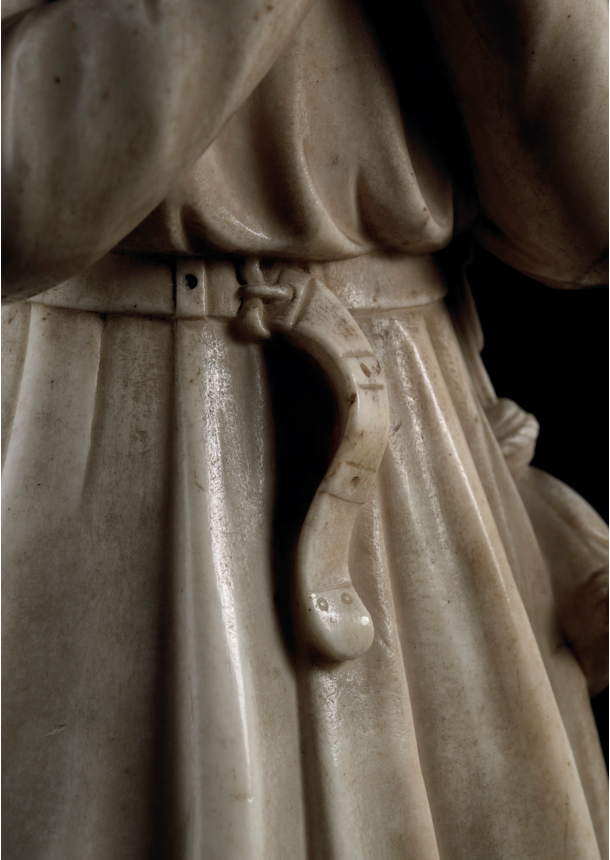
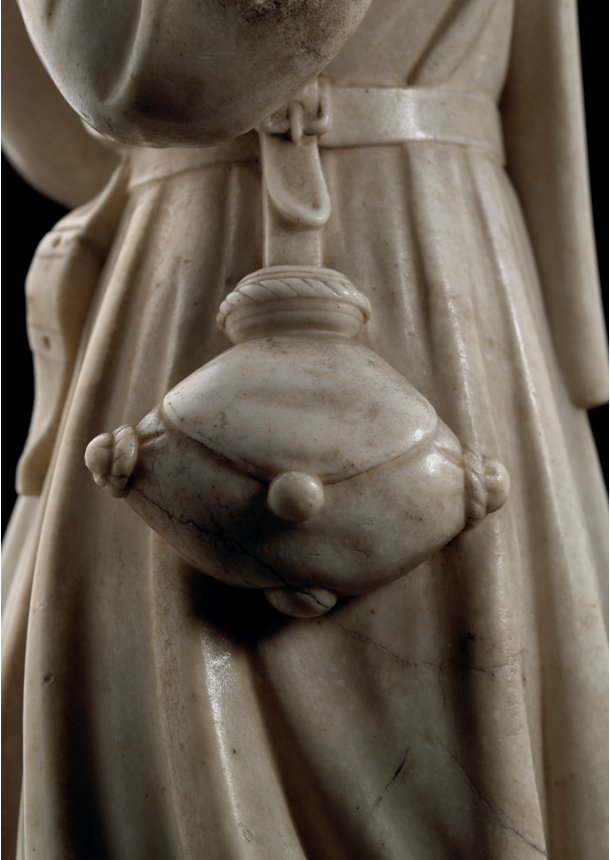
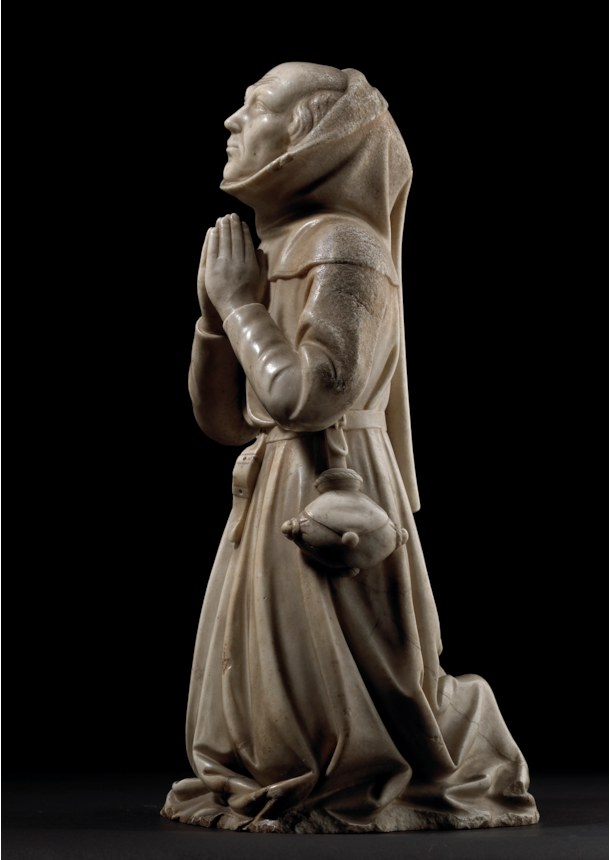
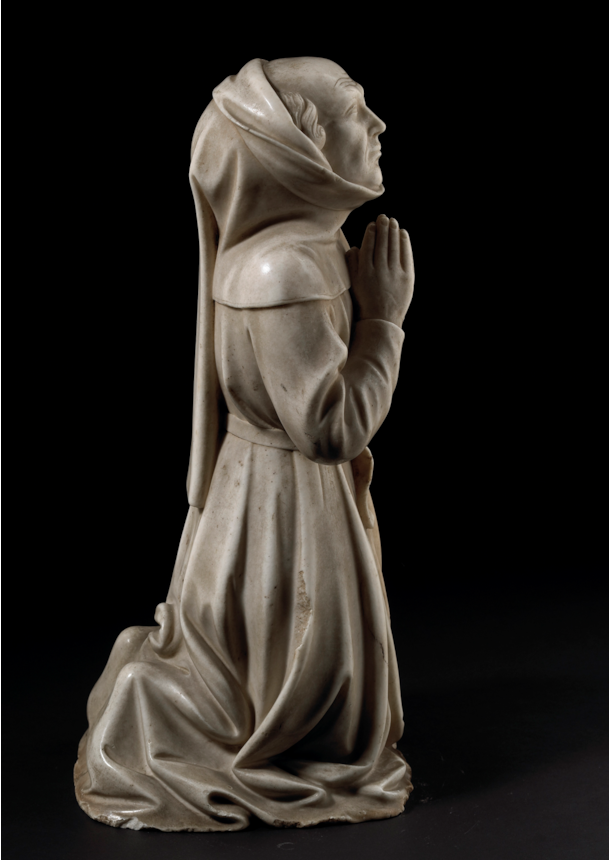
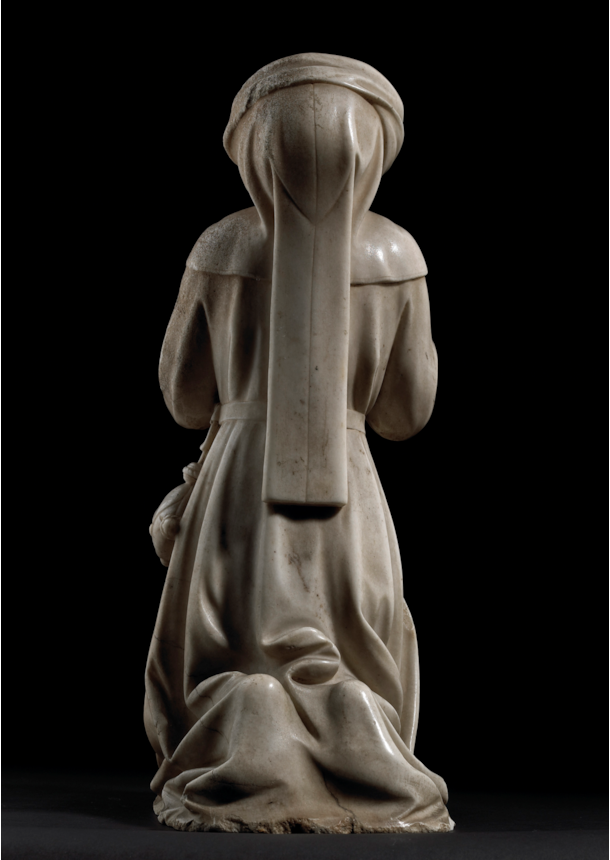
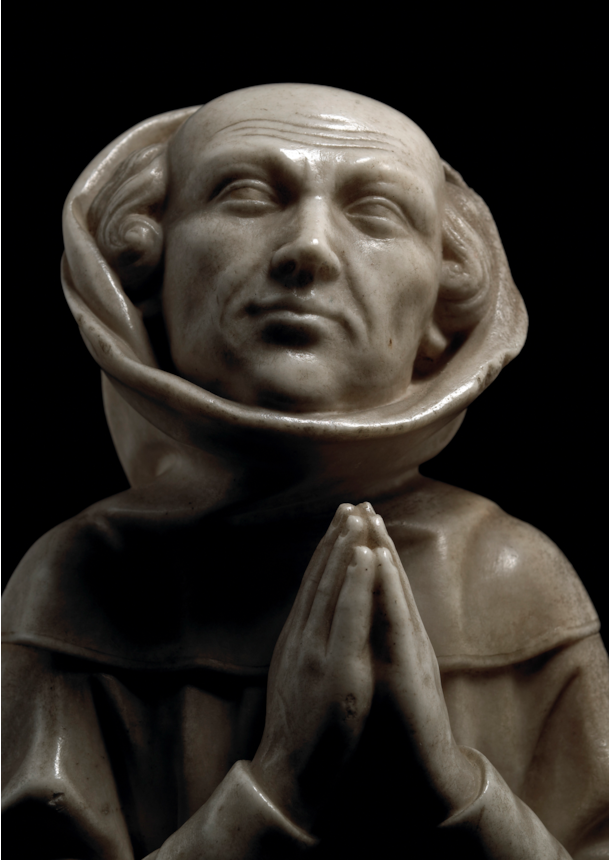
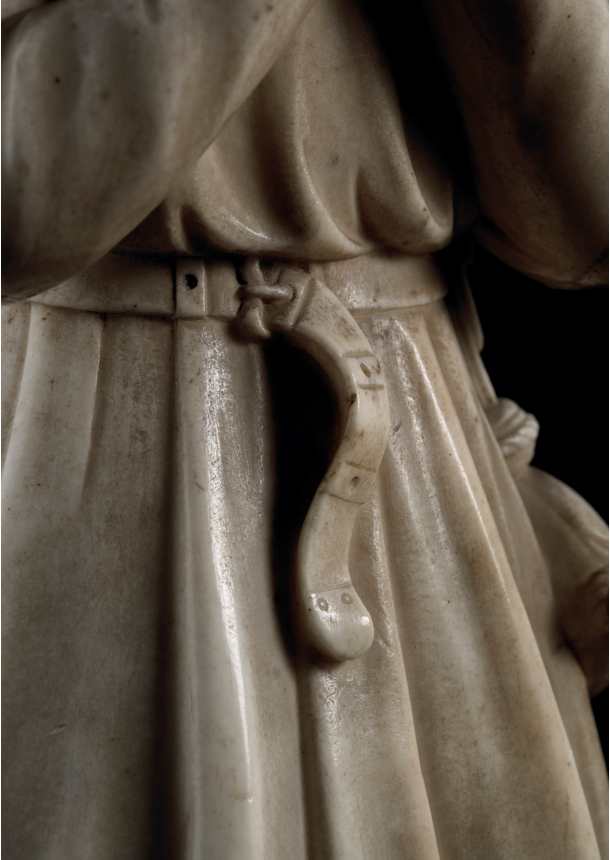
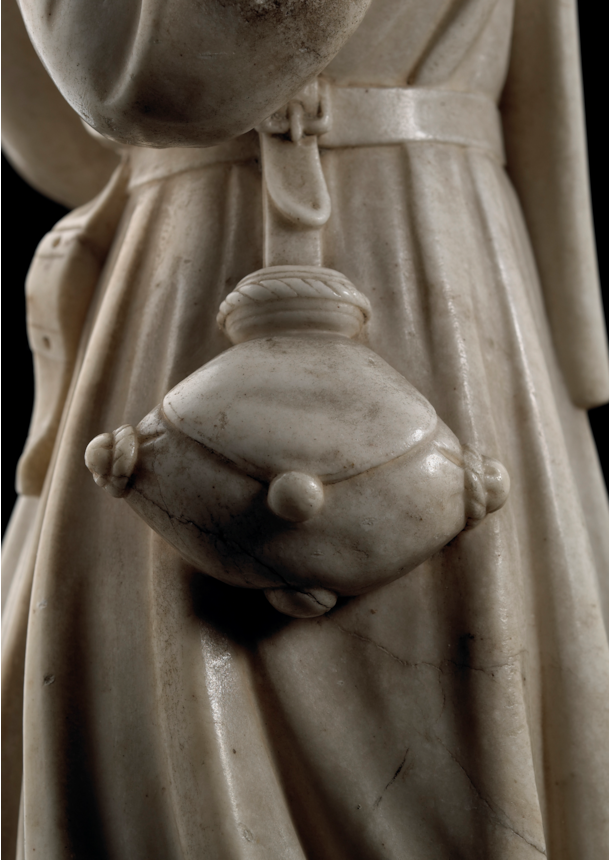
Our marble sculpture is carved fully in the round, indicating that it was likely intended to be viewed from multiple angles and most probably displayed from its dexter side, thereby revealing the alms purse (aumônière). The figure is solemn, almost liturgical in character, typical of late medieval sculptures intended for sacred spaces. It represents a kneeling layman; his hands joined in an attitude of fervent prayer. The figure wears a mantle with a long chaperon, fastened at the waist with a belt from which an alms purse is suspended.
In the medieval period, alms purses or pouches (small bags worn on the body) were essential everyday objects, serving practical, social, and symbolic functions. Medieval garments did not include pockets; purses were therefore used to carry money (coins, deniers, obols), keys, seals, small personal objects, and sometimes relics or amulets. Typically attached visibly to the belt as seen in our sculpture they were both functional and conspicuous. Here, the sculptor deliberately emphasized this powerful symbol by rendering the purse in detailed and prominent fashion at the figure’s waist.
Did our sculptor intend to evoke charity, almsgiving, and the tension between earthly wealth and the salvation of the soul? If so, the artist does not glorify money but instead underscores a posture of humility and penitence: the layman acknowledges his social condition while placing himself under the gaze of God. Alternatively, did the sculptor seek to represent the symbol of man’s power? The prominent presence of the purse strongly emphasizes the figure’s function, pride, and prestigious role, perhaps that of an almoner or treasurer to a member of the royal family.
The face, slightly raised, conveys an introspective and meditative expression. Its gravity is restrained, without theatrical emphasis. The heavy eyelids, closed mouth, and subtly modelled cheeks and forehead reflect a psychological refinement characteristic of high-level works intended to endure and to be viewed within institutional settings (chapels, tombs, cloisters). Although the realism of the face is striking with pronounced features, precisely rendered flesh, and unusual strands of hair emerging from beneath the chaperon the identity of the figure remains unknown to this day.
The donor’s joined hands are exceptionally well carved. Their delicacy, proportion, and symmetry attest to the skill of a highly skilled master sculptor of the late fourteenth century. The drapery is ample and structured, playing subtly with effects of transparency, with deep folds cascading to the ground, granting the figure a strong monumental presence despite its relatively contained scale.
Our marble sculpture, carved in the round, likely formed part of an altarpiece composition in a chapel or may have been an independent figure originating from a smaller ensemble perhaps positioned beneath a canopy or above a tomb such as the tomb of Enguerrand de Marigny, d. 1315. The donor may have been associated with a central devotional image such as the Virgin and Child or a Crucified Christ, or he may have been represented alone before the relics of Christ’s Passion, as seen in the illumination dated 1370 depicting a detail from the so-called Breviary of Charles V (1364-1380), King of France, shown kneeling before the relics of the Passion.
Sources of Inspiration (depictions of figures kneeling in prayer in pictorial art)
When examining the work of Guillaume de Machaut (1300-1377), the fourteenth century French poet and composer, and more specifically the manuscript illuminations produced by Parisian or Champenois workshops in the mid-fourteenth century, one gains a vivid insight into the society and lifestyle of the period. The illuminations of the fourteenth century frequently depicts patrons and donors kneeling in prayer, sometimes accompanied by a purse, sometimes not.
The artist who created our donor figure almost certainly had access to such works and may have drawn inspiration from them. It is worth recalling that artists of this period were highly mobile and often worked together within the same workshops, facilitating the circulation of models, motifs, and stylistic ideas.
Another manuscript produced for Cardinal Pierre du Luxembourg in the last third of the fourteenth century shows the Cardinal kneeling with his hands in prayer before the Virgin Mary. Its illuminator has been identified by François Avril as the Master of Charles V's Policratique, a painter active in Paris between 1366 and 1403.
Stylistic similarities can be found in the miniature illustrating Guillaume de Machaut's (1300-1377) narrative poem Le Dit du Vergier, dated around 1380-1395. The kneeling figure is dressed in a cloak cinched at the waist by a belt, with curly hair framing his face and a receding hairline. Is the blue drape around his neck and falling down his back a long hood like that of our donor? Born around 1300 in Champagne, Machaut was secretary and then clerk to John of Luxembourg, King of Bohemia. After the latter's death at the Battle of Crécy (1346), he enjoyed the support of several princely patrons, notably Charles V.
Close stylistic similarities and the presence of a purse can also be seen in the illumination on the frontispiece of Book I of the manuscript Le Mare historiarum, commissioned by Guillaume Jouvenel des Ursins and painted by the Master of Jouvenel and his workshop between 1447 and 1455. The frontispiece shows Guillaume Jouvenel des Ursins praying twice, the first time on the left, as Chancellor of France from 1447 to 1472, and the second time as a knight, descendant of the Roman Orsini family.
Finally, in Hans Memling's painting The Virgin and Child with Saint Anthony the Abbot and a Donor, 1472, we see a kneeling donor wearing a long coat and carrying a purse similar to that of our donor. As mentioned above, the donor is always depicted on the privileged side, which is his left side.
Artistic Milieu - Comparisons
While a few sculptors of the thirteenth century are known through signed works, the following century remains largely anonymous despite the considered scale of its production. In the second half of the fourteenth century, however, the situation changed significantly: artists’ names began to emerge and, north of the Alps, strong artistic personalities came to prominence. Their careers were closely linked to powerful princely patrons who played a decisive role in the development of monumental sculpture.
Funerary art, charged with political and dynastic significance, became one of the principal fields of artistic investment for these rulers. Concerned with affirming their memory and legitimacy, they secured the services of the most accomplished artists of their time. At St. Vitus Cathedral, Prague, the effigies of the Přemyslid dynasty illustrate the close relationship between Emperor Charles IV and Peter Parler and his workshop.
Similarly, at the French court, King Charles V entrusted the execution of funerary monuments for his parents, for Queen Jeanne de Bourbon, for his children, and for himself to sculptors such as André Beauneveu, Jean de Liège, and Jean de Marville. His brothers and relatives adopted similar approaches. The Duke of Berry, Jean de Berry, prepared his burial early on, initially intended for Bourges Cathedral and later transferred to the Sainte-Chapelle of his palace. He commissioned the architects Drouet de Dammartin and Guy de Dammartin, as well as the sculptors Jean Collet and Jean de Cambrai. As for the Duke of Burgundy, Philip the Bold, nephew of Charles IV and brother of Charles V, he decided in 1381 to erect his tomb and, in his 1386 testament, designated the church of the Chartreuse de Champmol as his burial place. Our marble sculpture carved fully in the round may be compared with several sculptures and applied figures executed by artists working at the royal court of France between 1350 and 1410, now preserved in museums in France as well as internationally.
Stylistically, our donor figure may first be compared with the three royal kneeling figures in marble from the Île-de-France region, circa 1350, formerly in the Le Breton and J. Pierpont Morgan collections and now preserved at the Metropolitan Museum of Art. These three royal figures, kneeling in prayer, have given rise to several identification hypotheses. Their attribution and dating have also been the subject of debate in recent decades. Recent scholarship generally identifies the crowned couple as King Philip VI of France and Queen Joan of Burgundy, while the uncrowned figure is believed to represent their son, Jean de France, the future Jean II of France. The flat treatment of the reverse suggests that these sculptures were originally integrated into an altarpiece, likely set against a contrasting background and associated with a central devotional image such as the Virgin and Child or Christ.
It is probable that the ensemble was intended for a major liturgical space, possibly the royal Abbey of Jumièges. Beyond their devotional function, these sculptures demonstrate an increasing concern for facial individualization: the king appears marked by the gravity of his office, while the queen, wearing a barbette, is characterized by a more withdrawn and contemplative attitude.
The face of the MET king tends toward a high degree of realism, with detailed wrinkles, pronounced features, and precisely rendered flesh. The modelling of the cheeks is a characteristic that is even more developed and accomplished in our donor.
Perhaps most striking is the resemblance to the depiction of the queen in terms of the modelling and the position of the feet covered by the cloak. The treatment of the folds, the drapery, and the transparency of the feet through the fabric are very similar to the marble figure of the queen in the MET, although it is slightly simpler in attitude. The treatment of the modelling and the position of the hands in prayer are also extremely similar.
We can once again find similarities in the marble figure, which is also in the round of Guy Baudet. Guy Baudet, Bishop of Langres (1336-1338), Duke and Peer of the Realm, was a powerful figure commensurate with the vast extent of his bishopric: southern Champagne and the northeastern marches of Burgundy. In his will, he bequeathed 120 pounds to have “an image of the Virgin in white marble and a small effigy at her feet” made for his cathedral. The work was completed in 1341, on the orders of Philip VI of Valois, for whom Baudet had been chancellor, by the sculptor Evrard d'Orléans, who was active in Paris.
The figure of Guy Baudet (0.63 m) is depicted kneeling in episcopal robes in an attitude of prayer. The effigy, elegant but conventional, is not an individualized portrait. Initially placed in the nave of Langres Cathedral and then under the rood screen, the statues were separated during the Revolution. The Virgin returned to the cathedral, while the statue of the donor did not rejoin it until the end of the nineteenth century. Since 1972, the group has been installed on the altar of the baptismal chapel.
It is probable that our donor was part of a composition for a chapel altar, as seen in the marble sculpture of Landres to the left of the Virgin. Or was it a figure like the fragment of the altarpiece of the high altar of the Cistercian abbey church of Maubuisson, executed around 1340 at the expense of Queen Jeanne d'Evreux?
Our sculpture is also similar in composition and modelling to two marble statuettes dating from around 1380-1400 depicting Carthusian monks, now in the Cleveland Museum of Art. The same smoothness and suppleness can be seen in the rendering of the habit, the drapery, the folds, and the accessories as in our sculpture. The Carthusian order, founded by Saint Bruno in 1084, advocated a contemplative life based on silence, prayer, and isolation. These figures are not portraits, but idealized representations of monastic devotion.
They were probably intended to frame a central element that has since disappeared, perhaps a crucified Christ, a Calvary, or a Virgin and Child, and were designed to be placed against a wall or integrated into an altarpiece. Although their connection to a Carthusian monastery is certain, their exact provenance remains a matter of debate. After belonging to the Micheli collection in the nineteenth century, they were associated with the Chartreuse de Champmol, a hypothesis now widely accepted by researchers, although not fully proven.
The accession of Charles V (r. 1364-1380) marks a decisive stage in the artistic development of the French kingdom, particularly in the pursuit of heightened realism in sculpture. The revival of sculpted portraiture constitutes one of the most significant phenomena of this period. This desire for stylistic renewal is especially evident in the recumbent effigies of members of the royal family and their entourage, most of which are preserved in the royal necropolis at Basilica of Saint-Denis.
A new generation of artists from Paris and the northern regions was summoned to court, bringing unprecedented dynamism to monumental production. Foremost among them was André Beauneveu (active 1361-1402), whom Charles V commissioned in 1364 to execute his own tomb as well as those of his predecessors: his father, John II of France, and his grandparents, Philip VI of France and Joan of Burgundy, for Saint-Denis. The effigy of Charles V represents the first royal portrait executed from the likeness of the living king. A clear intention toward realism is evident: individualized physiognomy, precise modelling,
accentuated volumes, and more natural treatment of drapery. A new sensitivity emerges in the balanced composition and corporeal presence of the figure.
Attribution during this phase of Beauneveu’s career remains complex, as he worked concurrently in the service of Charles V alongside Jean de Liège. The problem becomes no simpler after 1386, when Beauneveu entered the service of Jean de Berry at Bourges and the ducal château of Mehun-sur-Yèvre, where he worked simultaneously with Jean de Cambrai. Another major sculptor of Charles V’s reign was Jean de Liège. In 1368, the king entrusted him with the execution of his funerary monument intended for Rouen; in 1370, he received the commission for the tombs of Jeanne d'Évreux and Charles IV of France for the Abbey of Maubuisson (now preserved at the Louvre). He also produced the tombs of Blanche de France and her sister Marie.
Head of an important marble workshop, Jean de Liège exercised lasting influence through his collaborators and pupils. Among them was Robert Loisel, notably responsible for the tomb of Bertrand du Guesclin at Saint-Denis, and possibly that of Thomas le Tourneur, a senior royal official under Charles V. Jean de Liège maintained close relations with court circles and appears to have been particularly connected to Hugues Boileau, a key administrative and religious figure within Charles V’s entourage. These networks illustrate the close interweaving of artistic creation, royal administration, and dynastic affirmation at the end of the fourteenth century.
Jean de Cambrai (documented 1375-1438) was amongst the earliest sculptors to work on ducal tombs. First recorded in 1375-1376 under the name Jean de Rouppi as a ‘tailleur de pierre franque’ for the campanile of Cambrai Cathedral, he appears in 1386-1387 as ‘Jean de Ruppy de Cambrai,’ ‘imagier’ to the Duke of Berry at Bourges, receiving fifteen francs per month (a considerable salary), reflecting his established position. In 1401-1402 he was elevated to the rank of valet de chambre to the duke, and on 19 January 1403 Charles VI of France likewise granted him the title of valet de chambre and awarded him the Order of the Broom Pod (Cosse de Genêt). After this royal letter of 1403, documentation falls silent until his death in 1438. One
inevitably recalls the celebrated mourning figure (pleurant) carved by Jean de Cambrai in the first third of the fifteenth century for the tomb of Jean de Berry at the Sainte-Chapelle of Bourges (commissioned 1403), recently acquired by the Louvre.
Hugues Boileau (c. 1331-1392), originally from Vézelay in the diocese of Autun, belonged to a family already connected to the court. Before entering royal service, he served Jeanne d'Évreux, widow of Charles IV. Charles V appointed him executor of his will in October 1374. Boileau became a specialist in princely testamentary affairs and continued to serve numerous aristocratic patrons after the king’s death, including Jean de Liège himself. His career highlights the essential role of university-trained clerics in the legal, financial, and memorial administration of late fourteenth century elite.
Although difficult to demonstrate, the idea tentatively proposed by Professor Susie Nash that our sculpture might represent Hugues Boileau or even another member of the lay elite within the entourage of Charles V is plausible and compelling. At the time of Jean de Liège’s death, Boileau was in possession of a purse containing a sum of money belonging to the sculptor, under circumstances that remain unclear. His institutional role and proximity to the ruling circles thus placed him in a strategic position at court. In this light, the depiction of a purse may carry symbolic significance: it could function as the emblem of his office and authority, uniting his two most prestigious roles, almoner and treasurer. The personal and professional
relationships that linked these leading figures with artists at the end of the fourteenth century therefore allow our sculpture to be situated in close proximity to those commissioned by Charles V, such as works by André Beauneveu, Jean de Liège, Robert Loisel or Jean de Cambrai. Such an interpretation, while hypothetical, aligns coherently with the artistic and institutional context of the late fourteenth century.
It is important to recall that Philippe le Hardi (1342–1404) and his son Jean sans Peur (1371- 1419) transformed the Burgundian court into one of the leading centres of artistic patronage in Europe. Their wealth and political authority attracted artists and craftsmen, fostering exceptional artistic production across multiple fields painting, sculpture, manuscript illumination, goldsmith’s work, and architecture. For the execution of their tombs, they called upon the most accomplished imagiers of their time.
Philippe II of Burgundy, known as Philip the Bold, son of Jean II le Bon, received the Duchy of Burgundy in 1363 and became one of the most powerful princes in the kingdom through his marriage to Marguerite III de Flandre. A major patron, like his brothers Charles V, Louis I d'Anjou, and Jean de Berry, he commissioned in 1381 his alabaster tomb for the Chartreuse de Champmol in Dijon, an emblematic monument of late fourteenth century funerary art. In 1381, Philip entrusted the project to Jean de Marville, who had previously worked on the tomb of the heart of Charles V at Rouen under the direction of Jean de Liège in 1369. Marville began the initial sculptural work in 1384. Upon his death in 1389, he was succeeded by Claus Sluter, who created, among other elements, the celebrated mourners (pleurants) and the Well of Moses. After the duke’s death in 1404, Claus de Werve completed the tomb, carving the recumbent effigy, angels, and additional mourners, while Jean Malouel enriched the ensemble with polychromy and gilding. Installed in 1410 in the choir of the church, the monument epitomizes the refinement and realism characteristic of the International Gothic style. The mantle, belt, and the large, draped fold falling from the back of the long chaperon in our donor figure find close parallels in certain of the mourners from this ducal tomb.
Would it be too speculative to suggest that the sculptor of our marble may have been among the artists involved at least in the early phases of Philip the Bold’s tomb? Likewise, might the sculptors working on that monument have known of, or even drawn inspiration from, our sculpture?
While no documentary evidence allows us to affirm such connections, this hypothesis is not implausible. The artistic networks of the late fourteenth century were highly fluid: sculptors circulated between Paris, Dijon, Bourges, and other major centres, often collaborating within the same workshops or moving between princely patrons. In this context of intense exchange, stylistic correspondences and shared formal solutions could arise from direct contact, workshop models, or the circulation of drawings and sculptural prototypes. Thus, although speculative, the possibility of such artistic proximity remains consistent with the broader dynamics of the period.
Finally, our sculpture can also be compared in terms of composition, modelling, and the presence of a belt and purse to a stone sculpture (45 cm), probably from Burgundy, dating from the fifteenth century and nicknamed ‘Le Bourgeois’ (The Bourgeois), kept at the Petit Palais, Musée des Beaux-Arts de la Ville de Paris, (PPS2387).
Conclusion
The sculpture presented here is fully in line with the aesthetics of the International Gothic, characterized by an increased focus on naturalism and inner expressiveness. The facial features, marked by gentleness and restraint, reflect a search for measured individualization. The treatment of the costume and accessories, clearly observed with precision, reveals the hand of a highly skilled marble sculptor. The care taken with the hands and drapery, as well as the overall balance of the composition, testify to the high quality of its execution. The face, individualized without excessive idealization, suggests a possible commemorative function, in line with the princely effigies produced around 1380-1400.
Although the identity of the figure depicted and that of the sculptor cannot be established with certainty at this time, stylistic analysis nevertheless allows us to link the work to the circle of artists active in the service of Charles V and his successors. The figure of the donor or chaplain, close to the great princely patrons, fits into a context in which the representation of the secular elite underwent a significant renewal and exerted a lasting influence at the beginning of the fifteenth century. The work does not emphasize holiness or ostentation but embodies a new figure: that of a layman aware of his social position and spiritual responsibility, asserting his role at court while showing humility before God.
Its prestigious provenance, documented from the early twentieth century, the quality of its execution, the consistency of its formal language, along with its excellent state of preservation, give it definitive high status. It is a significant testimony to Western spirituality and sculpture of the International Gothic period and its appearance on the art market is therefore a major event for historians, collectors, and specialists.
Provenance
Our marble figure was part of the collection of Dr. Friedrich Lippmann (1838-1903). Born in Prague, Czech Republic, into a wealthy family of industrialists, he studied fine arts and technology in Vienna, then worked at the Austrian Museum. He created a group of art historians, following a methodical approach, to examine two variants of Hans Holbein's Madonna and determine which was authentic. In 1876, he was appointed director of the Kupferstichkabinett (print room) in Berlin. He was a highly cultured man and published numerous works, but he is best known for his work on Dürer, Holbein, and fifteenth century Italian woodcuts. Lippmann acquired our sculpture before 1903 and sold it to the French antiquarian Fernand Robert. It is also interesting to note that Fernand Robert was the advisor to the great American collector and patron Isabella Stewart Gardner (1840-1924) and purchased works of art on her behalf in France
William Waldorf Astor (1848-1919) inherited a considerable fortune upon his father's death in early 1890, making him the wealthiest American citizen of his time. Deeply disillusioned with his country, which he considered ‘no longer a suitable place for a gentleman to live,’ he moved to England in 1891, taking with him a fortune estimated at nearly $100 million. He acquired Hever Castle in 1903 and between 1903 and 1908, Astor undertook a vast restoration campaign of the castle, had the Astor Wing built, and landscaped the lake and gardens. It was during this extensive restoration campaign that he acquired the donor shown here on December 7, 1906, from the French antique dealer and advisor Fernand Robert at 30 rue Joubert, Paris, as attested by the invoice illustrated here.
Upon William Waldorf Astor's death in 1919, the castle passed to his son, John Jacob Astor, 1st Baron Astor of Hever. Our sculpture is mentioned in the 1919 insurance inventory on page 58 (50. 0. 0. An Alabaster Statuette of a Monk, wearing gown and cowl and kneeling in prayer – 16th century).
In the early 1960s, Gavin Astor (1926–1984), 2nd Baron Astor of Hever, set out to preserve the integrity of a collection comprising medieval and Renaissance sculptures, ancient architectural elements, furniture, and objets d'art, while adapting its presentation to gradually open it up to the public. As the heir to an already established collection, he did not limit himself to ensuring its conservation: he rethought its presentation and accessibility in the renewed context of the twentieth century. A leading figure in British cultural patronage, as well as a musician and publisher, he played an active role in several artistic institutions, notably as president of the Royal College of Music.
The opening of the castle in 1963 marked a key milestone: Gavin Astor decided to share his exceptional private heritage by organizing visitor traffic around the works, contextualizing the sculptures, and highlighting their provenance and artistic quality. This approach demonstrated a genuine awareness of heritage at a time when many aristocratic collections were still largely closed to the public.
Faced with growing economic constraints, Gavin Astor also strove to protect the coherence of the collection, avoiding its dispersion as much as possible. Despite opening it to the public, the increase in maintenance costs, exacerbated by the floods of 1968, permanently weakened the estate's financial situation. This situation led to the sale of the castle in 1983, to John Guthrie, and its collections were also sold through several sales at Christie's and Sotheby's. Our sculpture was rediscovered on the art market on April 21, 1982, during the sale of part of Lord Astor's collection at Christie's, London.
We would like to thank Alison Palmer, curator of Hever Castle, Kent, England, for researching the Astor archives and confirming that our sculpture was acquired by William Waldorf Astor (1848-1919) on December 7, 1906, from the French antique dealer and advisor Fernand Robert in Paris.
Isabelle d’Amécourt, 2026