









Hubert Gerhard (c.1550-1620)
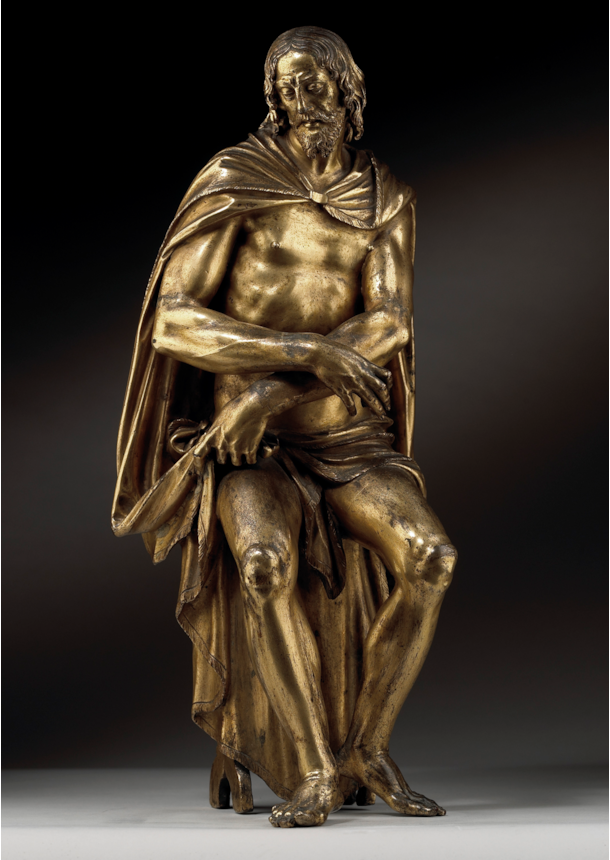
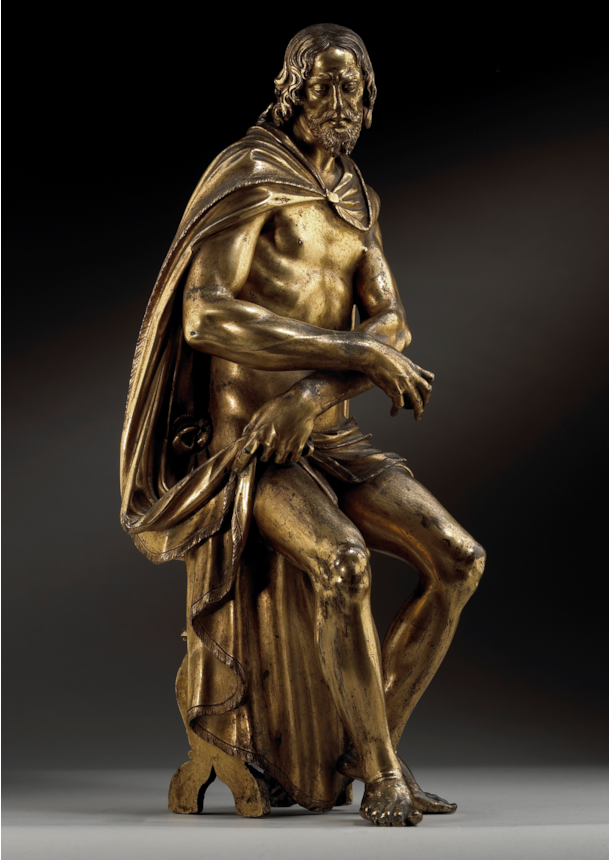
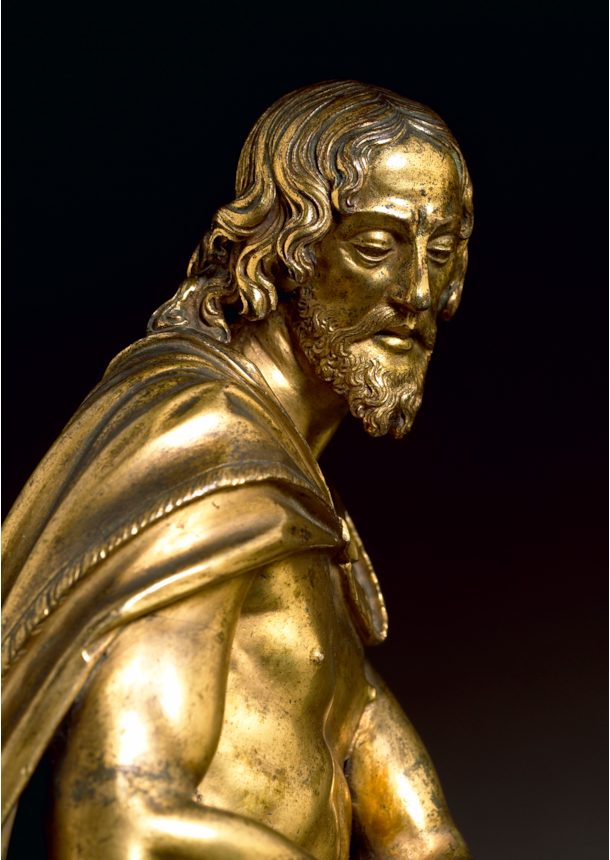
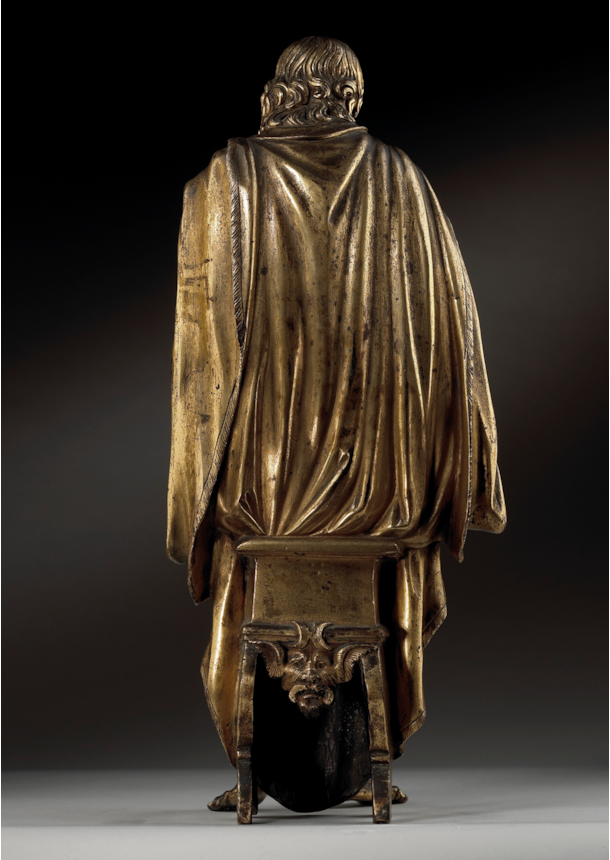
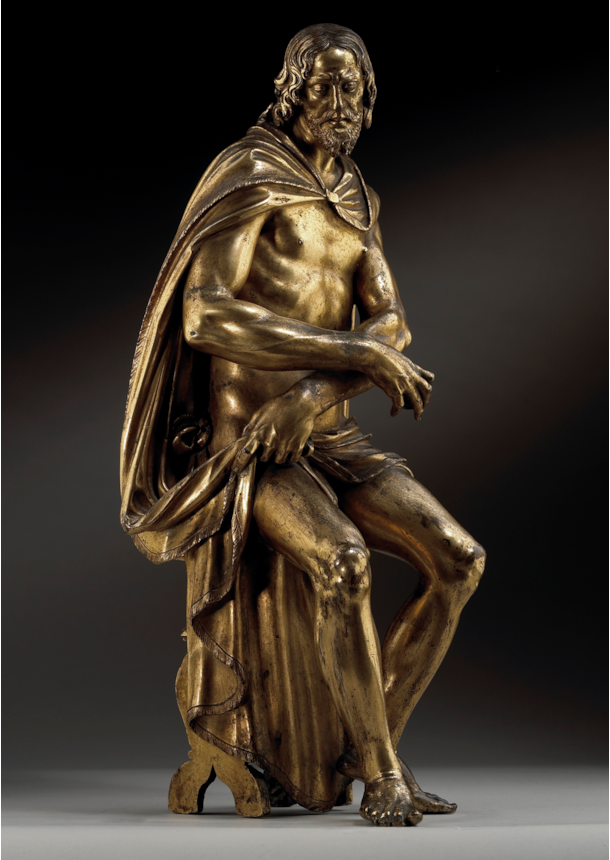
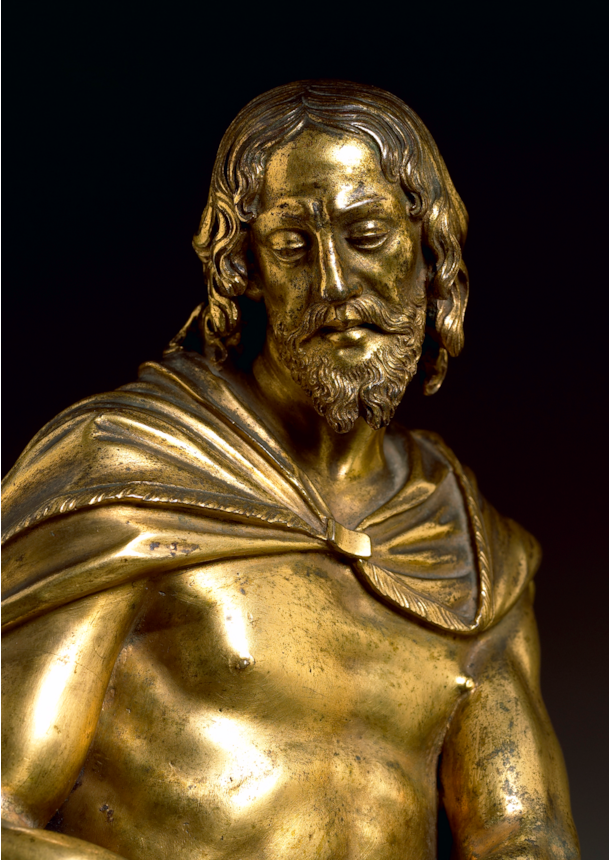
4. Seated Figure of Ecce Homo
Gilt Bronze
40 x 18 cm (15 ¾ x 7 in.)
Private collection, Italy, until 2019


Exh.cat. Bella Figura. Europäische Bronzekunst in Süddeutschland um 1600, ed. Renate Eikelmann, München 2015, p. 296-301.
Sotheby’s London, Old Master Sculpture & Works of Art, 2019, July 2, lot 63.
Arie Pappot, XRF Metal Analyses Report, 22 May 2025.
Cast in several pieces, legs, arms, both hands separately; they are soldered or mechanically connected; the surface is gilded. The scourge, the birch and the crown of thorns are missing. The flagellation tools were fastened to the hand and the cloth with metal pins; the crown left no traces in the hair.
In terms of style and iconography, the Ecce Homo fits perfectly into Hubert Gerhard‘s late sculpture from the years he was employed by Archduke Maximilian III of Habsburg in Mergentheim (Swabia) and Innsbruck, 1599-1613.
Alongside Adriaen de Vries, Gerhard was the most prominent bronze sculptor of the late 16th century in southern Germany. From 1582 to 1599, he was court sculptor to the Bavarian Duke Wilhelm V in Munich and had a profound influence on sculpture at court and far beyond. Gerhard had spent his apprenticeship in his native Netherlands, but moved to Italy at an early age, to the Florentine court where Giambologna was the formative force; he is documented as having worked in Giambologna‘s immediate vicinity. Both influences are reflected in his sculpture: the Dutch art of the later 16th century and Giambologna's highly artificial sculptural design of figures and groups.
After twenty years of service in Munich, Gerhard, then nearly 50 years old, switched to the Habsburg court in 1599, because Wilhelm V had to resign from power due to the impending financial collapse of the state. As a result, all court artists were dismissed. Gerhard was recruited by Archduke Maximilian III, a brother of Emperor Rudolf II, who had fought his way to the dignity of Grand Master of the Teutonic Order after a series of military defeats. Maximilian resided at the headquarters of the Teutonic Order in Mergentheim and moved to Innsbruck in 1602 when he was appointed ruling prince of Tyrol. Gerhard stayed in Innsbruck until 1613 when he returned home to Munich in old age.
During these years, an interesting constellation arose when both Habsburg courts, in Vienna and in Tyrol, employed the two outstanding bronze sculptors in the Germanic Empire who also knew each other rather well from their Florence years. Rudolf II once also gave cause to something like a competition between the two artists. Looking at Gerhard's smaller Ecce Homo, one might wonder whether Adriaen de Vries' large Ecce Homo (Liechtenstein collection), created in 1607 for the Prince of Liechtenstein in Vienna, inspired Rudolf's brother in Innsbruck to commission a bronze sculpture on the same theme; in general, this iconography is not very common in bronze sculpture.
Maximilian III maintained a court befitting his spiritual dignities. Unlike when employed in Bavaria, his court sculptor Gerhard was mostly commissioned to create bronzes with spiritual themes, to furnish altars with bronze and terracotta sculptures, create devotional figures for the private use of the duke and his closest entourage, and finally, to model the duke's large tomb still existent in the parish church at Innsbruck. In any case, it was also only during this late period of his oeuvre that Gerhard received commissions for gilded bronzes; we can conclude this from the two statuettes of a mourning Mary and John from a smaller crucifixion group (private collection, USA), a very small portrait bust of Maximilian III in Vienna and the Ecce Home which is presented here.
Just as the Ecce Homo fits into the iconographic milieu of the spiritual court—Maximilian even had a rustic hermitage built for him personally in a monastery in Innsbruck — it also fits into Hubert Gerhard's stylistic development during his later years. While his earlier sculptures were sometimes wild and expressive in outline, designed to be viewed from a distance, his later spiritual bronzes tended toward a calmer formal language with soft, flowing robes. This development converged with the taste of the time that tended to revert to earlier, late Gothic styles; it found its characteristic expression in the preference of princes like the emperor and Duke Maximilian of Bavaria for Dürer's art.
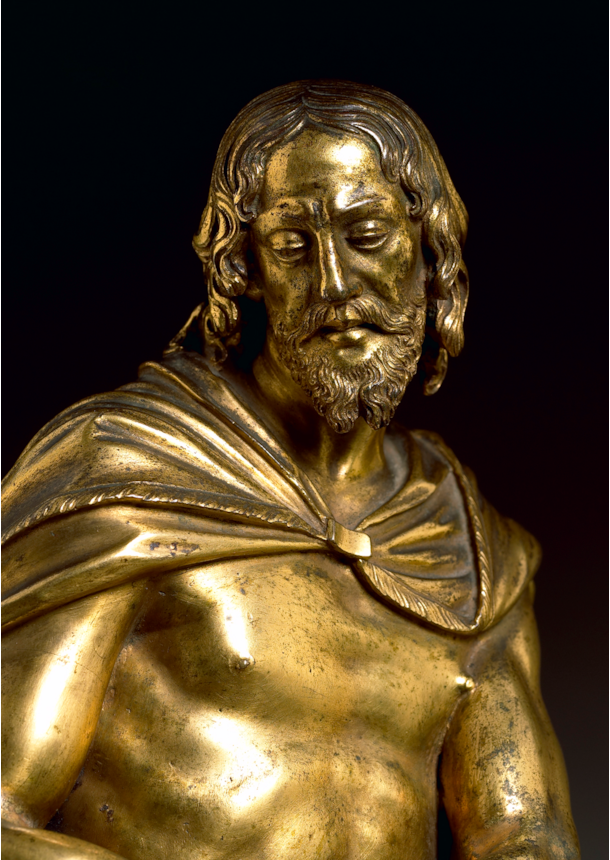
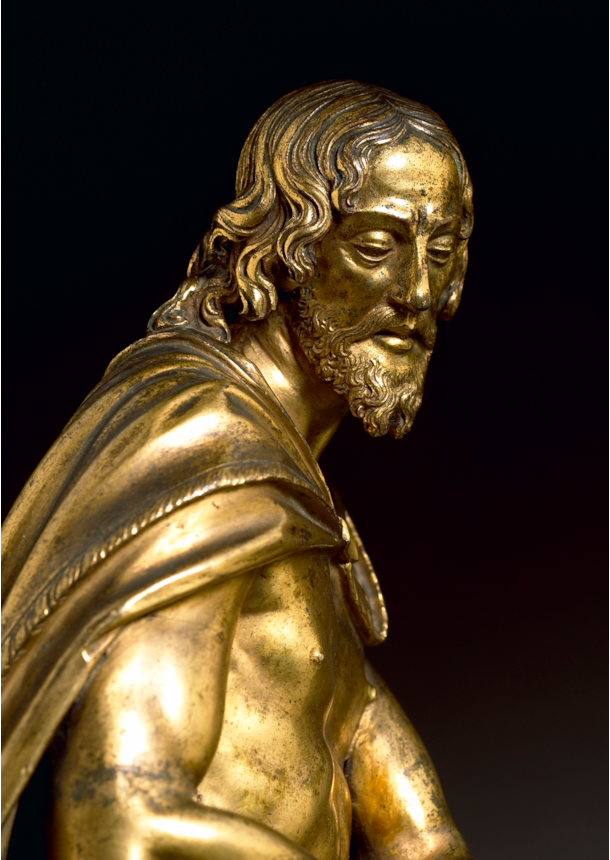
All these tendencies find characteristic expression in the Ecce Homo. The prominent eyelids, the painfully furrowed eyebrows are a stylistic device typically used by Gerhard in his late style, very similar to the recently rediscovered St. Elisabeth for Maximilian's chapel from 1600/1602 in Mergentheim (private collection), as well as in the later Vienna crucifix group (Vienna, Schatzkammer) and the epitaph of the Munich bronze caster Martin Frey (Munich, Frauenkirche). Particularly noteworthy is the rich design of the folds on the back of his cloak: such elaborate drapery is common in Gerhard's late small bronzes such as a small Pietà, or in the aforementioned mourning Mary and John. In Gerhard’s later years, very elongated figures with small heads are to be found as well, e.g., the Madonna from the Mergentheim chapel (Würth Collection, Schwäbisch Hall).
The metallurgical analysis of the Ecce Homo carried out at the Rijksmuseum Amsterdam in the summer of 2025 identified an alloy that is almost identical to that of a small bust of Archduke Maximilian III in Vienna. Other southern German bronzes from the same period also yield similar results. The analysis results strongly support the theory that Ecce Homo was created in the circle of Maximilian III.
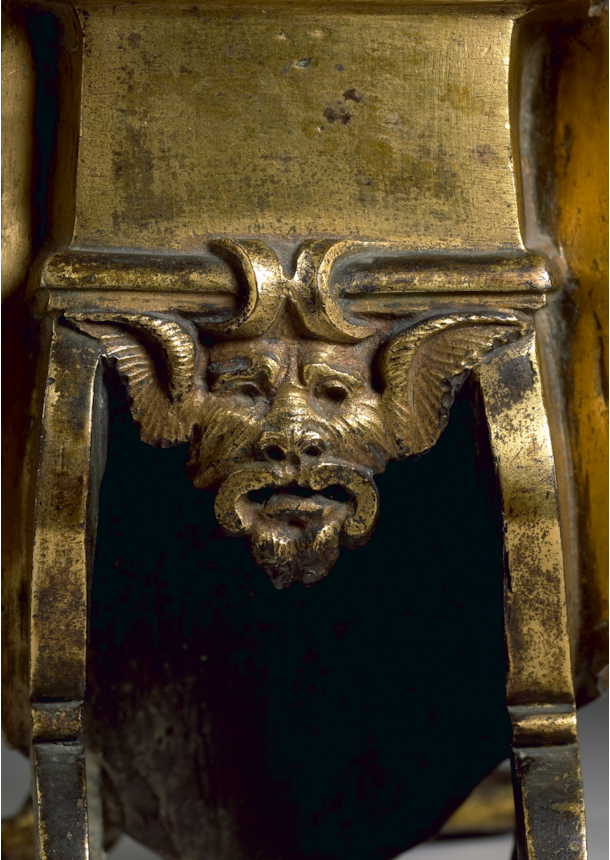
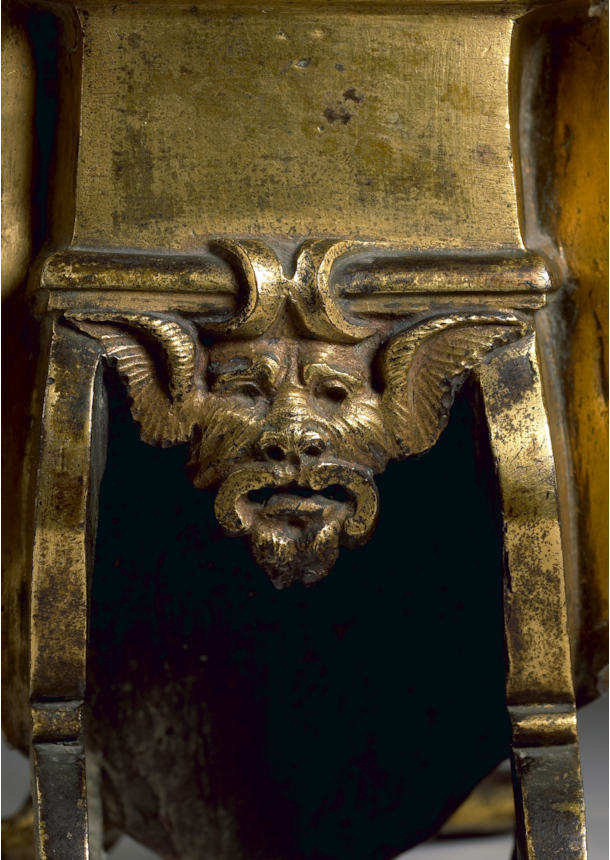
Apparently, it was common practice at the Innsbruck court to cast sculptural models several times. This is evidenced by the aforementioned mourning figures, which have been handed down in the form of gilded bronze and silver statuettes on the tabernacle cross of Innsbruck Cathedral. This might also explain why the Ecce Homo is mechanically assembled from a relatively large number of parts. We don’t know the caster or the goldsmith who were responsible for the casting and chasing of the bronze. The caster evidently had the sculptor's moulds or a prototype of the figure itself at his disposal, whereas there are no direct comparisons for the mask on the back of the scabello. Perhaps the unknown goldsmith chased it according to his own taste.
Most of the small bronze sculptures Gerhard made for Mergentheim and Innsbruck, according to written sources, have been lost. This adds special value to the discovery of the Ecce Homo, as this iconography was previously unknown in Gerhard’s sculptures. The Ecce Homo combines all the characteristics of his late oeuvre: a spiritual theme in a medium size, gilding (which never existed in Munich and was apparently due to the wishes of the client), a nuanced, slightly retrospective drape and an expressive face.
Dorothea Diemer, 2026