





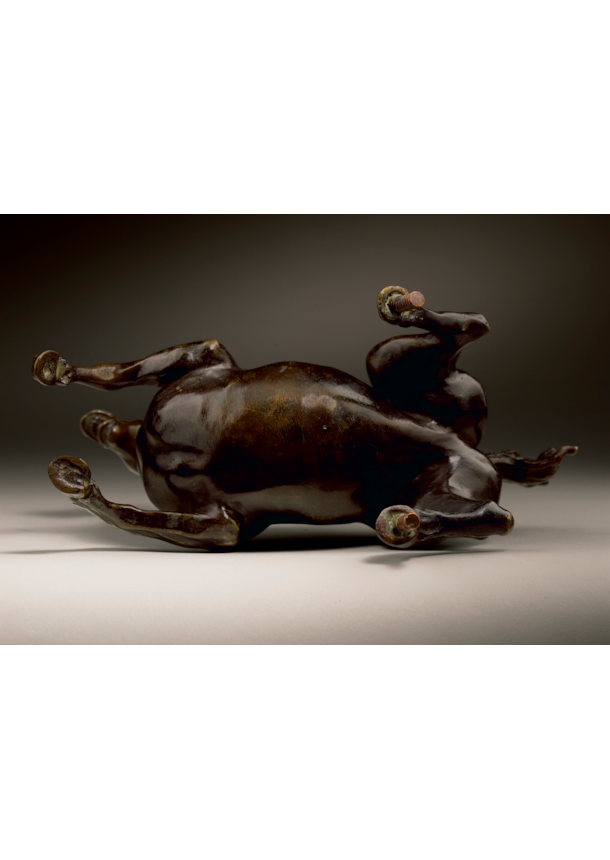



Northern Italy, late 16th century
9. The London Horse
Rearing Horse
Bronze
After a model by Leonardo da Vinci (1452-1519)
23.5 x 27 cm (9 ¼ x 10 ⅝ in)
Pierre Gabriel Jeannerat de Beerski (1902-1983)
Thence by descent until 2019


K. Clark, Leonardo Da Vinci: An Account of His Development as an Artist, Cambridge, 1952.
M. Hall, ‘Reconsiderations of Scvlpture by Leonardo da Vinci,’ in J. B. Speed Art Museum Bulletin XXIX, November 1973, pp. 7-59.
P. Jeannerat, ‘A Newly Discovered Statuette by Leonardo Da Vinci‘, Apollo XIX 114 (June 1934), pp. 312-316.
Z. Karpati, Leonardo Da Vinci and the Budapest Horse and Rider, Budapest, 2019.
Exhibition of Italian Art 1200-1900, Royal Academy, Burlington House, London, January-March 1930, cat. 986, pl. CCXLIV.
Leonardo Da Vinci Quincentenary Exhibition, Royal Academy, London, 1951-1952, cat. 262.
J. Pope-Hennessy, Italian Bronze Statuettes, Victoria and Albert Museum, London, July - October 1961, cat. no. 20, pl. 8.
Glorious Horsemen: Equestrian Art in Europe, 1500 - 1800, Museum of Fine Arts, Springfield, Mass., 1981, p. 90, cat. no. 30.
Profil du Metropolitan Museum of Art de New York, Galerie des Beaux-Arts, Bordeaux, 1981, cat. no. 128.
Exhibited
Royal Academy, London, Leonardo Da Vinci Quincentenary Exhibition, 1951-1952, cat. 262
Victoria & Albert Museum, London, Italian Bronze Statuettes, July – October 1961, cat. 20
Rijksmuseum, Amsterdam, Meesters van het Brons der Italiaanse Renaissance, October 1961 – January 1962, cat. 19, fig. 16 & fig. 17
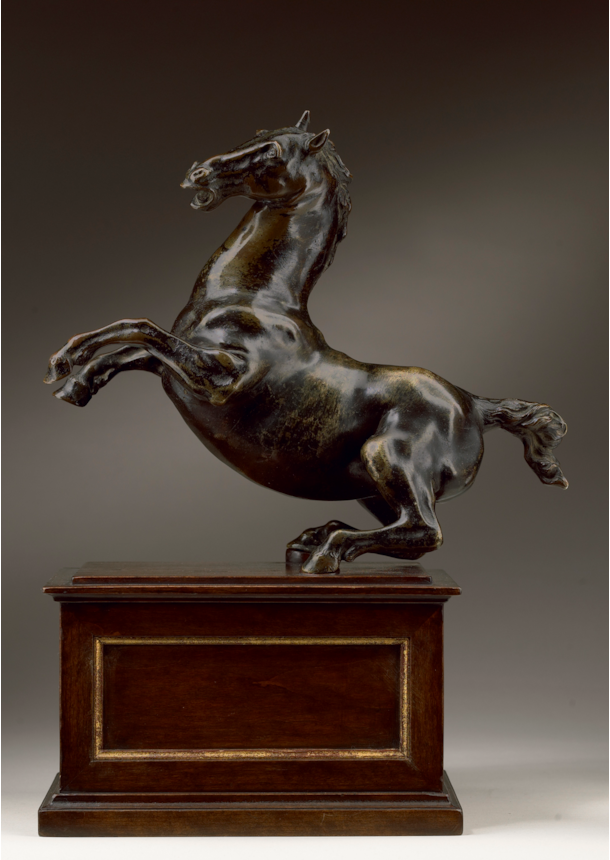
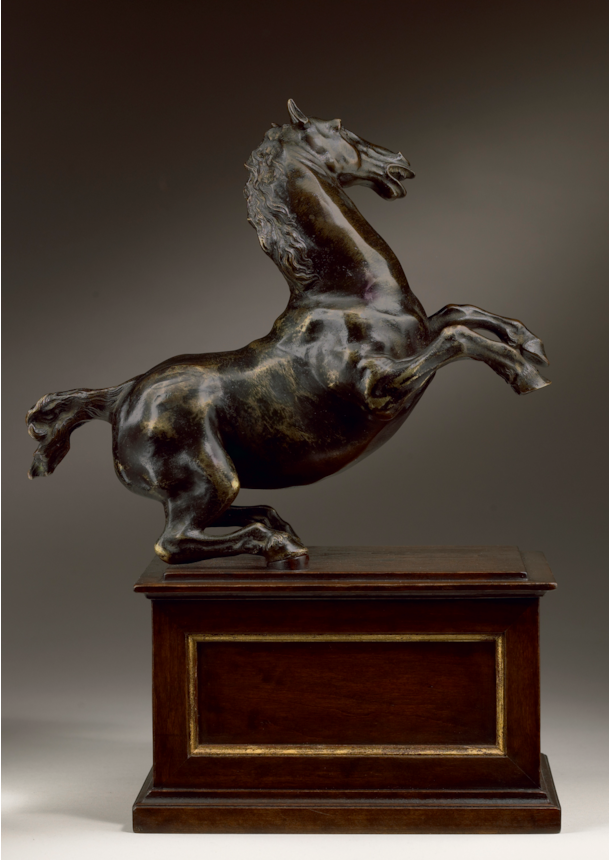
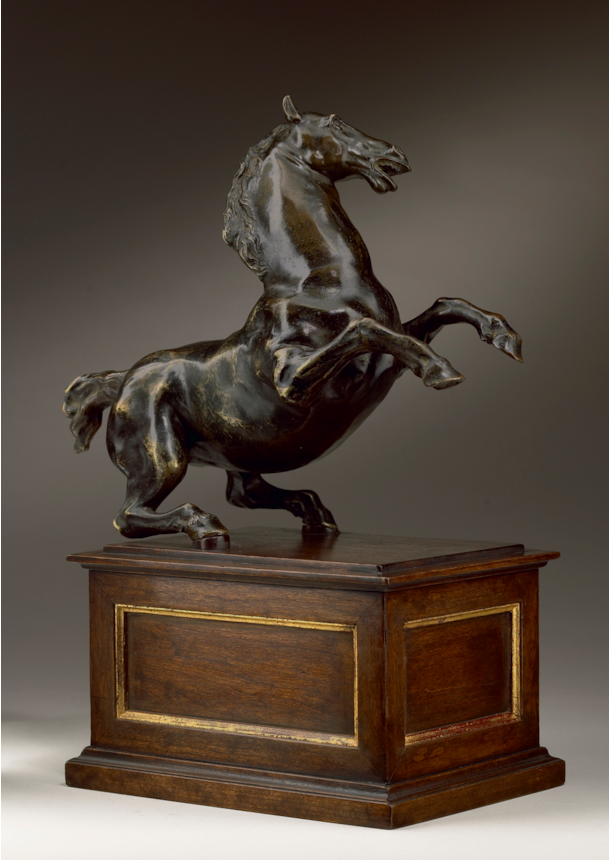
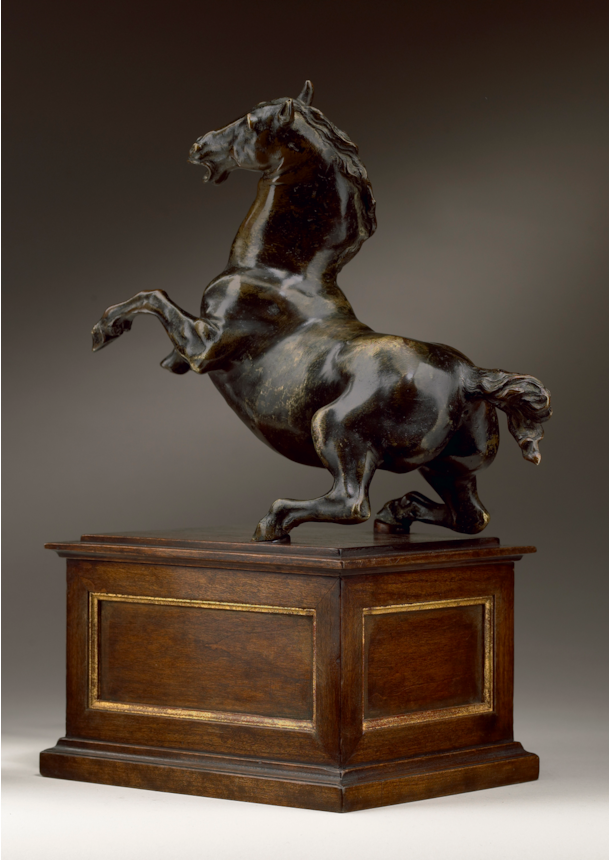
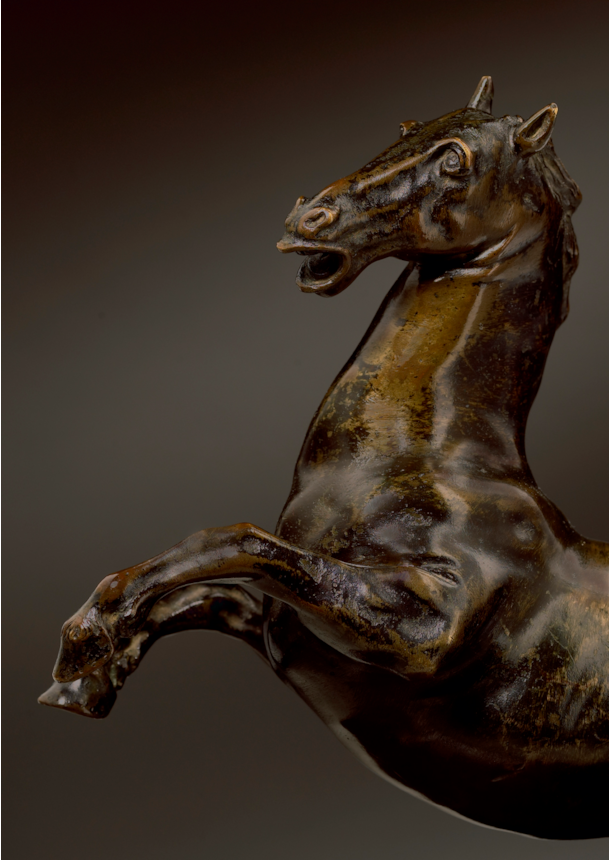
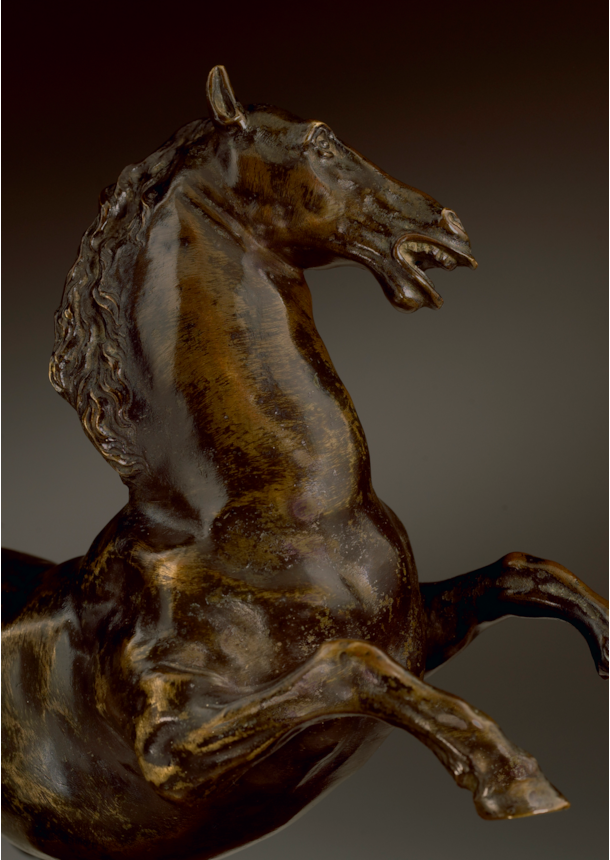
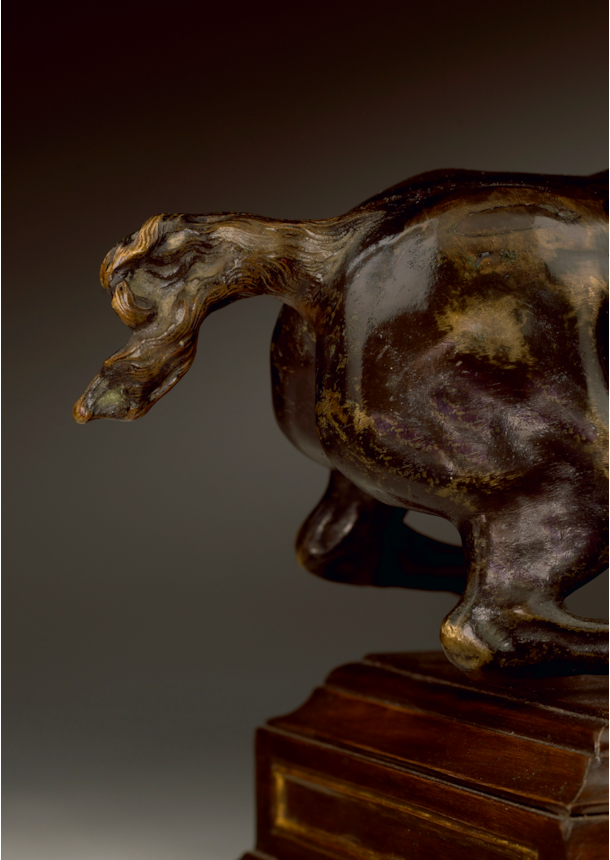
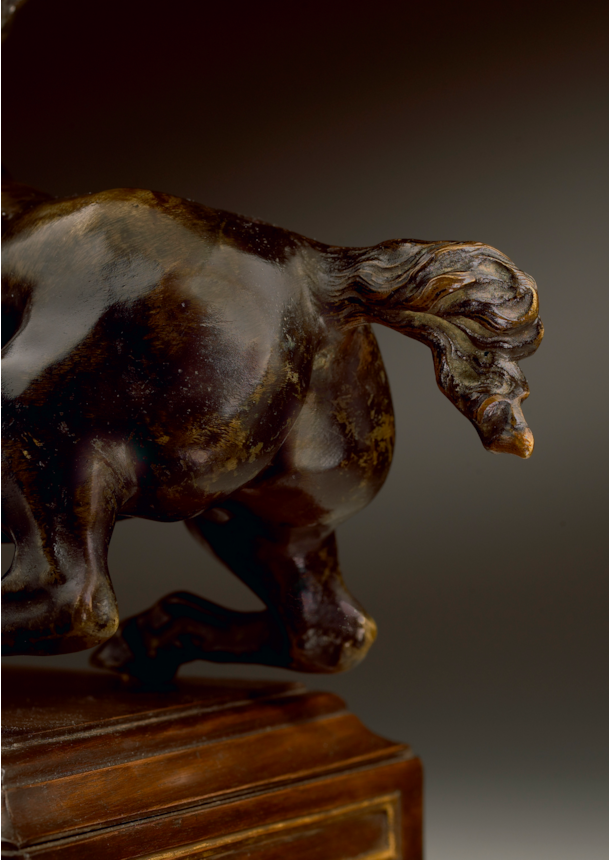
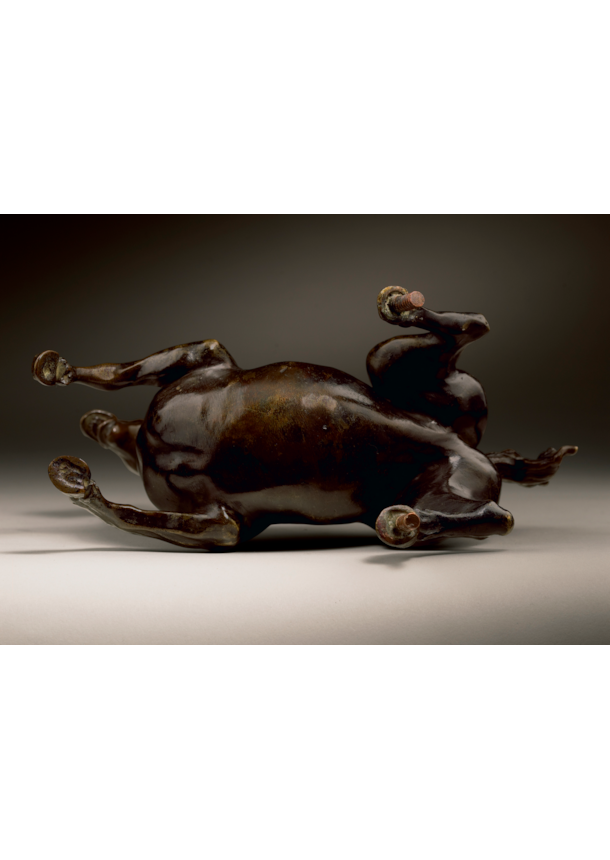
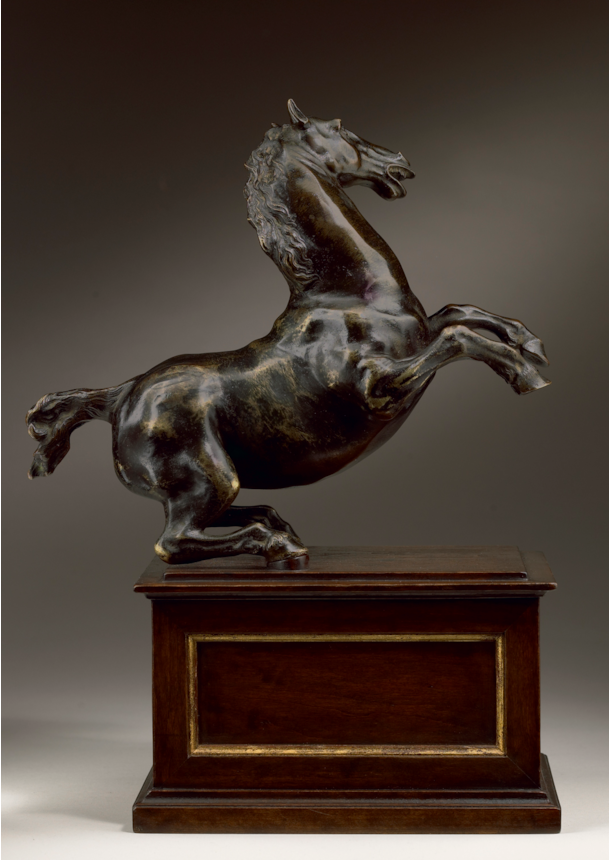
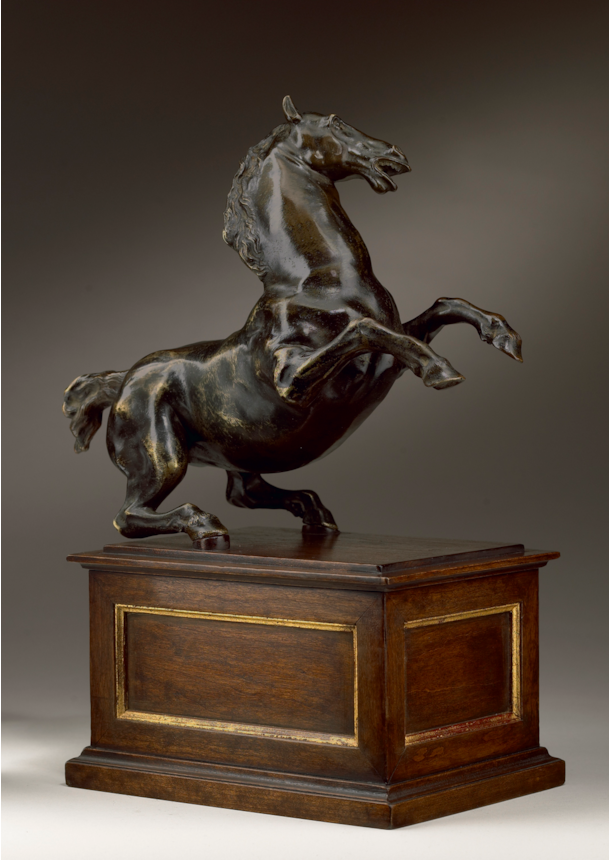
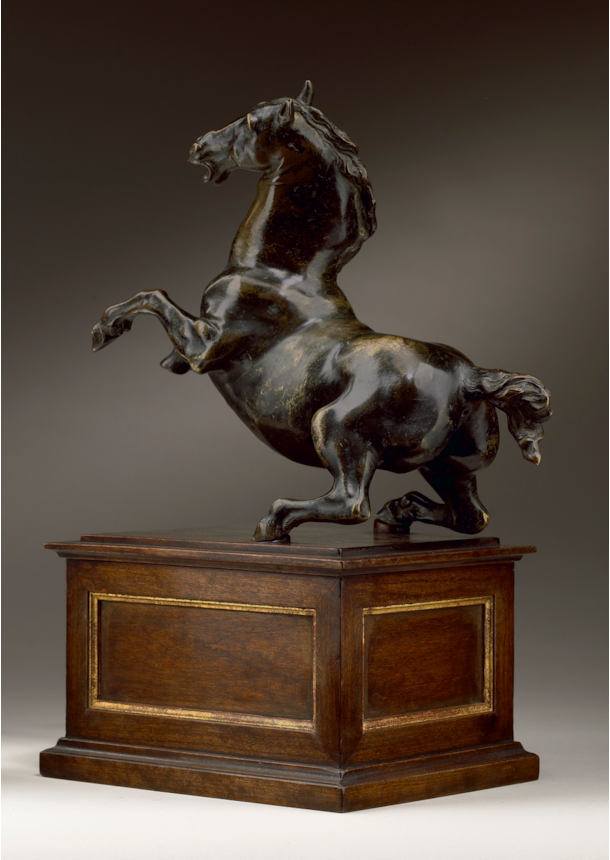
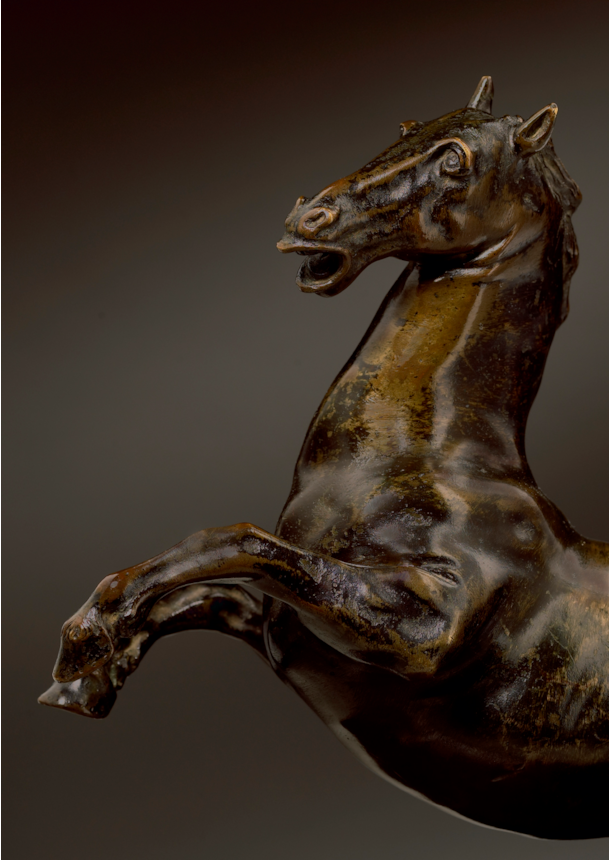
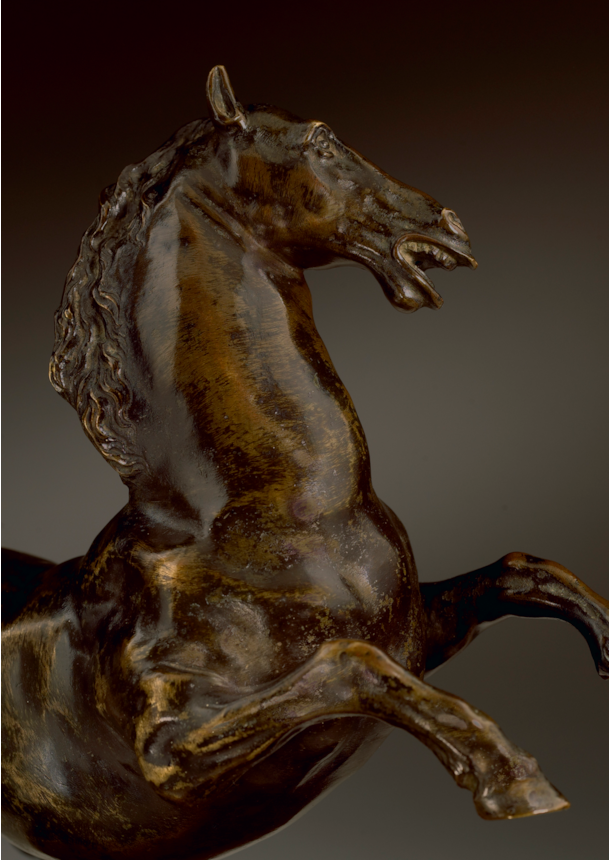
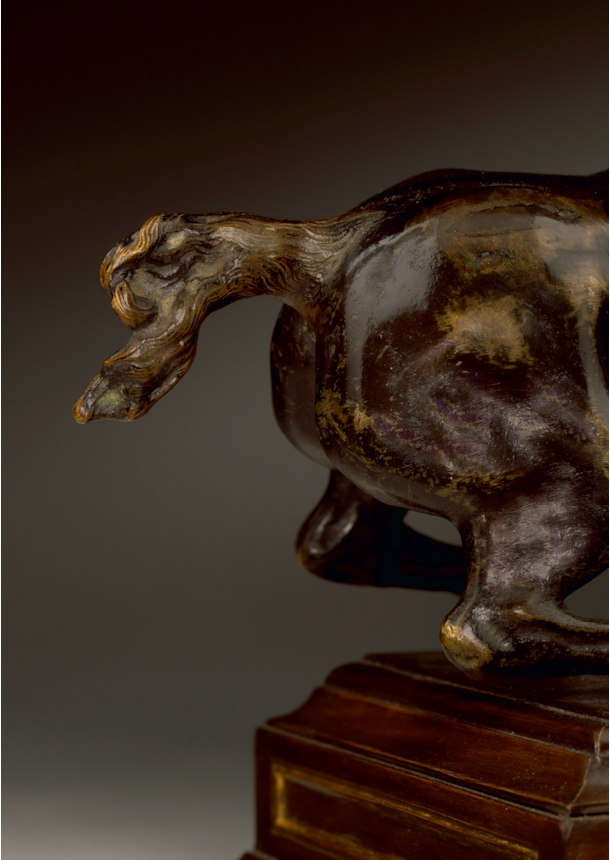
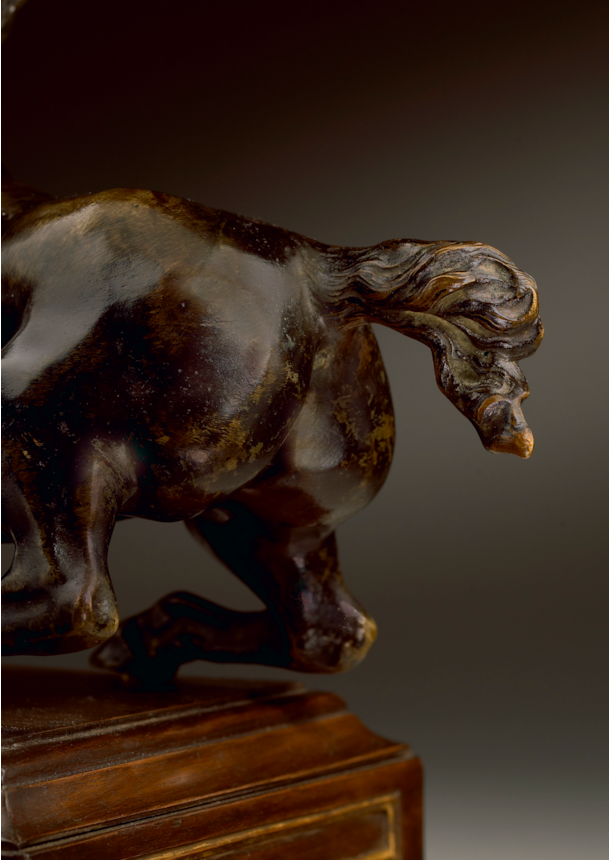
The present bronze is a North Italian late sixteenth century statuette of a rearing horse, almost certainly cast after a lost model by Leonardo da Vinci (1452-1519). Modelled in a compact levade-like posture, the animal gathers its weight deep over flexed hindquarters, the hocks bent and drawn close beneath the body, while the forelegs rise in subtly staggered suspension. The neck twists decisively to the left, introducing a torsional countermovement that binds the composition into a tightly organised spiral. The compact massing of the body, the tensile modelling of the musculature, and the sculptural coherence of the silhouette together evoke the expressive force characteristic of Leonardo’s equestrian studies of the first decade of the sixteenth century.
Known to scholars as ‘The London Horse’, or ‘The Jeannerat Horse’, the present bronze previously belonged to Pierre Gabriel Jeannerat de Beerski (1902-1983), a journalist and collector who was the private secretary to Marshal Lyautey in Morocco. Jeannerat acquired the bronze as part of a lot which included other bronzes for 11 guineas in a Christie’s sale in 1933. Recognising the bronze’s extraordinary dynamism and its remarkable resemblance to several of Leonardo’s equine studies housed in the Royal Collection at Windsor, he published an article detailing his discovery in Apollo Magazine the following year. The piece quickly attracted international attention, notably from Sir John Pope-Hennessy (1913-1994) and Sir Kenneth Clark (1903-1983), not only for its inherent magnificence but also for its undeniable similarities to a bronze of a horse and rider in the Museum of Fine Arts, Budapest.
The Budapest Horse and Rider, together with several other small bronzes was acquired in Rome sometime between 1818 and 1824 by the Hungarian sculptor István Ferenczy (1792-1856). Upon his death, Ferenczy stipulated that the crates containing his collection should remain unopened for fifty years. In 1913, the Museum of Fine Arts opted to purchase the entirety of Ferenczy’s small bronzes, and the Budapest Horse and Rider was catalogued as a sixteenth-century Florentine sculpture. However, Dr. Simon Meller (1875-1949), the keeper of the collection, suspected that this bronze was no ordinary ‘Florentine piece’. Next to its entry, albeit marked with a question mark, was the name ‘Leonardo.’ Subsequent press reports suggested that the Horse and Rider might be the sole surviving sculpture created by Leonardo's hand. By 1916, Meller published the Budapest Horse and Rider as an autograph work by Leonardo. Whilst Meller considered the small bronze to be a model for the Trivulzio monument, other scholars have since suggested that it dated to the period when Leonardo was designing the Sforza equestrian statue, and others have linked the work to his preparations for the Battle of Anghiari. The bronze was amongst the fine array of bronzes at the great loan exhibition of Italian Art at the Royal Academy, Burlington House in 1930, where it was compared to ‘an almost identical horse, without the rider’ in the Metropolitan Museum in New York.
Since Jeannerat's discovery in 1934, the present bronze has received considerable acclaim. It was exhibited at the Leonardo Quincentenary exhibition at the Royal Academy in London in 1952. In 1961, it was subsequently displayed at the Victoria and Albert Museum in London and then at the Rijksmuseum in Amsterdam, as part of a British Council exhibition devoted to bronze statuettes of the Italian Renaissance. This exhibition featured the present horse, chosen by John Pope-Hennessy to represent the group of horses associated with the work of Leonardo da Vinci.
What drew scholars to connect the bronze horses to Leonardo was the artist’s many studies of rearing horses, most of which can be found in the Royal Collection in Windsor. These drawings have been identified as preparatory studies for his various equestrian monuments, including those of Sforza and Trivulzio, as well as for the fresco depicting the Battle of Anghiari. Kenneth Clark posited that Leonardo may have ‘himself executed small wax figures of horses with which to build up the composition of his cartoon. Some such practice is suggested by a note beside one of his drawings ‘make a little one of wax about four inches long’ . The present bronze is in fact a mirror image of a horse in the aforementioned drawing. Clark goes on to add that the horses are ‘very like some of those which appear on the studies for Anghiari and reproduces almost exactly the pose and character of a horse on a sheet of studies at Windsor’. Conversely, Jeannerat believed that the model was more closely related to Leonardo’s designs for the Trivulzio monument, asserting, ‘the chief reason I have to put forward is that the London Horse appears to me to reveal its greatest beauty when seen from below’’. He elaborated that ‘The altitude of the hind legs [...] are spread and flattened out under the belly in a manner that suggests the idea that they were deliberately designed to support a massive weight’.
Whilst twentieth century scholars engaged in discussions regarding the extent of Leonardo’s involvement in the creation of the various bronzes and their intended purpose, there is now a general consensus that these bronzes derive from a now-missing model created in Leonardo’s workshop.
Horses played an important role in Leonardo’s oeuvre. During his apprenticeship under Andrea del Verrocchio in the 1470s, Leonardo was involved in the equestrian statue of Bartolomeo Colleoni, which left a huge impression on the young artist. Some of his earliest dated drawings depict mounted riders combating dragons or griffins, including the earliest instance of a rearing horse by his hand. Leonardo later moved to the Milanese court of Ludovico Sforza, where shortly after his arrival, he began work on his design for the seven and a half metre tall equestrian statue of Ludovico’s father, Francesco Sforza. Leonardo’s sketches from the late 1480s indicate that he initially intended to create a rearing horse for this commission.
Although numerous documents and contemporary accounts attest to Leonardo’s activity as a sculptor, none can be definitively linked to a specific sculptural work. Simultaneously, several sculptures can reasonably be classified as attributed to Leonardo based on stylistic analysis; however, these attributions lack corroboration from written sources. Paradoxically, therefore, whilst we have good reason to assume that Leonardo did indeed make sculptures, we suffer from a paucity of evidence to support any attribution. Extant sculpture which has been more recently accepted by certain scholars, including Carmen Bambach, as an autograph work by Leonardo is a terracotta group of the Madonna and Child in the Victoria & Albert Museum, London.
One notable source derives from the hand of Gian Paolo Lomazzo (1538-1592), who, in 1584 remarked upon a ‘cavallo di rilievo plastico’ by Leonardo that was in the possession of the sculptor Leone Leoni (c. 1509-1590). This indicates that wax models by the master were in existence by the end of the sixteenth century and could explain the existence of the present bronze and the New York horse. This was the argument theorised by Maria Aggházy in her 1989 publication. Whilst there are no securely identifiable small bronzes by Leoni for direct comparison, Lomazzo’s testimony implies that Leonardesque sculpture circulated within his artistic milieu. The possibility that the model was transmitted, whether directly or indirectly, through Leoni’s circle provides a historically grounded explanation for both its Leonardesque character and its late sixteenth century casting.
Although the New York horse has been dismissed as no older than the nineteenth century due to its ‘thin walls’ and the presence of threaded plugs, such claims can be easily refuted. The aforementioned features traditionally cited as indicators of modern production are not intrinsically anachronistic. Comparable technical solutions are documented in Italian, German, and French bronze casting from the late sixteenth century onwards. XRF analysis of the present bronze undertaken by Dr Arie Pappot of the Rijksmuseum in 2025 reveals an alloy containing 22% zinc, categorising the work as brass rather than traditional copper-tin bronze. Whilst such alloys were employed across a wide geographical range from approximately c. 1500 and 1750, nothing in its metallurgical profile compels a later date; on the contrary, its characteristics align coherently with late sixteenth century casting.
Whilst the question of direct authorship necessarily remains open, the bronze horse preserves the sculptural intelligence of the underlying invention. The compact massing, torsional counterpoint, and the disciplined articulation of movement reflect a conception grounded in anatomical inquiry and structural control. This is not merely a decorative evocation but rather a serious engagement with a Renaissance prototype of exceptional authority. Whether deriving from the master’s hand or not, the bronze embodies the enduring legacy of Leonardo’s equestrian imagination.