








Rombout Pauwels known as Pauli or Paoli (c.1625–1692/1700)
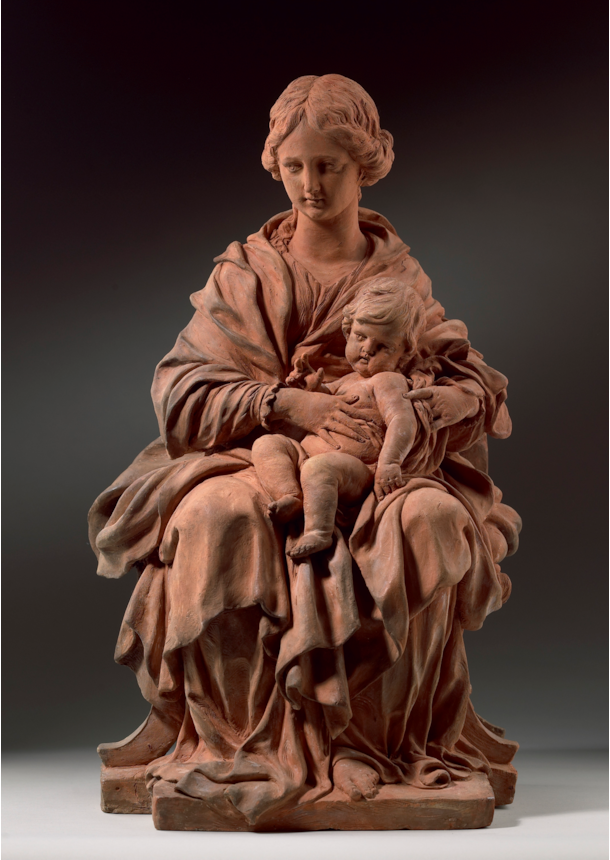
10. Virgin and Child
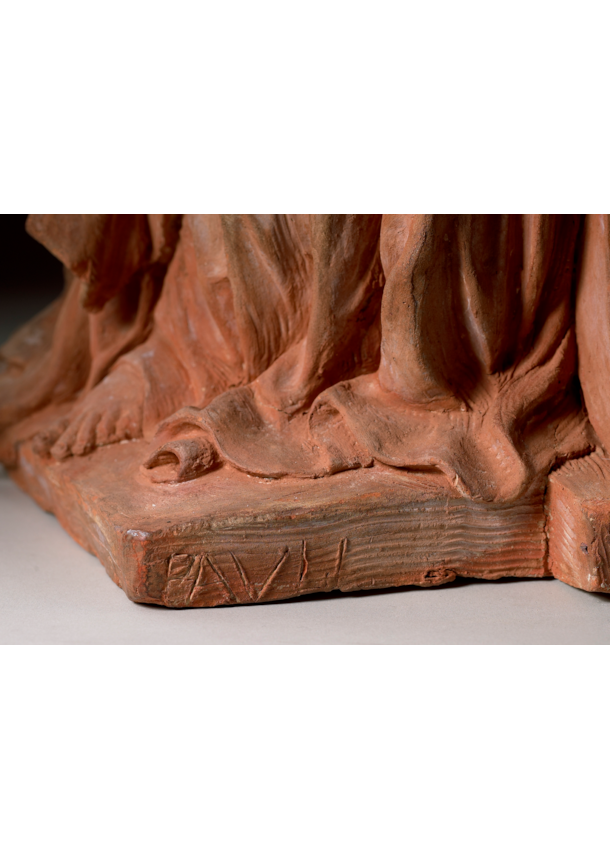
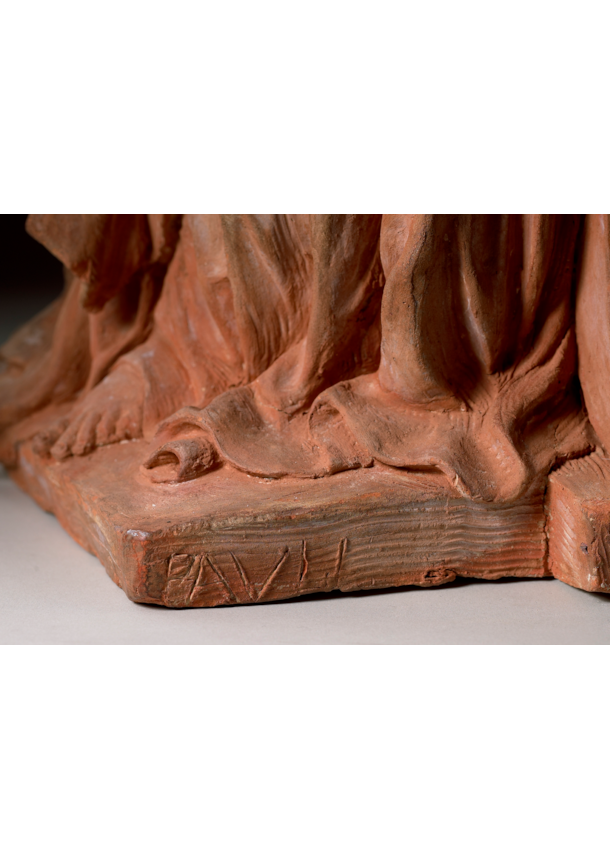
Signed 'PAULI'
Terracotta
49 x 28 cm (19 ¼ x 11 in.)


A. Jacobs, Fascination baroque: La sculpture baroque flamande dans les collections publiques françaises, Cassel, Musée de Flandre, 2011, 116-117.
J. Gabriels, Artus Quellien, de Oude « Kunstryck belthouwer », Anvers, De Sikkel, 1930: 92-96.
E. Marchal, La sculpture et les chefs-d’oeuvre de l’orfevrerie belges, Brussles, 1895: 529-531.
E. Marchal, ‘Pauli ou Pauwels (Rombaut)’, Biographie Nationale XVI, Brussels, 1901: 709-713.
E. Neeffs, Histoire de la peinture et de la sculpture a Malines, 2nd ed., Vanderhaeghen, 1876: 193-200.
S. Van Riet, Lucas Faydherbe 1617–1697, Mechelen Sculptor & Architect, Mechelen, 1997: 60.
P. Philippot, Baroque Religious Architecture and Sculpture in the Southern Netherlands and the Principality of Liège 1600–1770 by P. Philippot et al., Sprimont, 2003.
C. Theuerkauff, Von allen Seiten schön: Bronzen de Renaissance und des Barock, Alte Museum-Staatliche Museen zu Berlin, 1995-1996, n°196.
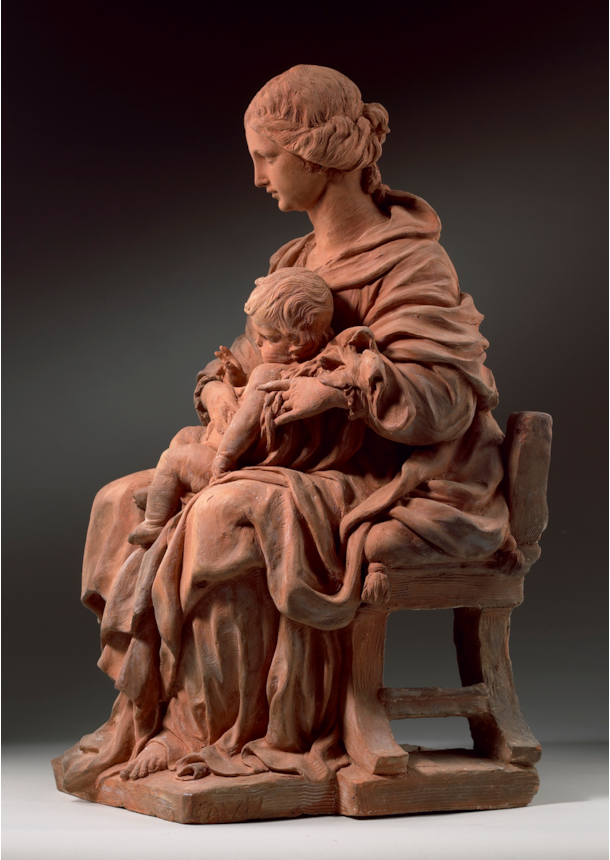
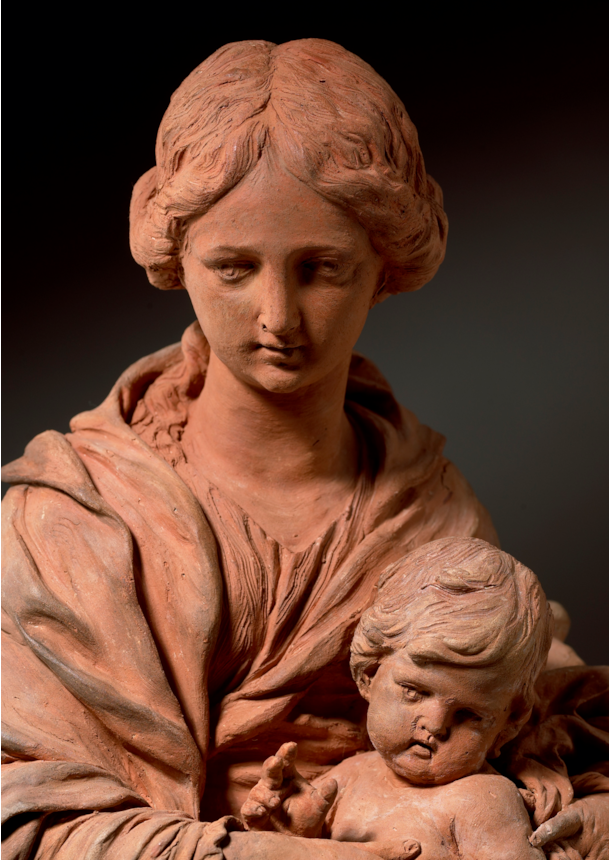
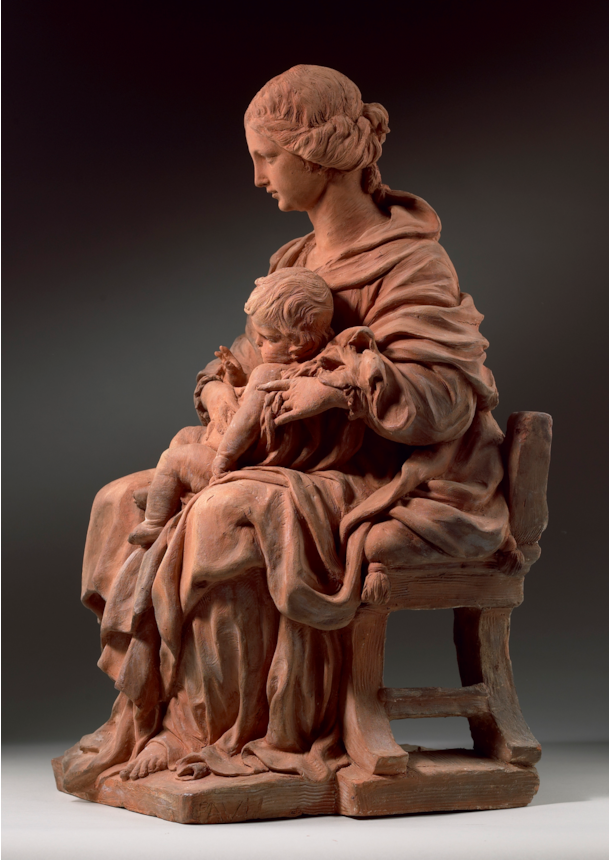
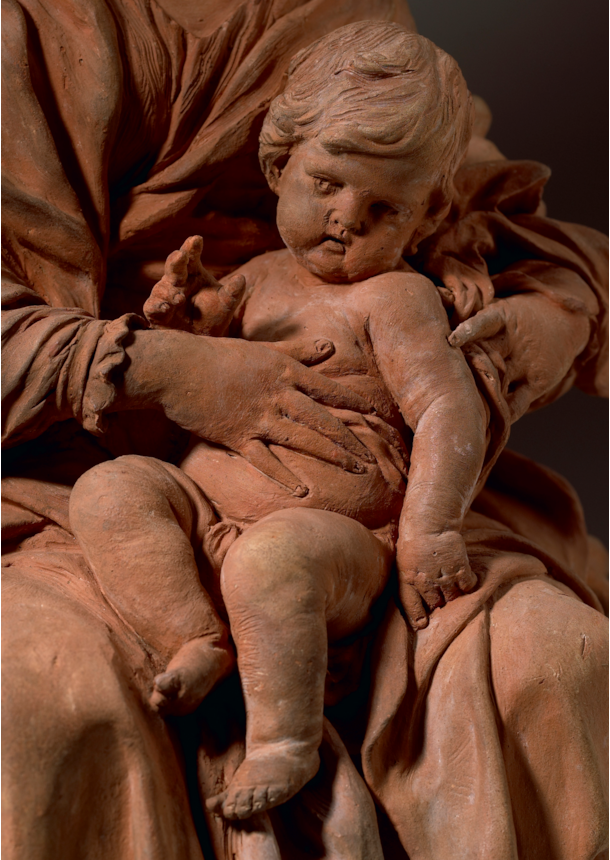
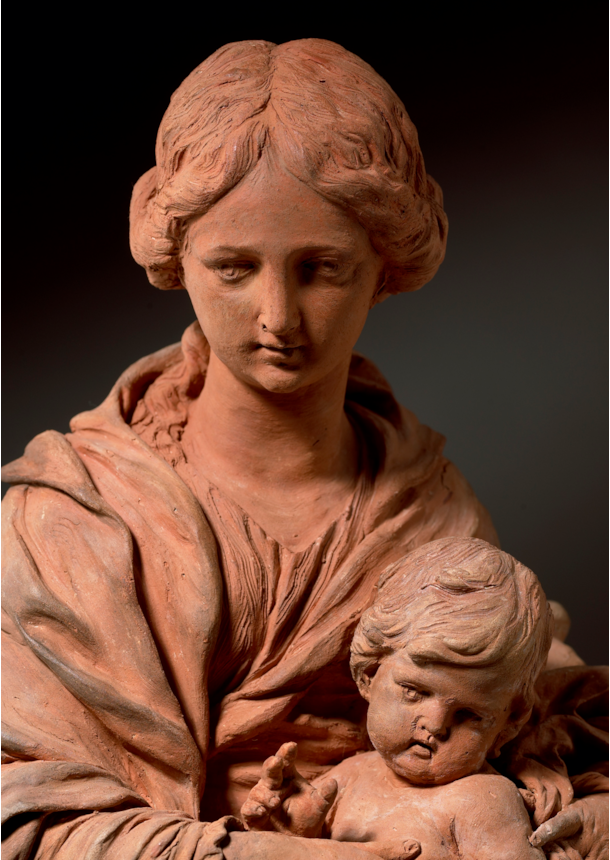
This delicate terracotta Virgin and Child is one of the most remarkable recent discoveries in the field of Flemish Baroque sculpture.
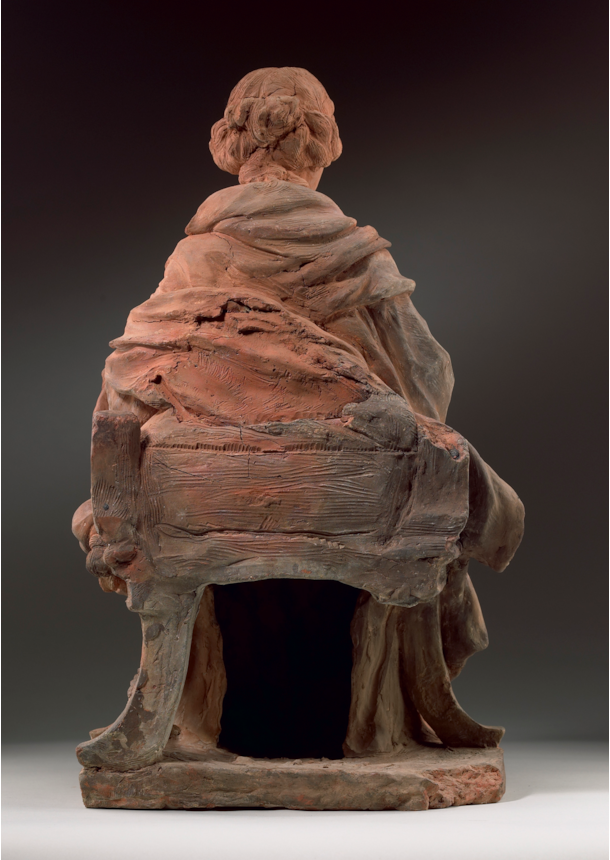
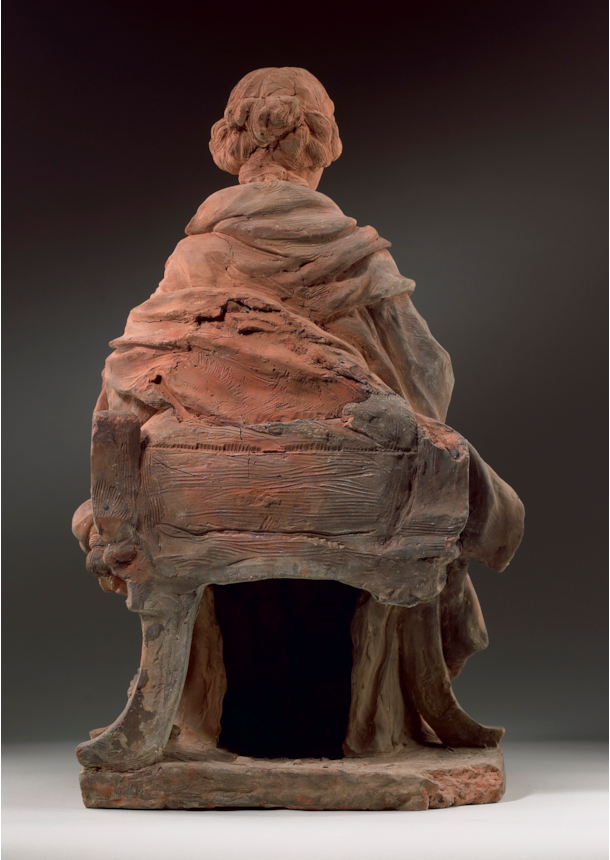
The Virgin is seated on a curule chair adorned with a cushion, a discreet symbol of dignity and majesty. She is enveloped in ample draperies, a tunic, a gown, and a large mantle whose heavy folds fall supplely to her bare feet. Her face, with its fine and youthful features, slightly inclined, her eyelids gently lowered, and her noble bearing together create an image of rare inwardness. The Virgin embodies an ideal of candour and innocence.
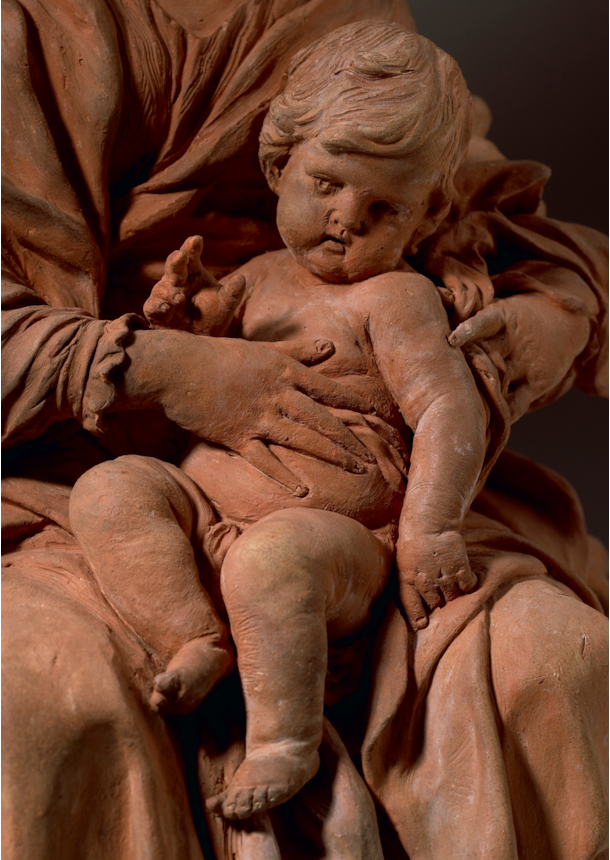
The abundant drapery, skilfully arranged, unfolds a setting of deep folds within which the Christ Child, plump and infantile, nestles trustfully under the Virgin’s tender protection, as she supports him with infinite delicacy in her long, elegant fingers. The Child’s face, animated by an almost stern gravity, turns toward the world, which he blesses with his right hand, in keeping with the tradition of Flemish Marian statuary. With his left, he instinctively grasps his mother’s mantle — a detail of touching naturalism and keen observation that lends the scene a moving humanity without diminishing its sacred solemnity.
The present terracotta is an autograph work by the Mechelen-born sculptor Rombout Pauwels, an artist who remains surprisingly little studied and largely unknown. Most of what we know about him is based on the biography devoted to him by Neeffs in 1876, later taken up by Marchal in 1895 and 1901 and by Devigne in 1932. No substantial study has since provided further information about his career.
Registered as an apprentice in the Mechelen Guild of Saint Luke on 7 July 1636, he is said to have subsequently travelled to Rome, where he may have worked in the studio of François Duquesnoy (1597–1643) before returning to the Low Countries in 1643 in the company of Jérôme II Duquesnoy (1602–1654). Such a hypothesis would imply an Italian sojourn before the age of eighteen, which may seem early for undertaking a journey of that magnitude. Might his use of the pseudonym “Pauli” or “Paoli”, together with the charm of his putti inspired by those of François Duquesnoy, such as the figure of the Christ Child in the statue discussed here, constitute clues suggesting a stay in Rome? An archival document nevertheless proves that Pauli was active in Mechelen in November 1642, already contradicting the idea of a return to his homeland with Jérôme Duquesnoy.
In 1643, he was admitted as a master in Mechelen. That same year, his wife Victoria van Oppenroy gave birth to a child who died on 24 September. He remarried Agnes Collaert, with whom he had two children, baptized on 13 February 1654 and 24 July 1655 respectively. Confronted with strong competition from Lucas Fayd’herbe (1617–1697), who secured the principal commissions in Mechelen, Rombout Pauwels settled in Ghent, where he was admitted as a master in 1656 and appointed dean of the Ghent guild in 1685.
The sources mention only about a dozen works executed by Pauwels, of which only a few have survived. Among them are the marble funerary monument of Bishop Carolus Maes, made in 1666 for Saint Bavo’s Cathedral in Ghent; two delicate marble statuettes of children from the former altar of the Confraternity of the Holy Cross in Saint Michael’s Church in Ghent (1653–1656); the marble enclosure of the chapel of Saints Peter and Paul in Saint Bavo’s Cathedral (1657); and a marble copy of Michelangelo’s Madonna and Child of Bruges, preserved in Saint Michael’s Church in Ghent. It is evident that this masterpiece, on which Pauwels worked, constituted a decisive source of inspiration for the conception of his own interpretation of the subject.
The discovery in recent decades of several terracottas has not only enriched the corpus of his work but has also highlighted the significance of his talent and his highly personal approach to the human figure. In the religious sphere, these include a Maria lactans or Virgin and Child Nursing (private collection) and a Saint John the Baptist as a Child (Lille, Palais des Beaux-Arts); and in the realm of secular sculpture, a Venus Teaching Cupid the Art of Archery and a Venus Caressing Cupid, works conceived as a pair and acquired by the Palais des Beaux-Arts in Lille in 1987. A second terracotta version of the latter group appeared on the art market in June 2021. An unsigned bronze version is also known, preserved in the Bayerisches Nationalmuseum. These different versions attest to the success of this type of composition in Pauli’s oeuvre. It is worth noting that the bronze version was initially attributed to Artus I Quellinus (1609–1668) and presented under the title Charity, thus revealing a genuine stylistic proximity between the two sculptors and a comparable level of execution.
One cannot fail to draw a comparison between this work and the celebrated Virgin and Child Nursing in the Palais des Beaux-Arts in Lille, whose attribution to Artus I Quellinus remains a matter of debate. While, in his marble statues for the Royal Palace of Amsterdam, Quellinus favours drapery inspired by antique sculpture and Roman Baroque models, foremost among them François Duquesnoy, combining finely clinging tunics with broad mantles articulated in long, supple folds, the Virgin and Child Nursing in Lille stands out for the abundance of fabrics enveloping The Virgin. Here, the drapery appears sinuous and vibrant, unfolding in folds and counter-folds of exceptional density, more exuberant and rounded than those of Quellinus, thereby lending the ensemble a distinctly monumental character.
This decorative approach — “sumptuous, melting, and tender,” to borrow the words of Juliane Gabriels, who was the first to attribute the statue to Quellinus, is expressed through exceptional plastic qualities that are likewise found, and indeed constitute a characteristic feature of Rombout Pauwels’s style, in the various versions of the Venus Teaching Cupid the Art of Archery and the Venus Caressing Cupid, as well as in the statue of Bishop Carolus Maes and in the present Virgin and Child. Might the discovery of the latter not reopen the debate concerning the attribution of the Virgin and Child Nursing in Lille?
The sources mention that Pauwels executed a marble Virgin Mary intended for the chapel of the Bishopric of Ghent and a Virgin and Child for the Jesuits of Ghent, both now presumed lost. Could our terracotta statue be a modello for the latter?
In any case, this work testifies to a consummate mastery, both technical, in the subtle modelling of the clay, and expressive, in the singular animation of the abundant drapery. It joins the select group of majestic, seated Virgin and Child sculptures produced in Flemish Baroque sculpture during the first two-thirds of the seventeenth century, sometimes placed in the upper niches of grand Flemish Baroque altars or intended for the devotion of religious communities or wealthy private patrons. It confirms that Rombout Pauwels was indeed one of the great Flemish sculptors of his time.
Alain Jacobs, 2026