








Eleanor Coade (1733-1821)
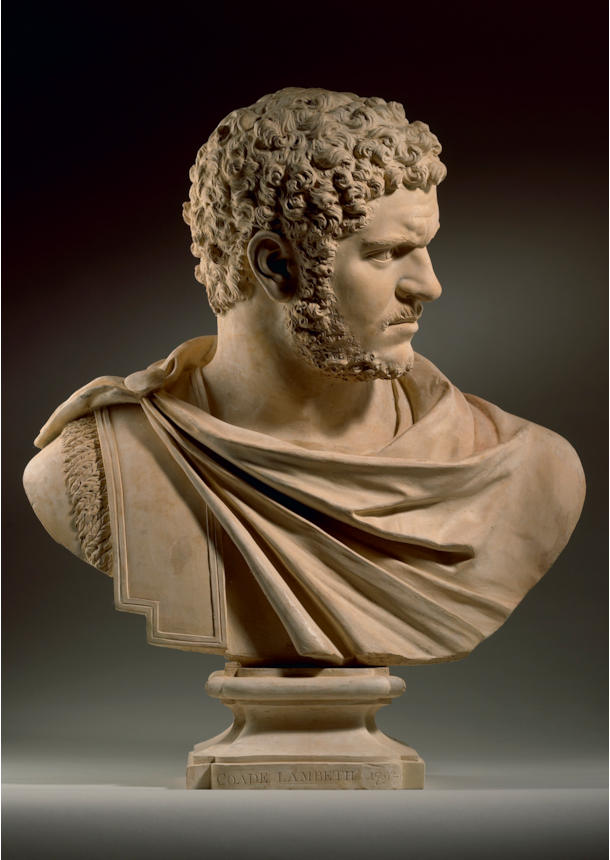
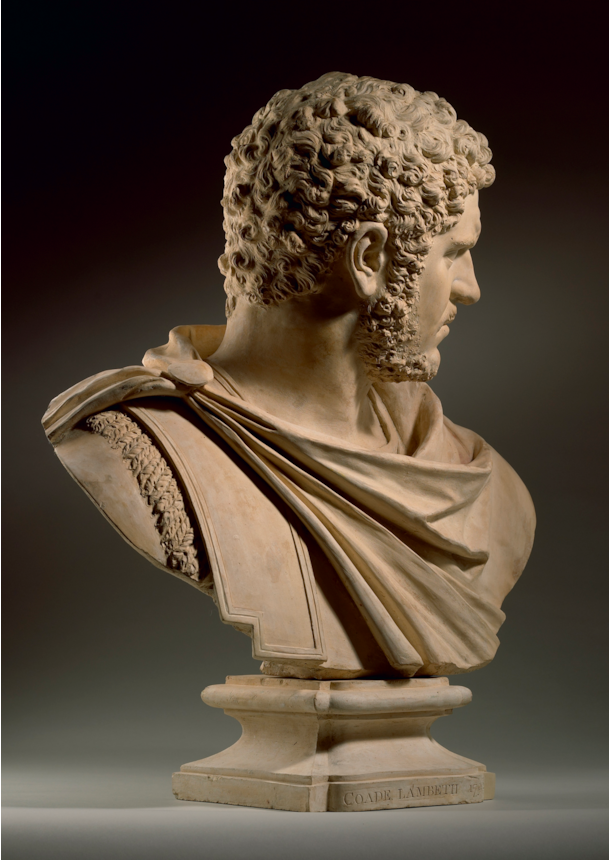
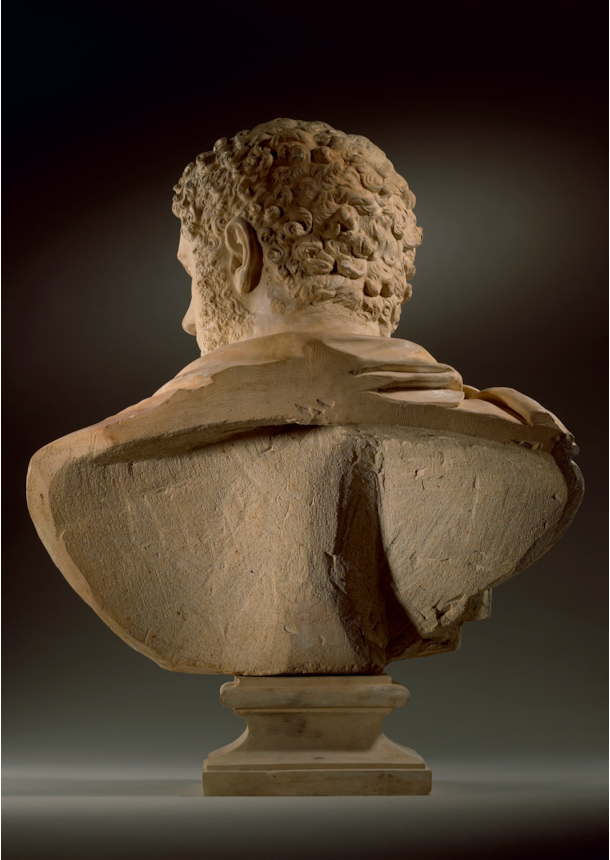
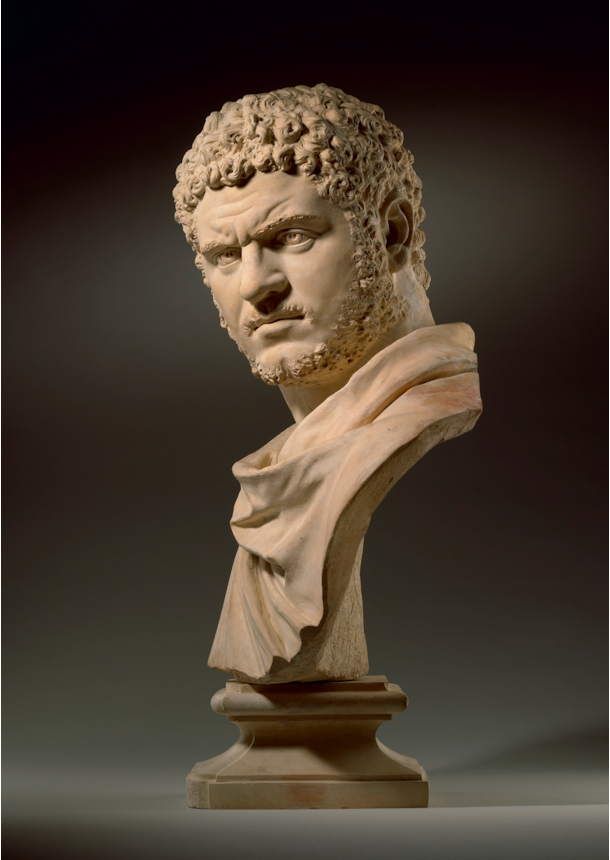
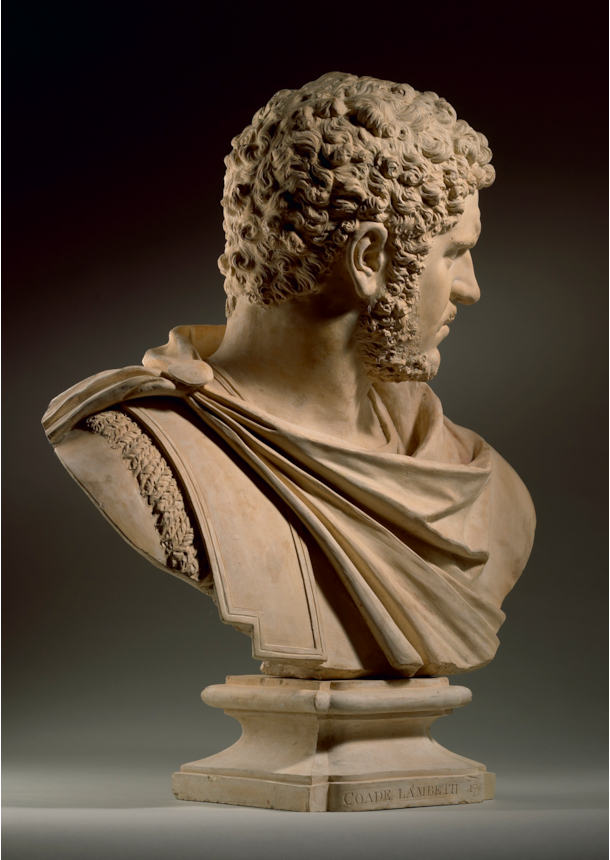
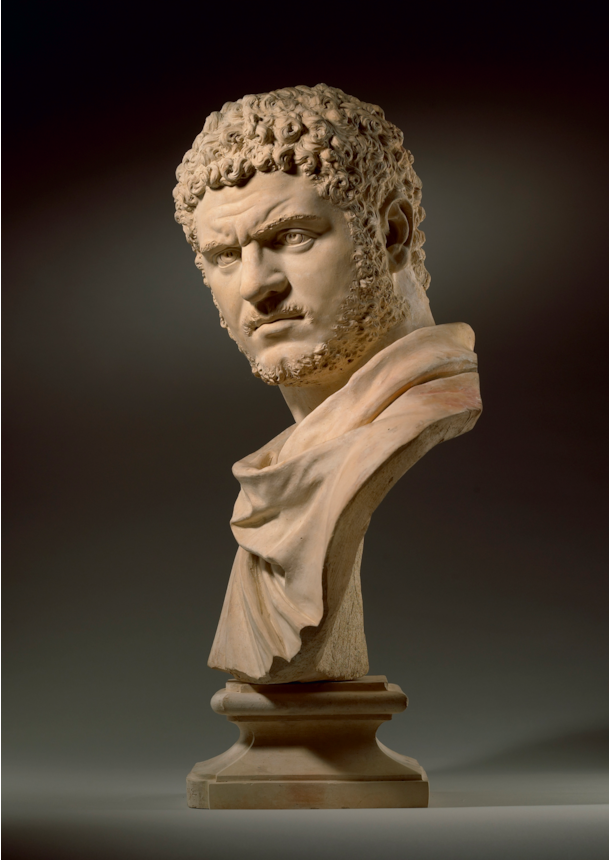
12. Bust of the Emperor Caracalla
After the Antique
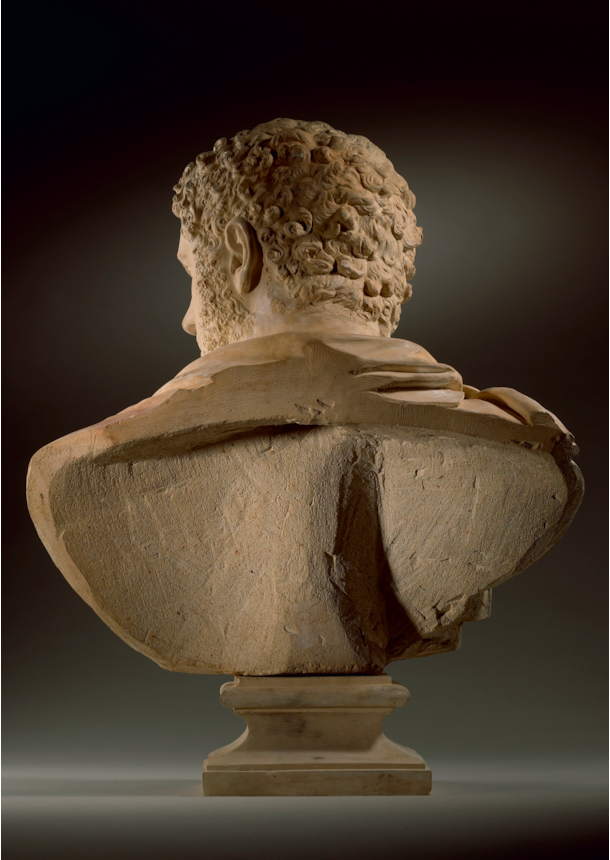
Coade Stone, or Lithodipyra
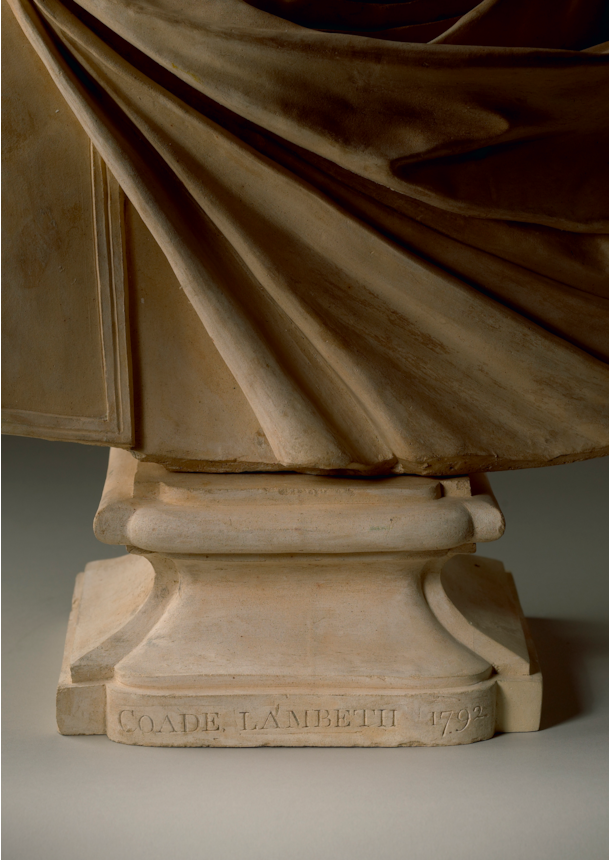
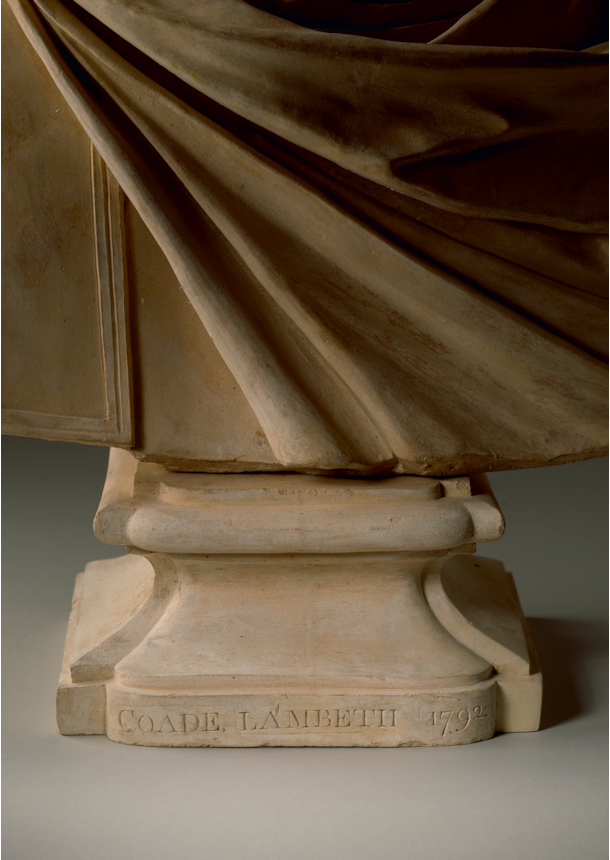
Stamped ‘COADE LAMBETH 1792’
Almost certainly modelled by John Bacon, The Elder (1740 - 1799)
60 x 49 cm (23 ½ x 19 ¼ in.)


A. Kelly, Mrs Coade’s Stone, Worcester, 1990.
The present work is a Coade stone bust of the Ancient Roman emperor Caracalla (188-217 A.D.) after an ancient portrait bust, previously in the Farnese Collection, now in the Museo Archeologico Nazionale, in Naples.
The ancient bust of ‘Caragallo con il petto’ was first documented in the inventory of the Palazzo Farnese in Rome in 1566, where it remained until the late 1780s, when it was transferred to Naples following its restoration, likely carried out in the workshop of Carlo Albacini. By 1796, it was recorded at Capodimonte, but by 1805, it had been relocated to the Museo degli Studi, later known as the Museo Borbonico and now the Museo Archeologico Nazionale, where it remains. Multiple versions of this type of bust were known by the early eighteenth century, with at least four documented in the Albani collection at the time of its acquisition for the Capitoline Museum. Though additional examples had emerged by 1800, none were comparable in quality to the exceptional bust in the Farnese collection. The bust was regarded as one of the final masterpieces of classical antiquity, often described as ‘the last effort of Roman sculpture or ‘le dernier soupir de la sculpture romaine’ (the last breath of Roman sculpture).
In the eighteenth-century marble copies of the bust of Caracalla were highly popular, mostly amongst English collectors who may have appreciated that Caracalla was proclaimed emperor in York. Examples by Laurent Delvaux, Claude Clair Francin, Francis Harwood, Bartolomeo Cavaceppi, and Joseph Claus, may be cited, but many are unsigned, such as the one in Chatsworth.
Rome was the central destination of the European Grand Tour, and classical fragments constituted the quintessential souvenir. In London, at least four sculptor’s workshops were able to sustain themselves through the commercial production and sale of classical copies, including the workshop of the sculptor John Flaxman’s father. In addition, volumes of engraved illustrations were available, though often prohibitively expensive (‘Count Caylus will cost us money’ complained Josiah Wedgewood to his partner Bentley), yet they nevertheless provided high-quality visual sources from which artisans could work. The Coade firm either owned or had access to the four major volumes documenting the Capitoline Museum on the Campidoglio in Rome. A further Roman collection of celebrated antiquities to which the Coade firm likely had visual access was that of the Farnese family. This explains the existence of Coade models after well-known works from the Farnese collection, including Venus Callipygis, Farnese Bull, Farnese Flora, and Farnese Hercules.
Eleanor Coade (1733 – 1821) was a British businesswoman and artist whose enterprise specialised in the production of Neoclassical sculpture, architectural ornament, and garden statuary made from Lithodipyra (commonly known as Coade stone) for over five decades, from 1769 until her death. Born in Exeter in 1733, relatively little is known of Coade’s early life. However, by 1766 she is documented as operating independently as a linen draper. Female entrepreneurship in Georgian England was uncommon, and Coade therefore constitutes a notable exception. Known professionally as ‘Mrs Coade’, the customary form of address for an unmarried woman of mature years engaged in trade in the eighteenth century, she achieved considerable contemporary prominence and commercial success. Her manufactory supplied commissions to the leading architects of the period, and her works were disseminated throughout the British Isles, as well as exported to North and South America, the Caribbean, and to Poland and Russia. Coade’s firm prospered from 1769, having received Royal Appointments under George III and George IV, until her death in 1821. Her obituary in The Gentleman’s Magazine described her as ‘the sole inventor and proprietor of an art which deserves considerable notice’.
Though it is unclear how Mrs Coade became involved in the production of artificial stone, she dated the foundation of her manufactory at Narrow Wall, by King’s Arms Stairs in Lambeth (later known as Belvedere Road and now a part of the area occupied by the South Bank Centre) to 1769. An artificial stone business had already been operating on the site under Daniel Pincot by 1767, and Coade appears to have assumed control whilst initially retaining Pincot’s services, though the arrangement subsequently proved unsatisfactory. Earlier manufacturers of artificial stone, including Daniel Pincot, Richard Holt, Batty Langley, and George Davy, preceded Coade, whilst Bridges of Knightsbridge operated as a competitor during the 1770s. However, the scale and reach of Coade’s enterprise significantly exceeded those of her contemporaries.
The distinguishing feature of the Coade manufactory lay in its technical mastery of kiln-firing processes, which enabled the production of a notably resilient and weather resistant material. The artificial stone produced by earlier manufacturers lacked sufficient durability to withstand prolonged exposure to harsh environmental conditions. From 1769 onwards, Coade produced her artificial stone in Lambeth using a proprietary formula, composed of a mixture of clay, terracotta, silicates, and glass. Owing to its exceptional durability and resistance to weathering, Coade stone proved suitable for a wide range of applications and was particularly valued by architects such as Robert Adam, who sought materials capable of supporting increasingly refined and intricate architectural ornament.
Following her acquisition of Daniel Pincot’s financially troubled manufactory, Coade terminated his employment in 1771 and appointed the Neoclassical sculptor John Bacon as supervisor. In notices published in the Daily Advertiser on 23 and 25 September 1792, Coade formally announced the change in management:
‘Her Manufactory at King’s Arms Stairs, Narrow Wall, Lambeth, lately conducted by Mr Daniel Pincot, is now under the Superintendance of Mr John Bacon, Sculptor, whose Merit as an Artist being too well known to need any Encomiums, she promises herself to Coninuence of that Encouragement she has hitherto received from the Publick…’
Coade’s appointment of Bacon reflects her deliberate policy of recruiting the most accomplished craftsmen available in Britain. The decision proved judicious, as Bacon, then an emerging sculptor of considerable promise, supplied the manufactory with many of its most successful designs over the subsequent three decades. Among his notable independent works is the monument to Mrs Draper in Bristol Cathedral, dating to c. 1780.
John Bacon (1740 - 1799) was apprenticed to Nicholas Crisp, who operated a workshop opposite St Mary-le-Bow and maintained a kiln in Lambeth for the firing of small porcelain figures. It is reported that Bacon was so struck by the large terracotta busts being fired in this kiln that he resolved to pursue similar work himself (particularly had he encountered the sculptures of Louis-Francois Roubiliac, which would have provided exemplary models for emulation). Certainly in the early years, the position was one of Eleanor Coade as the employer and Bacon as the employee. Coade herself exhibited regularly at the Society of Artists of Great Britain exhibitions between 1773 and 1778, and again in 1780, where she was listed in the catalogues as ‘Miss Eleanor Coade, sculptor, S. of A.’ For Coade’s manufactory, Bacon produced a wide range of works, among the most significant being A Tiger for Sir Francis Bassett, Charity for the Marine Society of London, Contemplation for John Coakley Lettsom of Camberwell, and relief sculptures for Hooton Hall, Cheshire. In 1768, Bacon enrolled at the Royal Academy Schools and relocated from the city to lodgings in Wardour Street, while continuing his professional association with Coade. His early models for the Coade manufactory were frequently executed as direct copies, though they display a notable degree of technical assurance and confidence, as exemplified by the present work.
The reputation of the Coade manufactory continued to expand in the years that followed its establishment. In 1773, Coade advertised that the firm was ‘employed by many of the Nobility and first Architects in the Kingdom,’ indicating a substantial volume of elite patronage. The scale of bespoke commissions may be inferred from the publication, in 1784, of a comprehensive trade catalogue comprising 778 distinct items, including figures, busts, paterae, capitals, a wide range of architectural ornaments, vases, urns, and chimneypieces. Coade’s firm employed an engraver to produce plates from which printed catalogues could be distributed in response to customer enquiries, facilitating the circulation of designs to a national and international clientele. The popularity of Coade stone was further reinforced by the consistently high quality of design produced at the manufactory. Several distinguished sculptors contributed models, notably John De Vaere, John Charles Felix Rossi, Joseph Panzetta, and John Bacon.
Coade stone enabled architects such as Sir John Soane, Robert Adam, John Nash, and James Wyatt to incorporate a rich vocabulary of classical ornament into their architectural schemes at a cost that would have been impossible in carved natural stone. The commercial success of Coade stone facilitated both the reproduction of high-quality classical models and the creation of new, ‘modern’ ornamental forms. Moreover, the material possessed several technical advantages over traditional stone, enabling the production of complex forms and delicate details that were either extremely difficult or practically impossible to realise through conventional stone carving. These material and economic advantages constituted a principal factor in the exceptional success of the Coade manufactory in the late eighteenth and early nineteenth centuries. The landscape designer Lancelot 'Capability' Brown likewise specified Coade stone decorative features, including bas-reliefs and statuary, for garden buildings commissioned by his patrons.
Architectural features manufactured at the Coade factory were soon incorporated into several prominent buildings, including the Royal Pavilion and the Old Royal Naval College. The manufactory reached the height of its commercial and artistic success in the early nineteenth century, when it secured several prestigious public commissions, including several monuments commemorating the jubilee of George III in 1810. The most ambitious of these undertakings was a monumental tympanum relief celebrating Horatio Nelson for the Royal Naval Hospital at Greenwich, designed by Benjamin West and modelled by Joseph Panzetta. The successful casting of a ceramic relief exceeding forty feet in length and approximately ten feet in height demonstrates the manufactory’s exceptional technical capabilities. Amongst the firm’s most prestigious later commissions was its contribution to Buckingham Palace, rebuilt from 1825 under the direction of John Nash. In addition to extensive ornamental work in scagliola and artificial stone, the Coade factory supplied nine statues modelled by Edward Hodges Baily to designs by John Flaxman, together with a further six modelled by John Charles Felix Rossi. These sculptures were later relocated during subsequent alterations to the building, with several ultimately being lost.
The achievements of the Coade manufactory were long underestimated, in part because Coade stone so closely imitates natural stone that examples have frequently gone unrecognised or misattributed. More recent scholarship, most notably by Alison Kelly, has substantially clarified both the scale and the breadth of the firm’s production. Eleanor Coade’s enterprise thus constitutes a significant manufacturing legacy, comprising a large corpus of durable sculptural and architectural elements that have survived over several centuries. Consequently, Coade works remain extant throughout the United Kingdom, as well as in more geographically distant locations, including South Africa, Russia, and Brazil.
The present bust may be identified as a model corresponding to no. 78, “Caracalla” (2 ft 1 in.), listed in A Descriptive Catalogue of Coade’s Artificial Stone Manufactory at King’s Arms Stairs, Narrow-Wall, Lambeth […] London, MDCCLXXXIV (1784), p. 5. Further evidence for the rarity of this model is provided by a sale recorded by Christie's on 24 February 1809, in which “an eminent publisher retiring from business” offered for auction Coade busts of Venus and Caracalla. No other version of a Coade bust of Caracalla has thus far been identified. By way of comparison, a related Coade bust of Elizabeth I of England is preserved in the collection of the Metropolitan Museum of Art, New York (inv. no. 2017.239).