








Northern Italy, Paduan or Mantuan, c. 1530-50
19. Euterpe, the Muse of Music and Lyric Poetry
Bronze
19 x 12 cm (7 ½ x 4 ¾ in.)


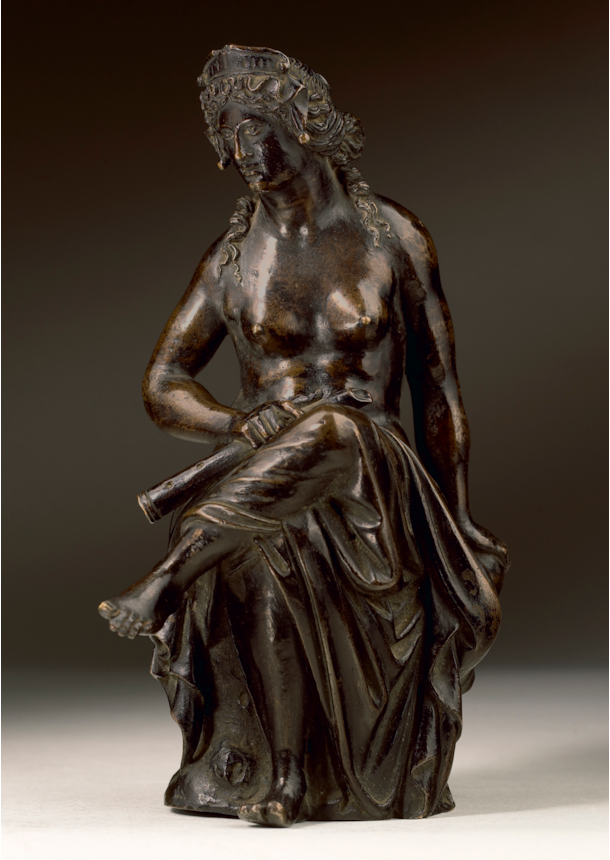
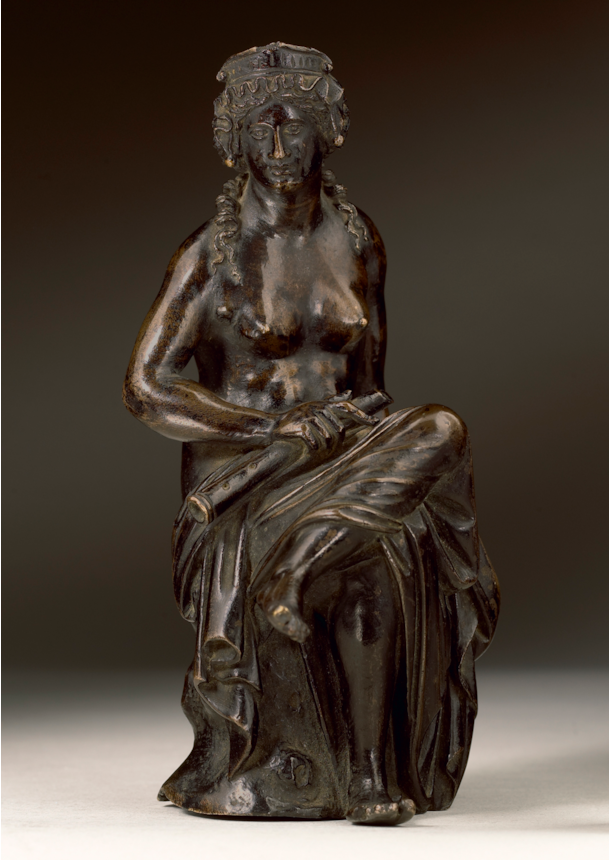
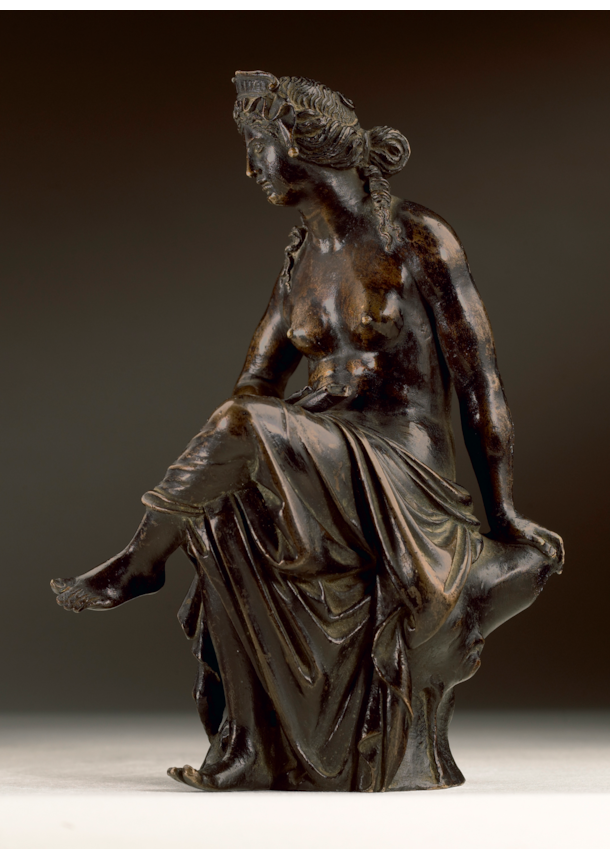
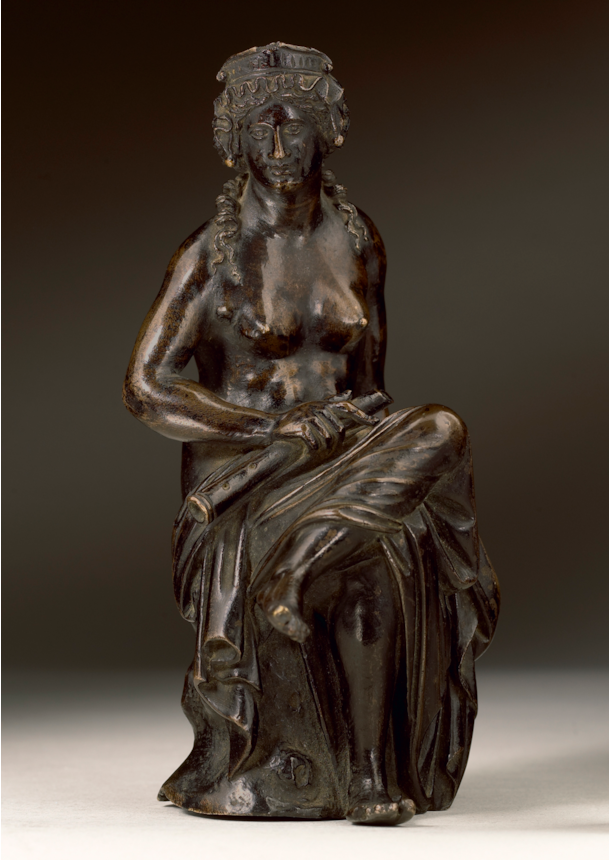
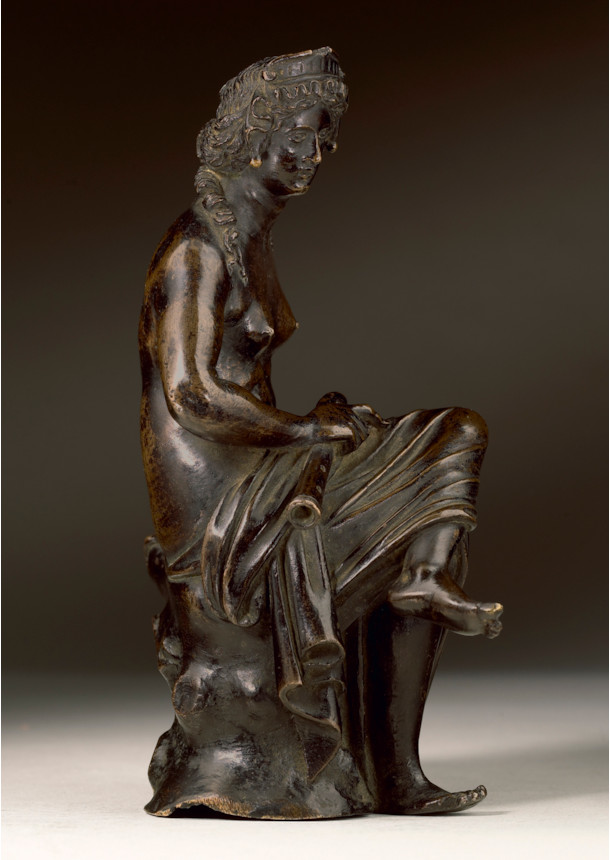
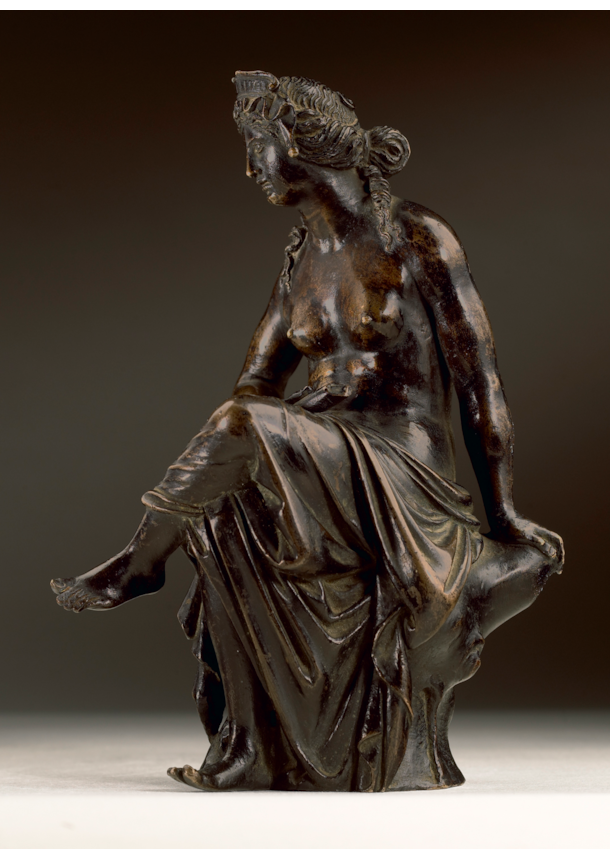
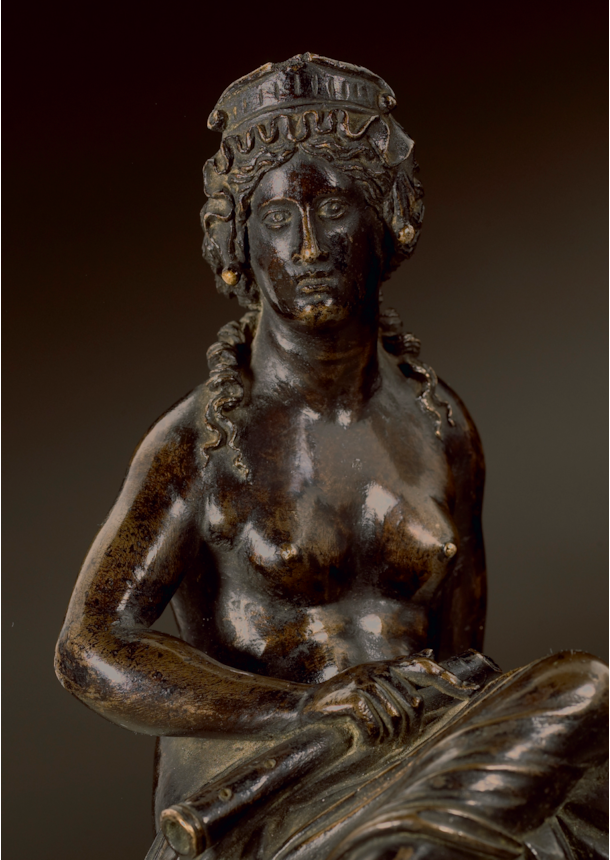
This beautifully conceived and modelled statuette is one of the finest of a series of small bronze reductions of an ancient marble figure of a young girl plucking a thorn from her heel, known as the Nymph of the Thorn. Here however the woman has been transformed, into one of the nine ancient Greek Muses who symbolised the arts. Holding a type of Renaissance wind instrument known for the sweetness of its sound, she may be identified as Euterpe, the muse of music and lyric poetry.
Two earlier small bronze reductions of the ancient marble were made around 1500, the first in Padua by the sculptor Giovanni Fonduli da Crema, the second in Mantua, by Pier Jacopo Alari Bonacolsi, known as Antico, court sculptor to the Gonzaga rulers. Antico’s model was especially influential and the basis for several modified versions of Antico’s model, mostly probably made during the period c. 1525-50. The present bronze is one of the very finest of these variants, but it is exceptional in its successful combination of elements from Antico’s Nymph with strong awareness of the Padua bronze tradition, exemplified by Giovanni Fonduli’s figure, but also the female figures of the Paduan sculptor Andrea Briosco, called Riccio (1470-1532), the greatest maker of small bronze figures in the decades after 1500.
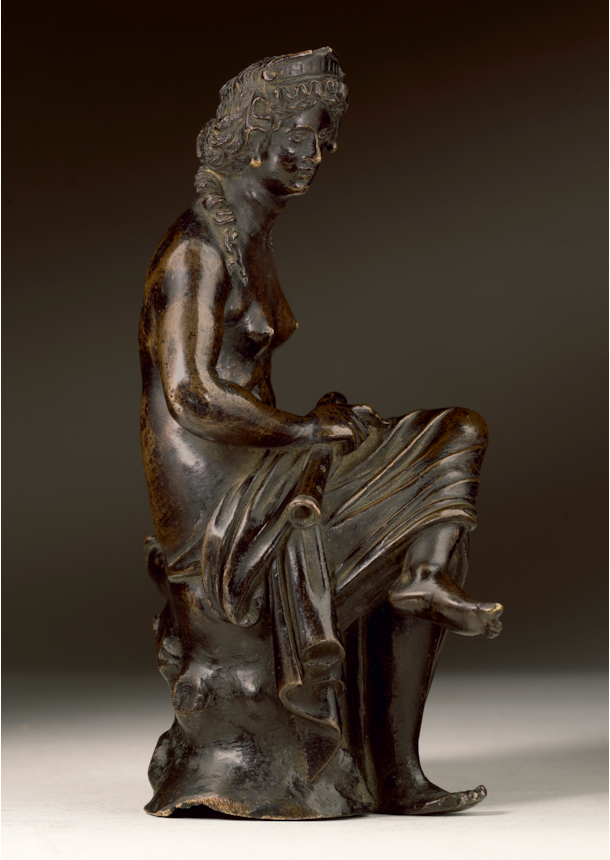
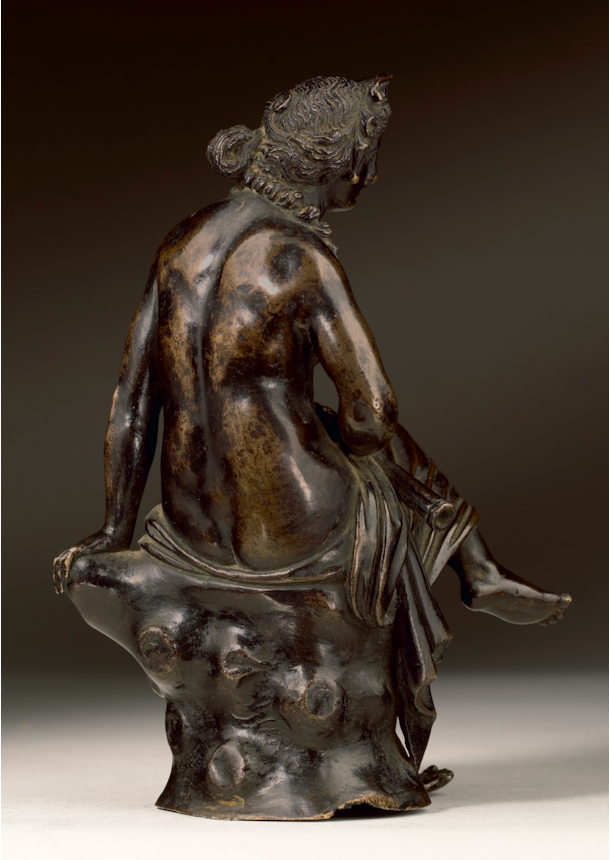
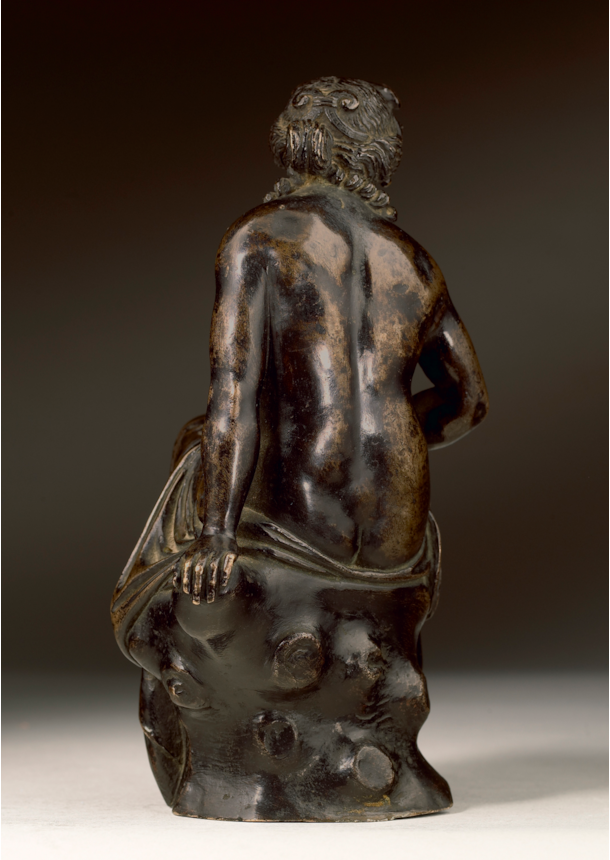
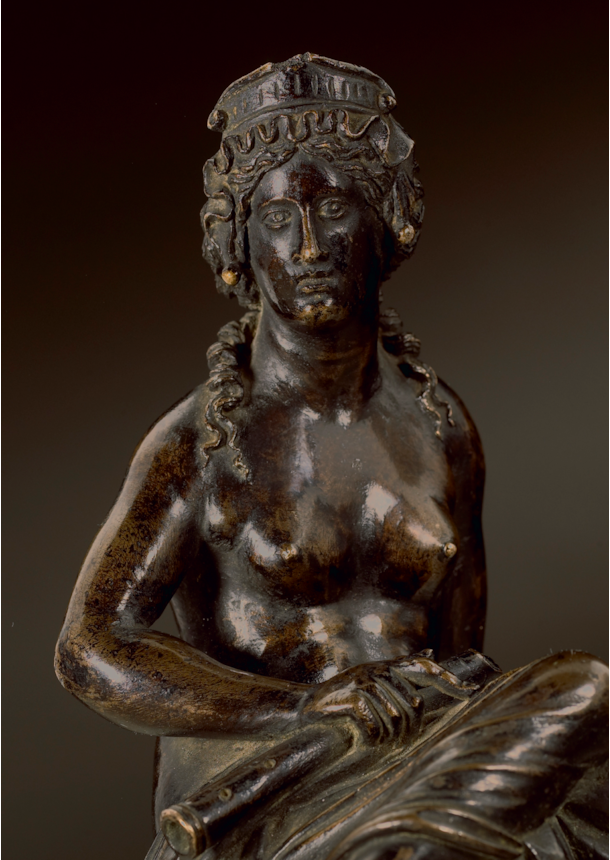
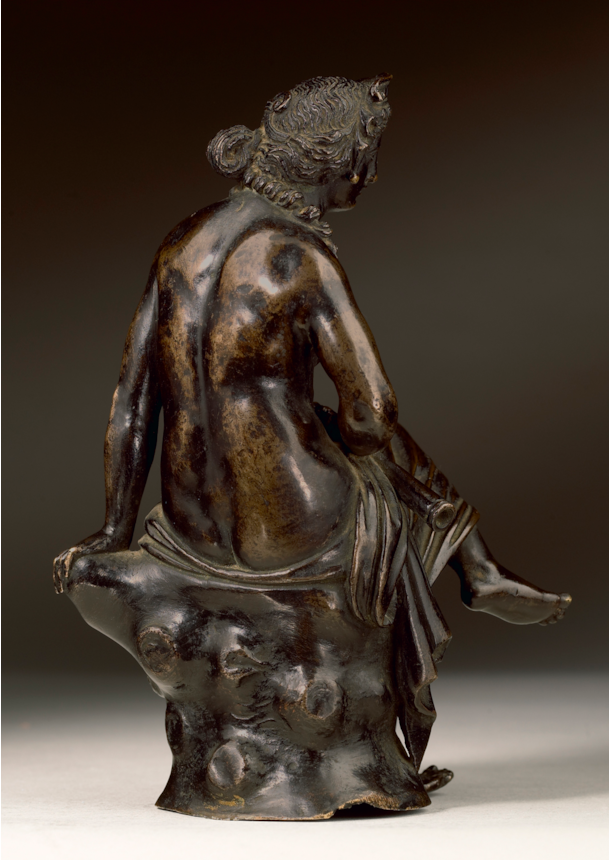
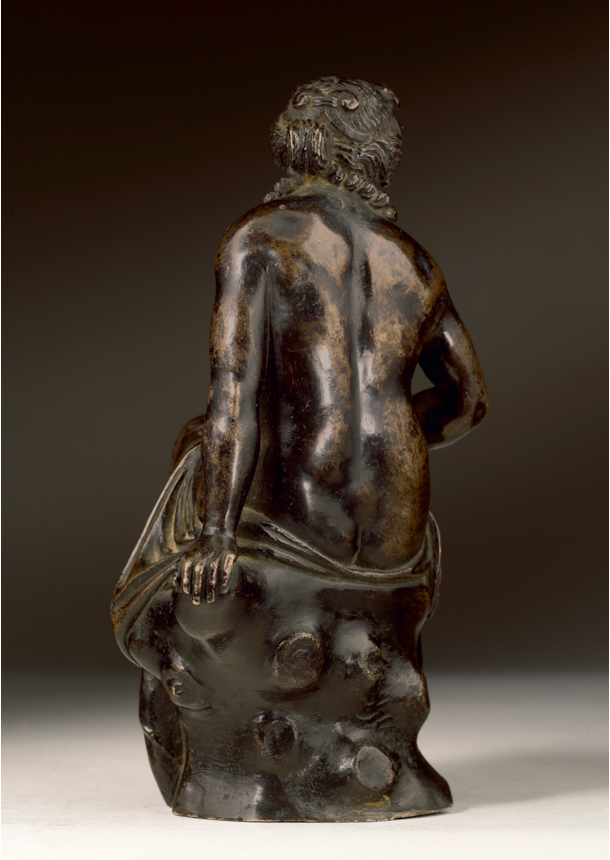
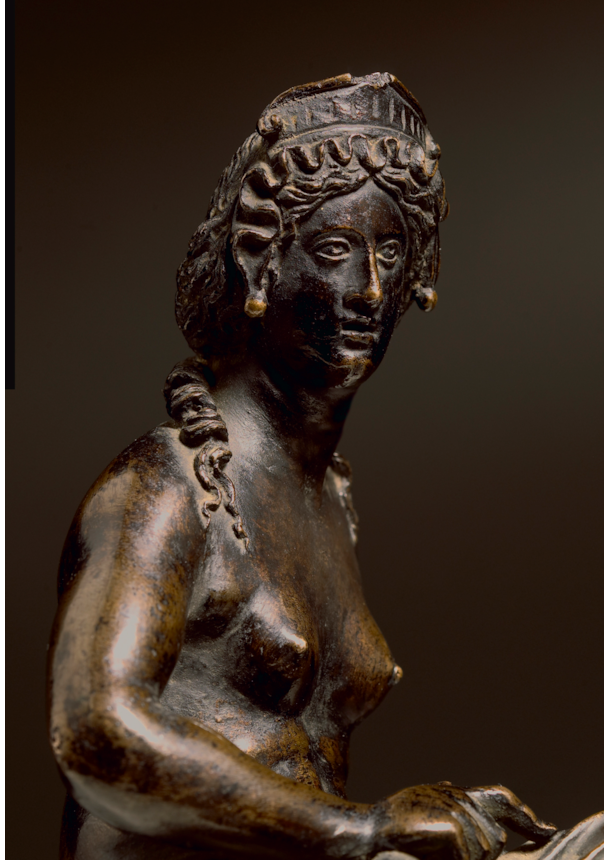
A young woman seated on a base formed from a tree-trunk, draped below the waist, her upper half naked. Looking slightly to her right, her left leg is crossed over her right knee, whilst with her left hand she supports herself on a corner of the tree trunk. In her right hand the woman holds a wind instrument. Her hair is carefully dressed, gathered into a bun at the back and with spiralling tresses descending over each shoulder. At her forehead is a crimped veil with balls at each end, held in place by a diadem, the ends of which rise at the back of the head into tied scrolling ends.
The bronze is expertly cast, with exceptionally thin and even walls. It is also extremely well-modelled and finished, with the surfaces carefully filed. There is a black lacquer patination of the type used for early sixteenth-century North Italian bronze sculptures. Rubbed in some places to reveal the metal, it survives largely intact in the face and head and in the lower part of the body and the draperies.
The statuette is overall in very good condition for an object of its age. There is a small casting flaw in the centre of the chest, now concealed, and a few small holes in the draperies. The woman’s left toe has been bent slightly upwards.
The original Hellenistic model on which the bronze statuette is based showed a nymph plucking a thorn from out of her left heel. Here, however, her right-hand rests on her lap, whilst the woman also holds a musical instrument. The instrument is a variant type of one of the most popular wind instruments of the early modern period, the cornett. Cornetts were usually curved, but this example is a particular type that was straight and had an integral mouthpiece, the mute cornett or cornetto muto in Italian. As an instrument, the cornetto muto was especially valued for the softness and sweetness of its sound.
The presence of this instrument, one that would have been used for intimate performances of consort music, in turn helps to identify the subject of the statuette as Euterpe, the muse of music and lyric poetry.
The nine muses were companions of Apollo, the divine patron of music and poetry in the ancient Greek and Roman worlds. Each of the nine muses, all of whom were female, represented one or more branches of the arts and learning. Euterpe was consistently depicted in art with a musical instrument, usually some form of wind instrument. Quite often the instrument was a set of double pipes, as can be seen in the depiction of Euterpe from the ceiling of Casa Maffi in Cremona, painted by Alessandro Pampurino in around 1500. But she is also sometimes found playing a cornetto muto very similar in form to the one held by Euterpe in the bronze statuette, for example in a picture by the Ferrarese painter Francesco del Cossa.
The source for the depiction of the attractive young woman, seated cross-legged, is a Greco-Roman marble sculpture depicting a seated nymph with her left leg resting on her right knee, in the act of putting on her sandal. The best-known of several surviving versions is the heavily restored sculpture now in the Uffizi, Florence, which may well be identifiable with an example that is known to have been in Rome in the late fifteenth century.
The figure of the seated nymph was conceived, together with the famous sculpture of the Dancing Faun (Uffizi, Florence), as part of a two-figure group known as the ‘Invitation to the Dance’. The original version was made by the Greek sculptor Doidalas in the late 3rd-early century BC, but has long been lost. This connection between the seated nymph and the dancing faun was only recognised in recent times, so would not have been known in the Renaissance period, except perhaps indirectly, through its depiction on the reverses of some Roman coins minted at the ancient Greek town of Cyzicus in Anatolia (modern Turkey), during the reign of the Roman emperor Septimius Severus (reigned A.D. 193-211). However, a variant two-figure group, known from a version in the Vatican museums, in which a lascivious satyr puts his left hand round the neck of the nymph and starts to tug at her drapery with his other hand seems to have already known in the Renaissance period.
A number of Hellenistic or Roman copies in marble of Doidalsas’s nymph alone survive, the best-known the sculpture now in the Uffizi, Florence. Although first certainly recorded in the Grand-Ducal collections in Florence only in 1704, it is probably to be identified with a marble recorded in the Palazzo Pitti in 1647. The Uffizi figure has in recent literature consistently been identified with an important version that was in Rome by the late 15th century, in the possession of the Caffarelli family, reproduced in the 1490s in a drawing in the Holkham Hall Album. The drawing is critical evidence that a fine example of the model was in Rome at an early date and was accessible to scholars and artists.
Another drawing of a marble copy of the seated nymph was made by Girolamo da Carpi (c. 1501-1556) when it formed part of the della Valle collection of ancient sculptures, assembled mainly by Cardinal Andrea della Valle (1463-1534). It is possible that Cardinal della Valle bought his statue from the Cafarelli, whilst much of the della Valle collection was bought by the Medici in 1584.
The statues recorded in Rome in the Cafarelli and della Valle collections may therefore be the same work, which in turn is quite likely to be identifiable with the sculpture now in Florence. The Uffizi statue was therefore most probably the principal starting point for the small bronze reductions made from the later fifteenth century in Northern Italy, along with the marble group in the Vatican, which also seems to have been a key model.
Although the nymph is depicted in the Vatican group, looking upwards at the satyr, in other surviving copies in marble of Doidalas’s sculpture - the heads on which are in all cases restorations, so do not necessarily reflect the original Greek model - she is seen looking downwards towards her foot, as if about to extract a thorn. This explains the popular name for this model in Renaissance Italy, the ninfa alla spina or ‘nymph of the thorn’. This interpretation can be especially clearly seen in an engraving of 1532 based on one of the marbles, by the anonymous printmaker known as the Master of the Die.
It is hardly surprising that the highly attractive Classical statue should have inspired Renaissance sculptors to make small-scale reductions in bronze. Two are of particular importance in helping to understand the figure of the muse Euterpe, one by the Paduan sculptor Giovanni Fonduli da Crema (fl. 1460s, d. before 1497) and the other by the Mantuan court sculptor Antico (Pier Jacopo Alari Bonacolsi, c. 1460-1528).
Giovanni Fonduli’s interpretation, today in London in the Wallace Collection, is the closest of the two to the Uffizi marble and is a direct (and therefore unique) cast of the very highest quality. The figure has been partly gilded, especially in the drapery but also on the woman’s fingernails. It is very rare among earlier Renaissance bronzes in being signed in a cartouche on the back of the base, ‘OPVS. IO. CRE’, translatable as ‘the work of Giovanni of Crema’.
This confirms the maker as Giovanni Fonduli, who moved at a young age from his native Crema to Padua, where he mainly made sculpture in terracotta, but is also documented as having received a commission for a relief in bronze, confirmation that bronze sculptures were produced in his workshop. However, among the mysteries that surround his Seated woman is the fact that it is the only bronze sculpture that can, in the present state of knowledge, be firmly attributed to Giovanni Fonduli. The prominent signature and outstanding quality suggest that the Seated Woman was a work of great personal significance for the sculptor.
It is a fairly faithful reproduction of the Ninfa all spina, except that the woman’s head is turned away to her left, whilst the base is embellished with mythological and fantastical motifs, of a sort that is also found in the work of Riccio, who may well have received some of his training in the workshop of Giovanni Fonduli.
The part-gilding of the draperies, a very rare survival in early Paduan bronze sculptures, relates Giovanni Fonduli’s figure to the bronze statuettes of the Mantuan court sculptor Antico (Pier Jacopo Alari Bonacolsi, c. 1460-15128), who used gilding extensively on his often sumptuously finished bronze statuettes, almost all of which are reproductions or interpretations of Classical statues.
Antico also made the second key small bronze reproduction after the Ninfa alla spina. Unlike Giovanni Fonduli’s unique bronze, his model is known through more than one version, the best-known being the partly-gilded example in the National Gallery of Art, Washington (Robert H. Smith Bequest). A second version, formerly in the Bedford collection at Woburn Abbey, is today in a private collection, whilst a third, this time without gilding, is in the Victoria & Albert Museum, London. The version in Washington has been generally dated to c. 1503 and associated with a commission from Isabella d’Este, Marchioness of Mantua (1474-1539), although it has also been suggested that the ex-Bedford version might have been that made for Isabella, the more lavishly-finished Washington bronze having instead been produced for Bishop Ludovico Gonzaga (1460-1511).
Antico’s Seated Woman is quite different both in pose and in mood from the introspective figure in the Wallace Collection. She is lively, even pert, her head turned to her right, whilst her right hand rests in her lap, instead of reaching for her foot. Since both these features also occur in the woman in the Vatican marble group, it is likely that that sculpture served as Antico’s primary model.
Giovanni Fonduli’s Paduan statuette exists only in a single version and appears to have spawned no copies or imitations. Antico’s figure on the other hand was extremely successful, with no fewer than 14 bronze statuettes that derive to varying degrees from Antico’s original model recorded. Probably made over a period of some decades, these derivations may all ultimately depend from a single bronze. They range from figures that follow Antico’s model very closely, including the woman’s head and hair, for example those in the Staatliche Museen in Berlin or formerly on the New York art market, through to more distant versions such as the one in the National Gallery of Art, Washington, in which the head is substantially different, the right hand raised to hold an apple and the seat has become more columnar in form. Whereas the Berlin and New York versions can be seen as aftercasts from Antico’s model, and perhaps were produced in Mantua, bronzes such as the one in the National Gallery of Art were evidently made at a greater distance. The NGA figure is likely in fact to have been made in the workshop of Severo da Ravenna (Severo Calzetta, c. 1465/75- before 1538), who for much of his career ran a highly productive foundry in his native Ravenna. As well as stylistic parallels, the woman is mounted on a triangular base characteristic of products from Severo’s workshop.
The present statuette of the Muse Euterpe may be added to the large group of casts dependent on Antico’s influential model. It is however one of the very finest and, more specifically, the finest example within a subgroup of four bronzes. These four bronzes look back towards Antico’s model, but are in other respects quite differently conceived, looking instead towards Padua with its great small bronze tradition, exemplified above all by the work of Riccio. Of the three other statuettes in the group, two are in the Musée du Louvre, Paris and a third in the Metropolitan Museum of Art, New York. They are probably based on the same model and were very probably made in Padua, conceivably in the same workshop. However, the present statuette is far superior in both modelling and finish to its cognates, which may be a decade or two later.
In this group of bronze statuettes, the figure has been adjusted to make it a little more frontal than Antico’s, with the woman’s head less sharply turned. The modelling of the head and hair are entirely different from Antico’s model, the woman wearing a diadem, the two ends of which run to the back of the head, where they rise into scrolled forms, held together by a connecting band, an arrangement copied from the fastening of the band that surrounds the signature cartouche on Giovanni Fonduli’s figure. The hair is gathered into a bun at the back and, in the case of the present bronze and the one in the Metropolitan Museum, tresses tumble over the shoulders.
In addition, in all four bronzes, Antico’s strange amorphous seat with its bulging protrusions has become a more naturalistic representation of a tree-trunk, with the bulges transformed into knots in the wood. Whereas in Antico’s model the woman’s right hand simply lies in her lap, in the Paris and New York figures she holds a sprig of flowers in her right hand on her lap, identifying her as the Roman goddess Flora. In the present bronze, she has of course become the muse Euterpe.
The gifted sculptor who made the bronze statuette seems therefore to have been directly aware not only of Antico’s Mantuan nymph but also of Giovanni Fonduli’s version, probably well-known to artists and collectors in early sixteenth-century Padua. The maker of the present statuette and its cognates seems to have borrowed from Giovanni Fonduli’s version the frontal positioning and the pronounced downwards sloping of the right shoulder. The parallels are at first sight less evident since Giovanni Fonduli’s woman looks to her left and in the present statuette and its cognates, the nymph’s head is turned to her right. The maker of the Euterpe will likewise have noted the elaborate all’antica dressing of the hair in Giovanni Fonduli’s figure, very similar in conception to the heads of female figures by Andrea Riccio, such as the satyress in the Victoria and Albert Museum’s Satyr and Satyress, or the Abundance in the Museo Nazionale del Bargello in Florence. These women, with their sometimes fantastical diadems and carefully gathered and arranged tresses, reflect the explosion of interest in the world of the antique in Northern Italy from the second half of the fifteenth century, exemplified in the influential work of the painter Andrea Mantegna (c. 1431-1506).
It has been argued that Riccio, who also worked as a terracotta sculptor, may have trained as a young man in the workshop of the older Giovanni Fonduli, where he could have imbued much of the imaginative classicising language that he would go on to use in his small bronze compositions. The present bronze is close to Riccio in conception and mood, but the construction and finishing both exclude the possibility that it could have been made by him. The thickness of the bronze tends to be rather greater in Riccio’s bronzes than the remarkably thin and even walls of the present statuette, which point to a highly expert caster working highly efficiently – the hollow base would have made it easy to extract the core material after casting. Riccio generally after casting his statuettes heavily worked the surfaces in a highly characteristic manner, including extensive use of a small hammer to create a faceted effect on the surfaces. In the case of the present bronze, there is no evidence of any hammering, although the surfaces have been carefully filed.
It has been suggested by Denise Allen that the Metropolitan Museum Flora, which is a much less carefully modelled and finished cast, might have been made ‘as a cheaper alternative to the rare, costly ancient statuettes so prized by elite Renaissance collectors.’ She also proposed that the giving to the figure of a clear identity as the goddess Flora marked a move away from ‘the often poetic ambiguity of Antico and the recondite antiquarianism of Riccio.’ The muse Euterpe is likewise a much clearer and straightforward subject than, say, Giovanni Fonduli’s enigmatic and mysterious figure.
As an image of Euterpe, the muse of music and lyric poetry, the statuette would have been made in response to the demand amongst the educated elites in mid sixteenth-century Europe for tangible modern interpretations of the personalities of the classical world and their legendary life stories. Some of the greatest interpretations of the Classical world made during the first half of the century, from Raphael’s Parnassus to Titian’s scenes from the Metamorphoses painted for King Phillip II of Spain, have never been surpassed as evocations of that world, a realm through the imagined prism of which many of the cultivated citizens of Padua would have sought, to varying degrees, to frame their own lives.
As a representation of a goddess of music, the statuette of Euterpe reflects the keen interest in music as a form of conversation and sociability among Italian Renaissance elites. The cornetto muto held by Euterpe also links the statuette to the lively fashion in early sixteenth-century Padua and Venice for the pastoral, an imaginative evocation of a dreamlike ancient world of verdant landscapes populated by lovers, shepherds and shepherdesses. Among the great exponents of the pastoral were Giorgione (1477-1510) and Titian who, on Giorgione’s early death, completed his friend’s famous painting of the Fête Champêtre.
The girl in the foreground at right holds a cornetto muto that is all but identical to the one held by Euterpe in her lap. Several times through his career, Titian portrayed this very specific instrument in the hands of young women, suggesting that, with its soft seductive sounds, it must have been primarily an instrument played by women within consorts.
Whilst instruments might occasionally have been played in the open air, music-making generally took place indoors, often in specially designed spaces.
In Padua today, the Loggia and Odeo Cornaro survive as among the most evocative reminders of that remarkable period, also reminding us of the importance for the city’s elites of the imagined worlds of the antique and the pastoral. These two lovely small buildings were created in the 1520s by the architect Giovanni Maria Falconetto, for the discriminating patron Alvise Cornaro (c. 1484-1566). Standing at the centre of fashionable learned society in Padua, Cornaro was just the sort of sophisticated collector who would have sought after exquisite small bronze figures for his collection.
Whilst the Loggia was used for theatrical performances, the Odeon, with its intimate and beautifully decorated small rooms, was created as a venue for the performance and enjoyment of music, as well as meetings of the seat of the short-lived influential literary association, the Accademia degli Infiammati.
The rooms of the Odeon are empty today although they preserve much of their frescoed decorations. Walking through them, it is certainly possible to imagine the muse Euterpe, through her representation in bronze, presiding over intimate musical and literary gatherings in interiors such as those of the Odeo Cornaro.
Perhaps within a consort, the cornetto muto would have been played by a beautiful young woman, who might have sprung from one of Titian’s paintings.
This beautifully-modelled and conceived figure is the finest of a group of four bronze statuettes that are likely to have been made in a still to be identified Paduan workshop, probably in the period c. 1530-50. The statuette of the muse Euterpe, derived from the antique marble sculpture known as the Ninfa alla spina, demonstrates on the part of its maker a sophisticated knowledge of the two earlier outstanding bronze reductions from that model, by Giovanni Fonduli and Antico. The sculptor of the figure took elements from both small bronzes, as well as the work of Andrea Riccio, to create a figure that carries its own powerful presence and its own haunting beauty. Beyond its intrinsic power as a very fine example of the Renaissance bronze, the subject of the muse of music and lyric poetry takes us to the beating heart of artistic, literary and musical culture in Renaissance Padua and Venice.
Dr Jeremy Warren, DLitt, M.A., F.S.A.
February 2024