



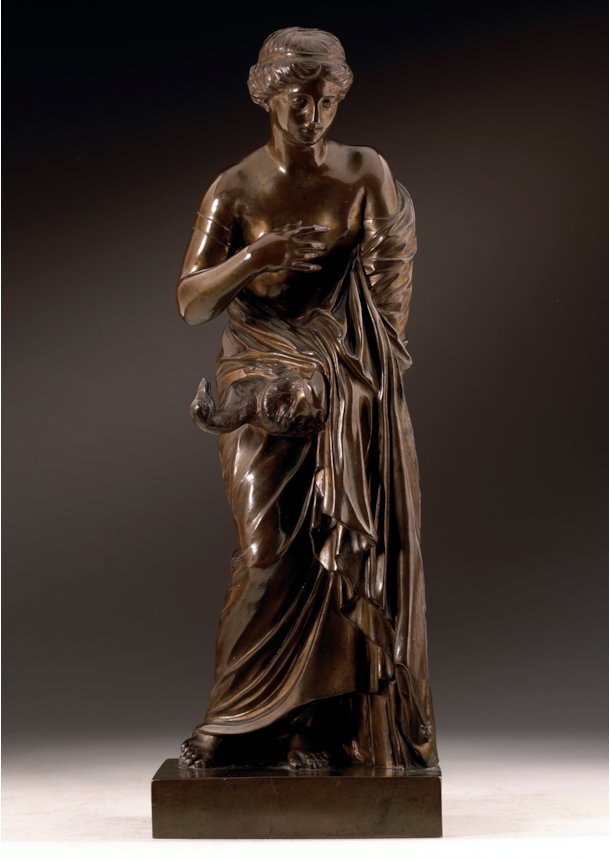
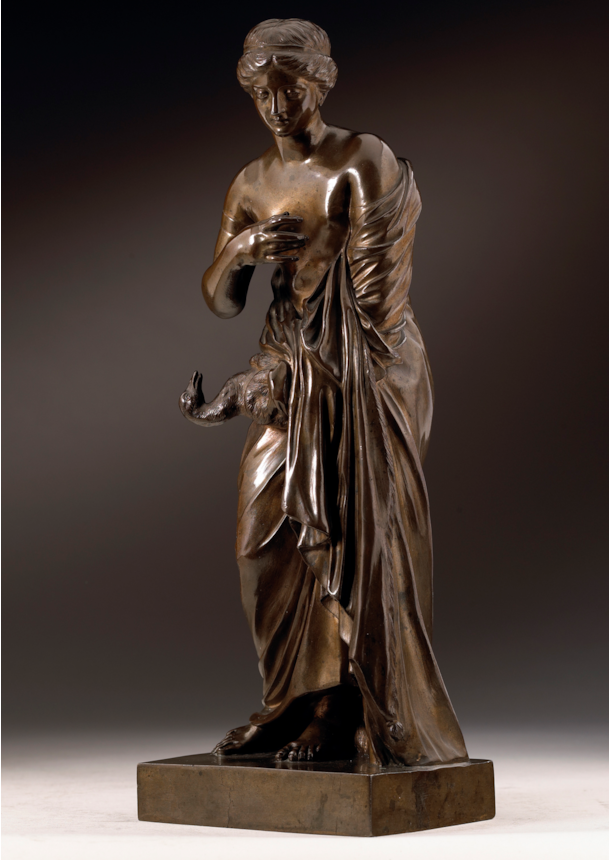


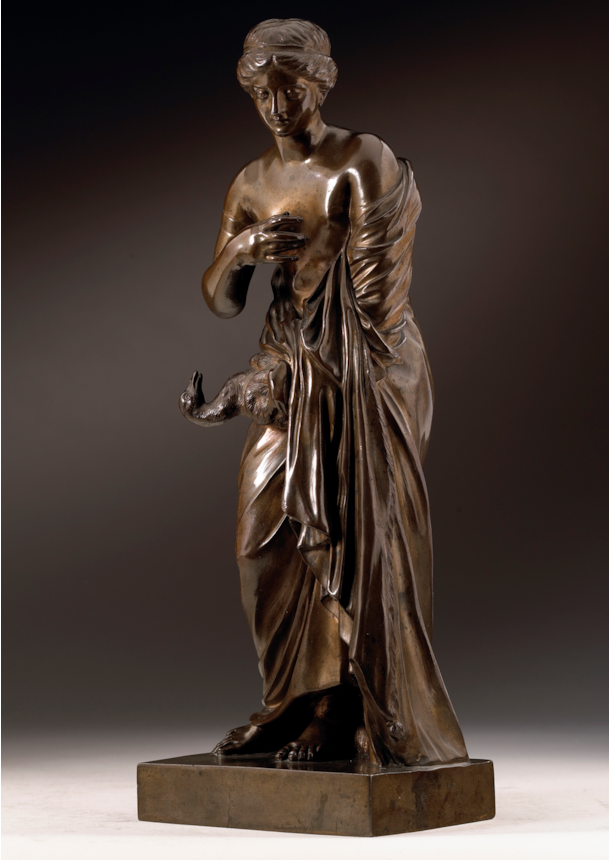
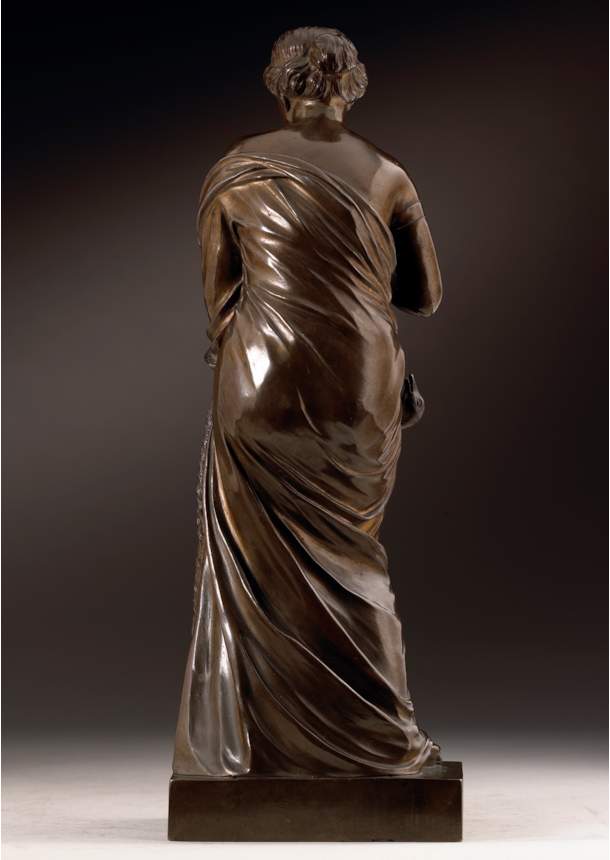



Massimiliano Soldani - Benzi (1656 - 1740)
21. Leda and the Swan
Florence, first quarter of the 18th century
Bronze
32 cm (12 ½ in.) high


H. Weihrauch, Die Bildwerke in Bronze und in anderen Metallen: mit einem Anhang, Die Bronzebildwerke des Resideznmuseums, Munich, 1956
K. Lankheit, ‘Eine Serie barocker Antiken-Nachbildungen aus der Werkstatt des Massimiliano Soldani’, Mitteilungen des deutschen archäologischen Instituts Römische Abteilung, 65, 1958, pp. 186–97
G.A. Mansuelli, Galleria degli Uffizi, Le Sculture, Rome, 1961, no. 85 C. Avery, ‘Soldani’s small bronze
statuettes after Old Master sculptures in Florence’, in Kunst des Barock in der Toskana, Munich, 1976, pp. 165–172 (reprinted in C. Avery, Studies in European Sculpture, London, 1981, pp. 122–32)
C. Avery, ‘Bronze statuettes by Soldani after Old Master sculptures in the Uffizi Gallery and elsewhere
in Florence’, in The Ian and Margaret Ross Collection: Baroque Sculpture and Medals, Art Gallery of
Ontario, Toronto, 1988, pp. 41–45, 63–64, no. 18
C. Avery, ‘The Pedestals, Frames, Mounts and Presentation of Massimiliano Soldani-Benzi’s Bronze
Statuettes and Reliefs’, Furniture History, XXXI, 1995, pp. 1–16
C. Avery, ‘Lord Burlington and the Florentine Baroque bronze sculptor Soldani: New Documentation
on the Anglo-Florentine Art Trade in the Age of the Grand Tour’ in E. Corp, ed., Lord Burlington –
the Man and his Politics: Questions of Loyalty (Studies in British History vol. 48), 1998, pp. 27–49,
figs. 2–15
C. Avery, ‘Soldani’s mythological bronzes and his British cliente`le’, Sculpture Journal, XIV, 2005,
pp. 8–29
The present statuette depicts an ancient Roman marble, formerly interpreted as representing Leda and the Swan, now in the Uffizi Gallery, about which the curator Mansuelli, writing in the early 1960s, was scathing: ‘The statue is not of high quality: the nude parts are flat and insignificant (partly due to rubbing down), while the drapery is rendered without finesse. The stance itself appears hard and wooden in the bust … [while] it is hard to recognise the swan in the little figure of the bird.’[i] The body of the statue is in Pentelic marble, but the head in Parian, while the right arm with the torque, the base, the feet and the upper part of the drapery are restorations. The surface has been re-polished on the nude parts and the face, while the drapery, especially round the back, is severely weathered. Once optimistically attributed to the Greek sculptor Skopas, the identity of the antiquity as Leda cannot be retained, for the bird is actually a duck or a goose.
The present model is documented as having been among the bronzes after the Antique listed in the 1730 inventory of the Düsseldorf collection: ‘Leda with a swan in her hand, of bronze’.[ii] It is also included in the inventory of the Doccia porcelain manufactory, which had acquired Soldani’s original moulds from his heir: ‘A statue representing Leda with a swan in her [left] right hand. With its moulds’.
Bronze statuettes after Antique and Old Master sculptures in the Uffizi and elsewhere in Florence
This series was first studied and published by Klaus Lankheit (Lankheit 1958). Some of them – and their general implications – have also been discussed by the late Hans Weihrauch (Weihrauch 1956). The present author summarized their research for an exhibition in Toronto in 1975 and later published some revisions and discoveries (Avery 1976).
The subjects were not confined to ancient sculpture, but included works by Michelangelo, Jacopo Sansovino, Cellini and Giambologna, as additions to Soldani’s commercially successful series after the Antique. The bronze statuettes are intimately connected with a set of twelve wax figurines that Soldani sent from Florence on 21 February 1702 to Johann Adam, Prince of Liechtenstein, to serve as models for full-scale garden statuary for his newly erected palace in Vienna. The wax statuettes were cast in sections from piece-moulds taken from a number of small models made by one of Soldani’s assistants after the most celebrated Antique statues in the collection of the Medici Grand Dukes in the Uffizi Gallery in Florence. The same piece-moulds may have been used in Soldani’s workshop for casting the bronze versions. As none of the waxes or garden sculptures has survived and there is no descriptive inventory of them, we can reconstruct the lost series only by a process of deduction from various inter-related strands of evidence.
In December 1706 Soldani wrote and offered Prince Johann Adam first refusal on a set of twelve bronzes which he had produced: ‘I find that I have made twelve bronze statuettes for a Cabinet, half a braccio [30 cm] high, some of which are nude and some partly draped. They are copied exactly from the most famous statues in this city. It occurs to me that they might be something for Your Highness, so I am offering them to you to see if you are interested, before I propose them to any other clients. The final price will be 30 piastres apiece. Wishing that you be well served, if you would graciously deign to let me know your decision, then I can resolve the matter. I am letting you know my reasons as an assurance of my deepest obligation.’
The lapse of nearly five years between the production of the wax figurines from the existing piece-moulds and the appearance of the bronzes on the market is hard to account for, and one wonders whether Soldani, when he suggested that the series was being offered to the Prince before any other client, was writing in good faith, or merely indulging in some judicious salesmanship. In any case, it is a foregone conclusion that he would already have supplied any that might have been required by his permanent employers in Florence, the Medici, who owned the original statuary that he was copying.
The eight examples now in the Bargello Museum have an implicit Medicean provenance, while the statuettes that were inventoried in Düsseldorf in 1730 would probably have been given to the Elector by his father-in-law, Grand Duke Cosimo III, soon after Soldani made them available, for the Elector’s wife, Anna Maria Luisa, was a favourite of her father. A further example, now lost, belonged to the collection of Anna Maria Luisa, who acquired it, with at least eleven other statuettes, directly from Soldani, on 3 November 1727.
However that may be, we do not know the composition of the set in question, although it is generally assumed to have been identical with that of the waxes sent earlier. Furthermore, it is not known whether – in the face of the Prince’s negative reply of 4 January 1707 – Soldani succeeded in selling him a set, even though he wrote again in more pressing terms on 7 February. There is some reason to suppose that Soldani was successful, at least perhaps in part, for two bronze statuettes after Florentine antiquities and of the right dimensions (about 30 cm high), a Venus de’ Medici and a Dancing Faun, feature in the catalogue of the Liechtenstein Gallery made in 1767 by Vincenzo Fanti (nos. 119–120). We also know that by 31 July 1716 a set of a dozen statuettes of ‘the best statues in the Gallery here’ had been purchased by Lord Burlington for £100 (presumably one of the sets – partially dispersed – which are now in Chatsworth House, Derbyshire).
Thereafter, documentation in the Bodleian Library, Oxford, indicates that Soldani began in earnest to cast further sets of statuettes from the models for Liechtenstein (Avery 2005, pp. 8–29). Among his lengthy correspondence with Zamboni, an Italian agent living in London, the first letter referring to such a series is dated 16 March 1719; Soldani writes, ‘If you decide to have the 12 statuettes copied from the Antique made in bronze, you have already heard my thoughts, and I shall await your orders’.[iii]
Seemingly he was instructed to cast the statuettes, for some five months later, on 8 August 1719, having received in the interim some substantial bills of exchange, he writes: ‘Please advise me again whether I am to send you the twelve bronze figures referred to in my other letter to you [missing], for Baron Dagen has not sent any response and I am still making them for you, in accordance with what Mr Berenstadt tells me’.[iv] A page or two later, Soldani states, ‘In the big crate, you will find the 12 bronze figures … [together with various other items]’.[v]
So it seems that he did decide to forward them to London without awaiting further specific instructions, and so this series may be still in England: possibly it is to be identified with one of the otherwise undocumented, partial, sets with different, rocky plinths, in Chatsworth House, the others of which could have come into the Devonshire family from the estate of Lord Burlington, with whom Soldani had previously been in touch (Avery 1998, pp. 27–49).
Four years later, on 29 July 1723, Soldani wrote to Zamboni again about some similar statuettes, including two new subjects, not after the Antique: ‘I [wonder] if you might have the chance of helping me to dispose of a little group of two figures copied from Giambologna, that represent Virtue treading down Vice [the original marble group, now in the Bargello Museum, is known commonly today as Florence triumphant over Pisa]; a little Bacchus in the act of walking which comes from Sansovino, the famous sculptor [Jacopo Sansovino’s original marble group is now in the Bargello Museum]; a soldier with a vase in his hands, copied from the Antique; and the little Faun playing the foot-clappers, also copied from the Antique – and the four pieces are each half a braccio high including their bronze bases and are highly polished and would cost nine doubloons each if you could elicit any interest – they are beautiful and finished’.[vi]
A further four years later, on 24 April 1727, Soldani again alluded to such statuettes, this time to the standard series, which he was desperate to dispose of: ‘I have also got twelve statuettes, all the same size, copied from the most beautiful marble statues of this Gallery [the Uffizi] all worked tastefully and cast in the most beautiful metal. If you had a chance to help me to dispose of them all together and if the money were paid to me here, it would induce me to do you the favour of letting you have them for 20 scudi each in our currency, even though all are worth far more. They are very suitable for mounting on cabinets and would make a fine effect, if that suited you.’[vii] Copies of two of his statuettes – though not of the present type – were indeed used to decorate an important English cabinet by John Channon (Avery 1995, pp. 1–16).
The ageing sculptor referred again to this set in a letter of 28 August: ‘I find myself with twelve finished figurines all of the same size which are after the Antique, and I think that I sent you some on a previous occasion, but these ones are easy to dispose of because they are completely finished, and, as I would like to raise some money for a particular investment, it would give me great pleasure to let you have them all for two hundred scudi, though I believe that on other occasions I have sold them for nearly three hundred: they are all diligently fashioned, and when you have a chance – as I hear – to compare my works in bronze with that of others whom I hear are in touch with you [Soldani means his rival Foggini, the Medici court sculptor], I believe that you will see the difference of work and finesse and gracefulness, because a direct comparison clarifies everything. These ones are particularly well worked and the expressions of the faces and the taste in finishing them to perfection [are evident]. I do not set out to make something that is not the case appear to be true to you, but I genuinely believe that by making a [direct] comparison you cannot fail to see the difference.’[viii]
Exactly three months later, on 28 November 1727, Soldani was able – with a note of ill-concealed triumph – to tell his dilatory correspondent: ‘I would willingly have agreed to the deal of taking the clocks in exchange for the twelve bronze statuettes, had I not on the third of this month given them to His Electoral Highness of Cologne who was passing by on his way to Rome, so that I could not do anything else, for I was at a standstill with the job’.[ix] Reading back through Soldani’s last three letters, one can deduce that this set was ready for the market by 24 April 1727, if not before. The purchaser was Clemens August of Bavaria, a member of the Wittelsbach dynasty and Archbishop-Elector of Cologne (1700– 1761), and so it is likely that this fine set of Soldani statuettes was sent back to Germany and may be the source of several fine examples now in museums there.
Certainly, the clear golden bronze and the high degree of finish on the present Leda and the Swan bear out Soldani’s claims about this later set that the metal alloy was of a particularly beautiful colour and that the expressions of the faces and the degree of finish were extraordinary. Even by Soldani’s own high standards, these characteristics are especially manifest in the present, glamorous statuette, which he cast probably quite early in his career.
It is also arguably the finest of these statuettes in existence, in view of the plain, rectangular plinth, and the careful wax-to-wax joint between it and the figure above (visible from below), which is typical of his earlier casts. Soldani had the imagination and sleight of hand to improve radically on the heterogeneous ‘original’ antiquity that he was copying, refurbishing its weathered drapery into the semblance of cloth, with taut folds caused by its being drawn against the body, as ‘Leda’ claims the ‘swan’ for herself, and thus conveying a sense of movement and urgency to the pose. It is sad that the ‘Leda’ still in Florence, in the Bargello Museum (inv. 351 B), which one might fondly have imagined would be descended from the Medici Grand-ducal collection and therefore of top quality, is in fact a very poor, probably later, example, in which these very traits have been lost again, while its irregular, roughly oval plinth also debases the crisp original design of Soldani.
Dr Charles Avery