





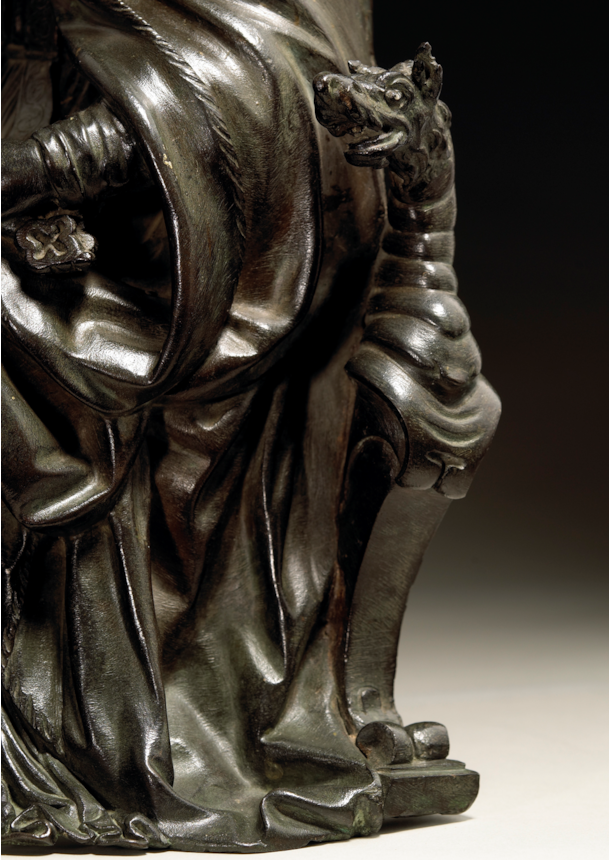



Paolo Sanquirico (c. 1565 - 1630)
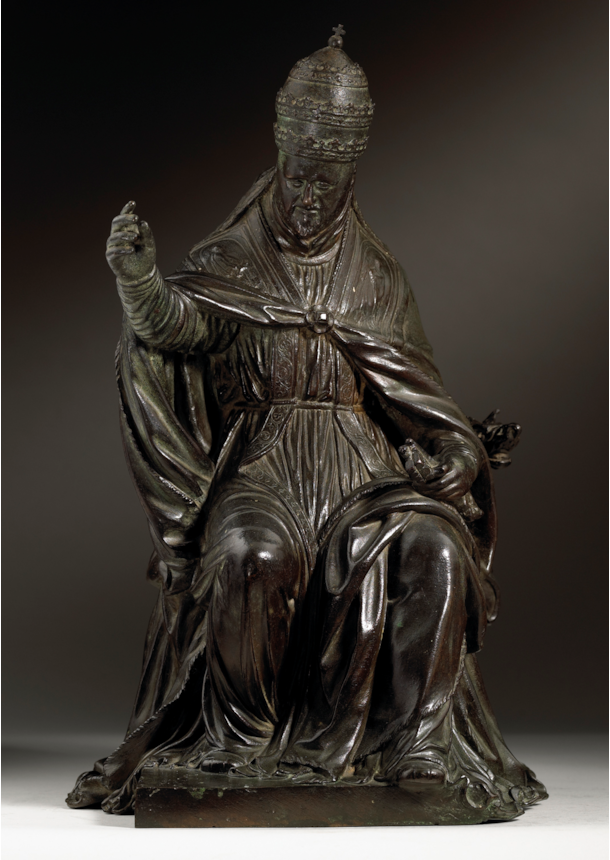
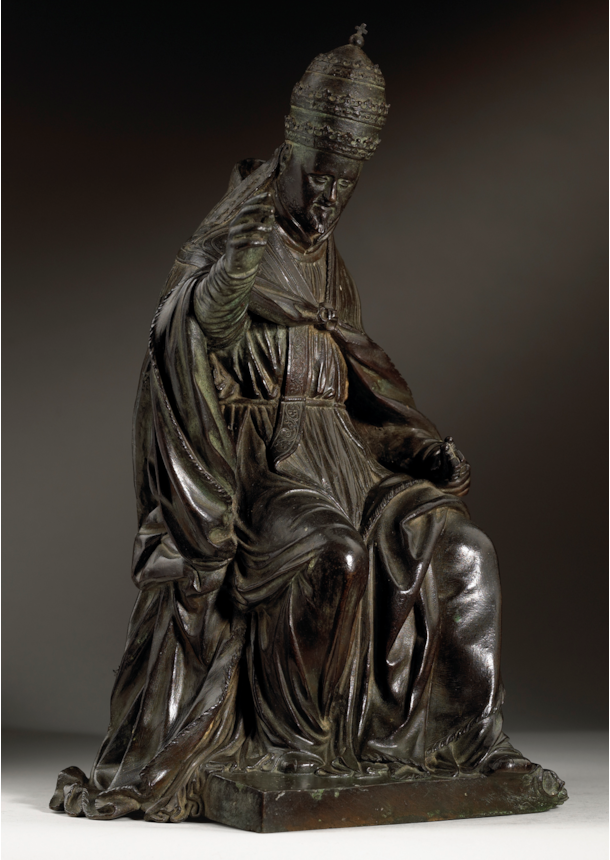
23. Pope Paul V Borghese Enthroned
Rome, c. 1616 - 1619
Bronze
38.7 cm (15 ¼ in.) high
By descent to Paolo Borghese, 9th Prince of Sulmona, Palazzo Borghese, Rome
Sold at auction, Giacomini & Capobianchi, Rome, 1892
Private collection, France


S. F. Ostrow, ‘Paolo Sanquirico: A Forgotten virtuoso of Seicento Rome’, Storia dell’arte, 92, 1998, pp. 27-59
S. Guido & G. Mantella, ‘Paolo Sanquirico a Santa Maria Maggiore: la grande statua si Paolo V Borghese. Nuove osservazioni a seguito del restauro’, in M. Jagosz (ed.), Figure, Liturgia e Culto, Arte. Studia Liberiana X, Rome, 2015, pp. 321-328, 472-488
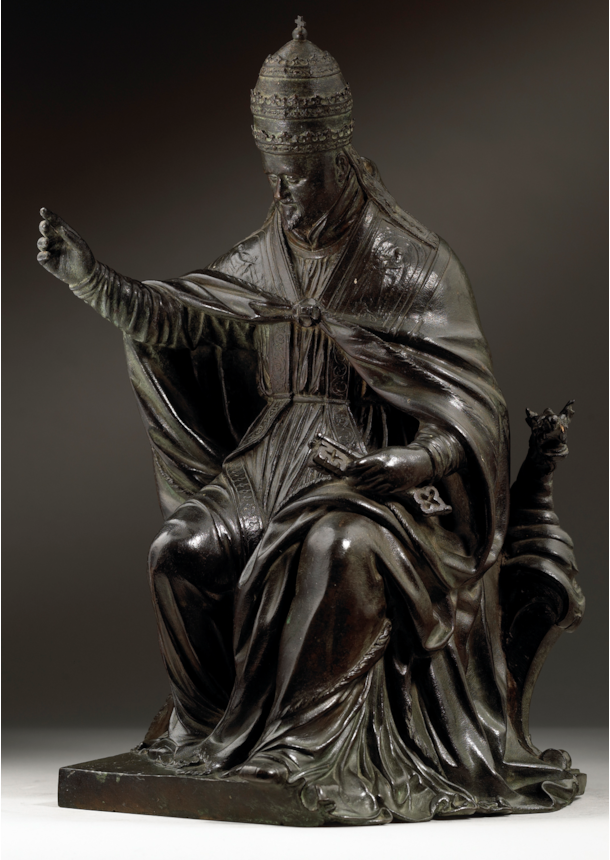
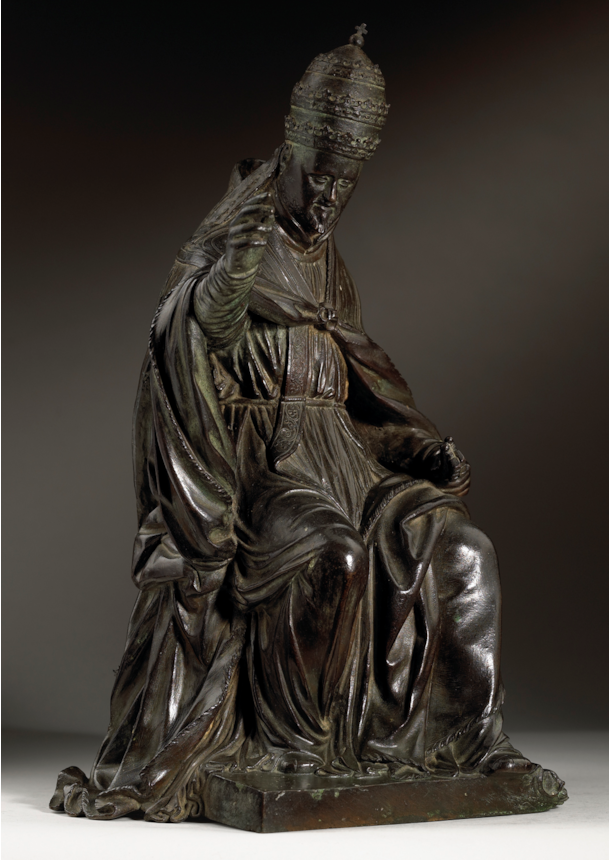
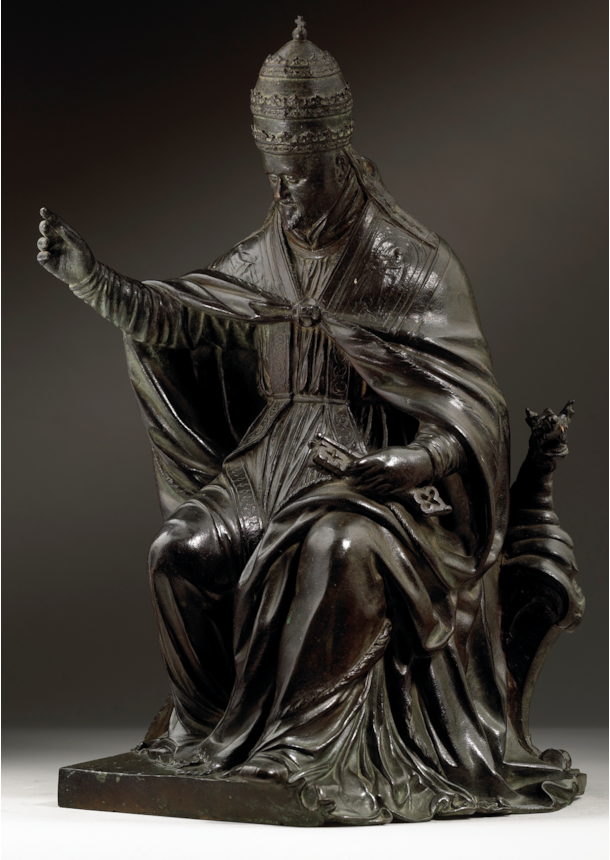
This fine small bronze, a relatively thin-walled hollow cast representing Pope Paul V Borghese (r. 1605-1621) enthroned, can be attributed with certainty to Paolo Sanquirico, an artist from Trecasali, a small town near Parma.
Although little-known today, during his lifetime Sanquirico was widely recognized as a virtuoso—a man of many talents, not just in the arts but in other spheres as well. He moved to Rome in his youth, according to Giovanni Baglione (1566-1643), his sole early biographer, and there befriended and studied under the Vicentine sculptor Camillo Mariani (c. 1567-1611), who instructed him, we are told, in the art of “making models in relief.” During the early part of his Roman period, Sanquirico specialized in the production of small portraits in coloured wax, an art form invented in the mid-sixteenth century that enjoyed European-wide popularity. By combining different coloured waxes for the skin, hair, and clothing; impressing the wax with different textures; and incorporating tiny seed pearls and semi-precious stones, artists were able to achieve remarkable lifelikeness in these low-relief images.
No doubt his experience in crafting wax portraits led Sanquirico to the art of making medals, a specialized field he likely learned from Mariani and Giacomo Antonio Moro (c. 1575-1624), a skilled medallist who worked for Paul V at the papal mint from 1605 until his death. In 1608 Sanquirico began working for the pope at the mint as well. His tenure there lasted until 1613 (serving as maestro in his final year), during which time he designed and cast (as opposed to struck) four foundation medals. In keeping with tradition, all feature profile portraits of the pope on their obverse sides and on their reverses depictions of major architectural projects: the new façade of St. Peter’s basilica (1608), the Fortress of Ferrara (1609), the Fountain of the Acqua Paola (1610), and the Port of Fano (1613). In addition to demonstrating a mastery of the casting process and considerable skill in rendering architecture in the medallic medium, his medals also reveal his considerable talent as a portraitist. By subtly varying the depth of relief and incising the finer details, Sanquirico produced vivid likenesses of the Borghese pope, capturing a sense of his stern countenance and considerable physical presence.
Beyond his sculptural practice, Sanquirico served in a number of other roles during his career, which speak to his social, professional, and intellectual ambitions. Throughout most of his Roman period he held the title of bussolante de’ Pontefici in Palazzo (attendant to the popes in the palace), an honorific clerical position. He was also closely affiliated with Cardinal Giovanni Battista Deti (c. 1580-1630), who in 1611 named the sculptor a canon of his titular church, S. Maria in Cosmedin, and for whom the artist designed and cast a medal in connection with the cardinal’s literary academy, the Academia degli Ordinati. Later in his life the sculptor entered the Roman court of Cardinal Maurizio of Savoy (1593-1657), enjoying membership in his Academia dei Desiosi and, as a document of 1627 informs us, providing drawing lessons to the cardinal’s pages. Baglione also tells us that Sanquirico, “delighted in designing fortifications, gave lectures on the subject, and also taught the rules of architecture.” His rendering of the monuments on Paul V’s foundation medals attests to this engagement with and knowledge of architecture, and so, too, does his short treatise of 1606, written on behalf of the pope, on the history of the flooding of the Tiber River and ways to resolve the ongoing problem. On several occasions Sanquirico was asked to evaluate—as an expert judge (perito)—works of both sculpture and architecture by some of the most prominent artists in Rome—testimony to his reputation in both fields. He was recognized by Marco Baldanza, in a manuscript on numismatics dedicated to Cardinal Francesco Barberini, as a distinguished collector of medals, both ancient and modern. In the early 1610’s he served as a procuratore (a representative with power of attorney) for his friend and fellow student of Mariani, Francesco Mochi (1580-1654)—one of the preeminent sculptors of early Seicento Italy—in a hearing before the Roman Tribunal, concerning payment to Mochi for his statue of St. Phillip for the cathedral of Orvieto. In 1624, in collaboration with Giuseppe Cesari, the Cavalier d’Arpino (1568-1640), he drew up the inventory of paintings and sculpture belonging to the just-deceased nobleman, Monsignor Costanzo Patrizi. And in keeping with his interest in water and hydraulic engineering, at the end of his life, following the malaria epidemic in Rome of 1629, Sanquirico published his Parere dell’aere di Borgo (1630), dedicated to Taddeo Barberini, Urban VIII’s nephew, in which he argued that it was necessary to rid the area of stagnant water (in fountains and elsewhere), which he asserted was the primary cause of the infectious air.
Beyond his medals and coloured wax portraits (none of latter have been identified), Sanquirico’s corpus of works is remarkably small. During the brief pontificate of Gregory XV Ludovisi (r. 1621-1623), the sculptor produced silver statuettes of Saints Peter and Paul—now lost—in all likelihood meant to adorn an altar, plausibly one in St Peter’s. For the pope’s cardinal nephew, Ludovico Ludovisi (1595-1632), the artist returned to making wax images, this time “two wax heads on octagonal ebony boards covered with glass […,] one of St John the Baptist in a basin, the other of St Catherine crowned,” which the cardinal displayed in the casino of his villa (they too are lost). An additional work is the elegant bronze corpus of Christ (a Crucifix) that Sanquirico cast for the Sacchetti Chapel in the Roman church of San Giovanni dei Fiorentini. Based on a model by the late sixteenth-century sculptor Prospero Bresciano (c. 1560-1592), Baglione judged it to be “the best [work] he ever made.”
Sanquirico’s grandest and most important sculpture is the monumental bronze statue of Pope Paul V, to which the present bronze is integrally related, which was commissioned in August of 1615 by the canons of Santa Maria Maggiore to honor and thank the pope for his extensive patronage of their basilica. The contract for the statue required the sculptor to depict the pope exactly as we see him—seated in his pontifical throne, wearing his cope (a long mantle) and tiara, following the longstanding tradition of honorific papal statues. Not mentioned in the contract, perhaps because they were standard in the iconography of such works, are the raised right hand in a gesture of blessing and the keys of St Peter, which the pope holds in his left hand. The contract also called for Sanquirico to produce a clay model of the statue by April 1616, then a model in wax, and to complete the casting of the statue and have it placed on its pedestal by November of that year.
Payments and other documents indicate that the sculptor began designing the statue soon after signing the contract but owing to delays in securing funding for the project it was not until July 1619 that Sanquirico cast the bronze. One year later it was erected on its marble pedestal in the vestibule of the summer choir, opposite the door leading into the canons’ sacristy. There it remained until 1825 when it was relocated to an obscure nearby chapel. Then in 1931 it was moved once again to its present location: the landing of the grand staircase in the canons’ palace that leads to the benediction loggia on the basilica’s facade.
In seventeenth-century Rome, founders who created their own models were very few in number, and sculptors who cast their own models were even fewer. Thus it is especially significant that Sanquirico was commissioned to design, model, and cast the statue—a rare example of a single artist’s complete control over every phase of a work’s production, which attests to the confidence the canons had in the artist. This is surprising, however, in light of the fact that prior to this commission, his experience in designing and casting bronzes was exclusively in the field of medals (as far as we are aware). And it was likely this lack of experience that led to the failure of Sanquirico’s first attempt to cast the full-sized bronze, as Baglione reports in his biography. Given that experienced professional founders sometimes ran into serious problems while casting large-scale bronzes (the most spectacular example being that of Gregorio de’ Rossi when casting Nicolas Cordier’s Henri IV for the Lateran), for Sanquirico, the transition from making small-scale medals to producing a monumental bronze statue—which involved many steps in the modelling, mould-preparation, and casting—must have presented numerous challenges.
Insight into the present small bronze is provided by Baglione’s account of the papal statue. After describing the work and its location in Santa Maria Maggiore, he informs us that “This statue was cast two times; and although it turned out very well in the small wax model, in its large form in bronze it did not correspond.” The biographer’s statement alerts us to the fact that the small-scale model must have been seen by more than just the artist and the canons of the basilica. In fact Baglione, who was a contemporary of Sanquirico and was employed by Paul V at Santa Maria Maggiore during the same period in which the statue was being made, likely saw the model himself or at the least heard about it from other artists who were working at the basilica for the pope. Most importantly, the model was highly praised.
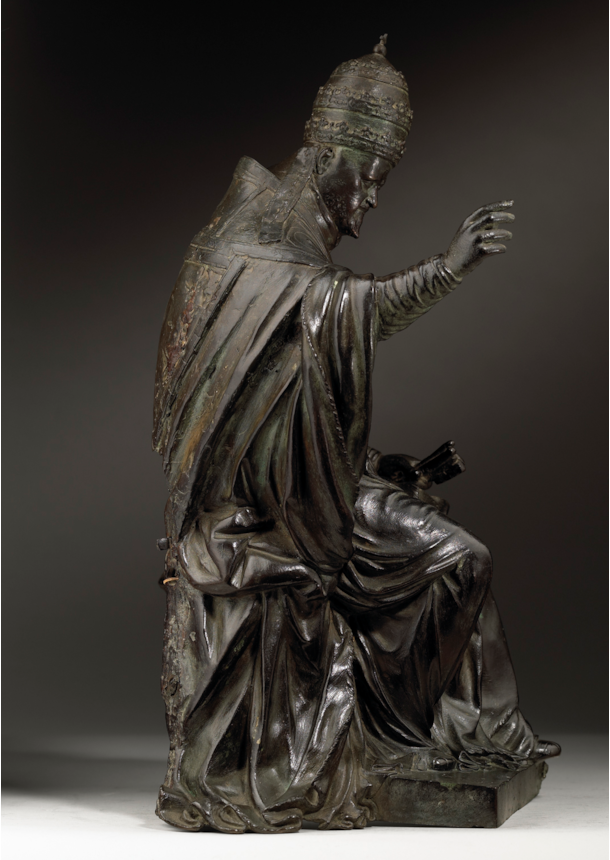
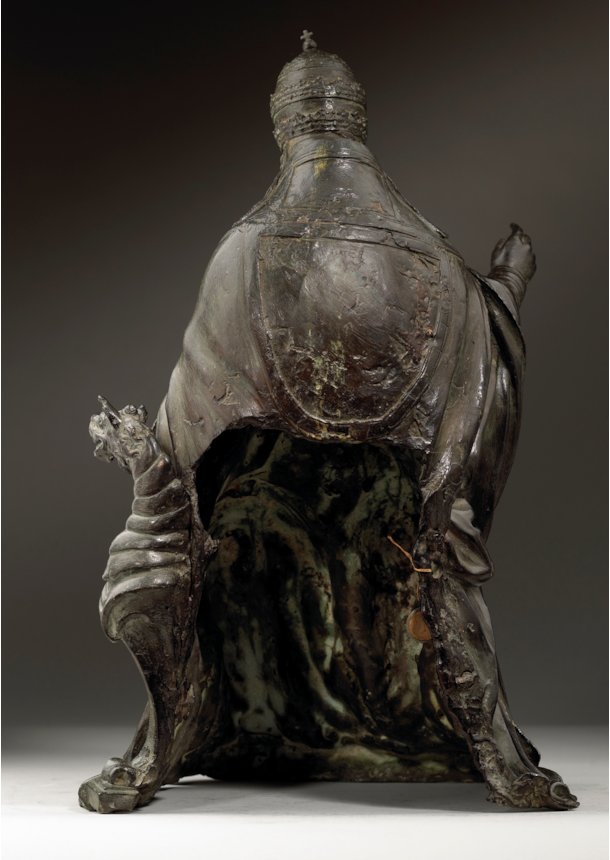
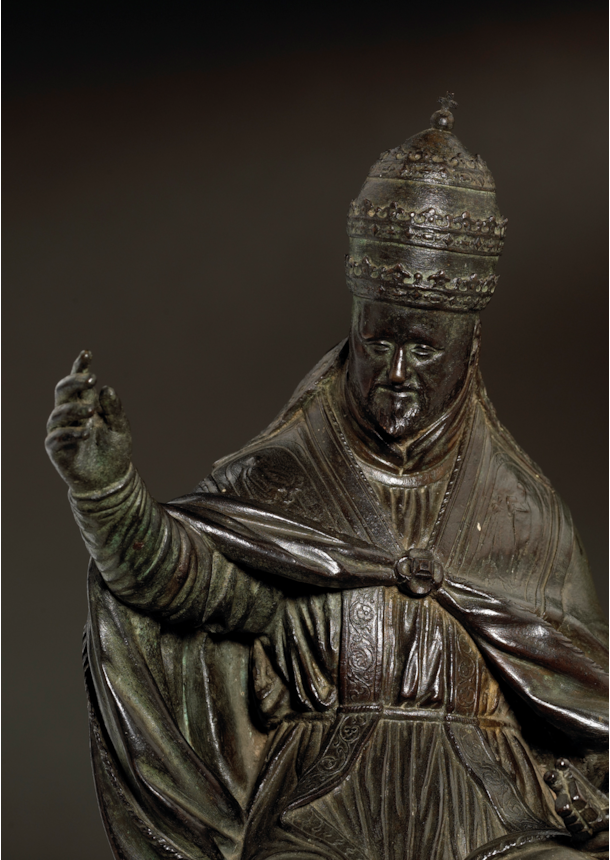
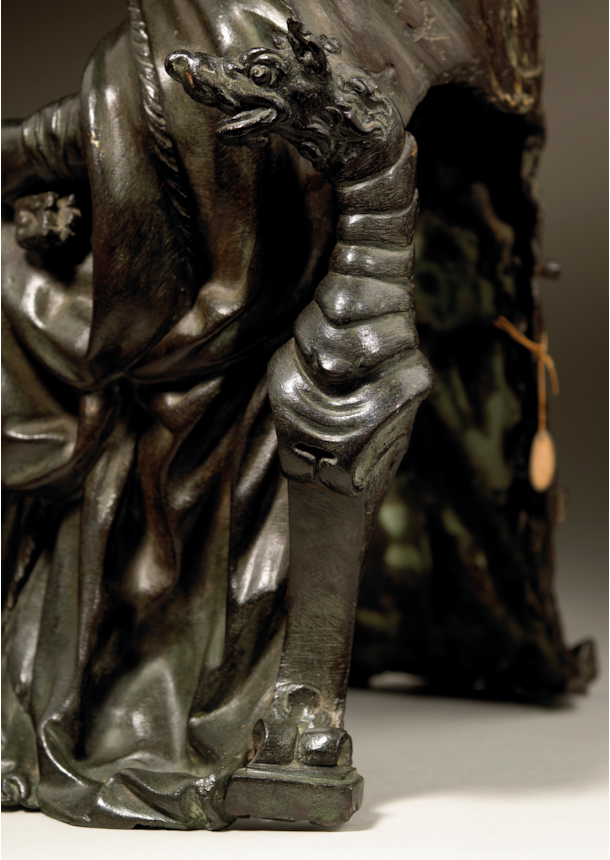
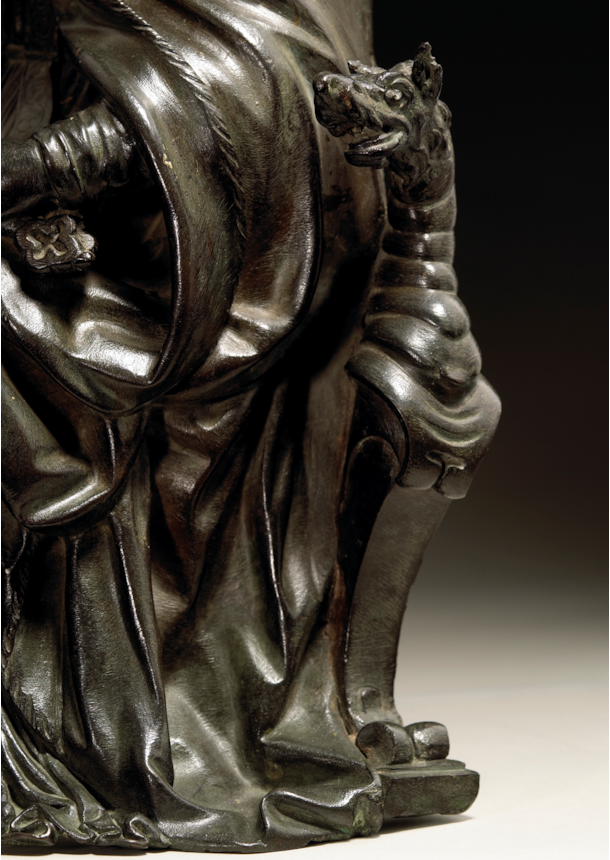
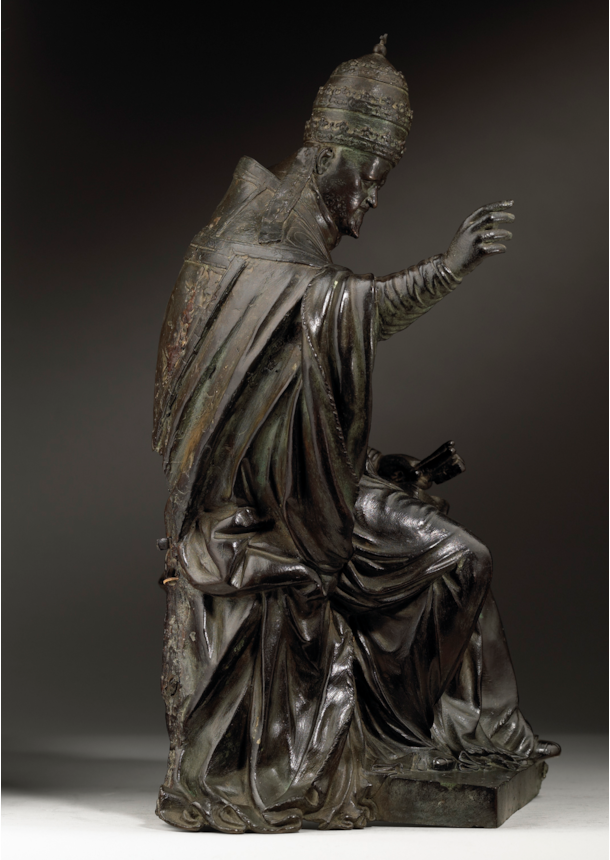
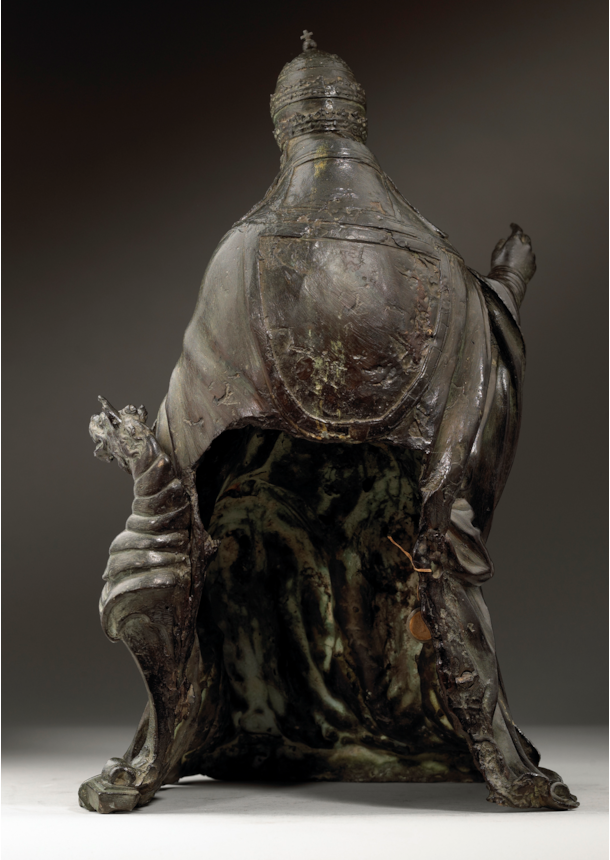
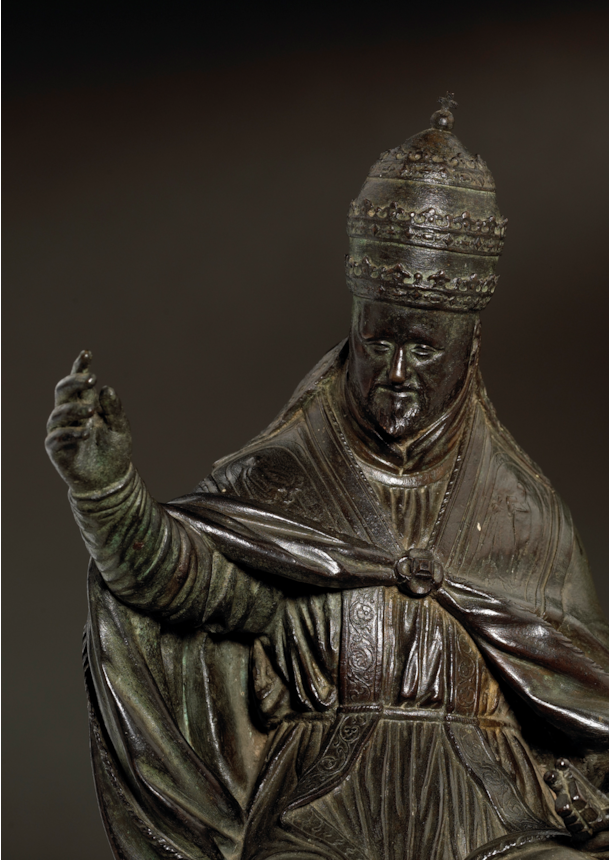
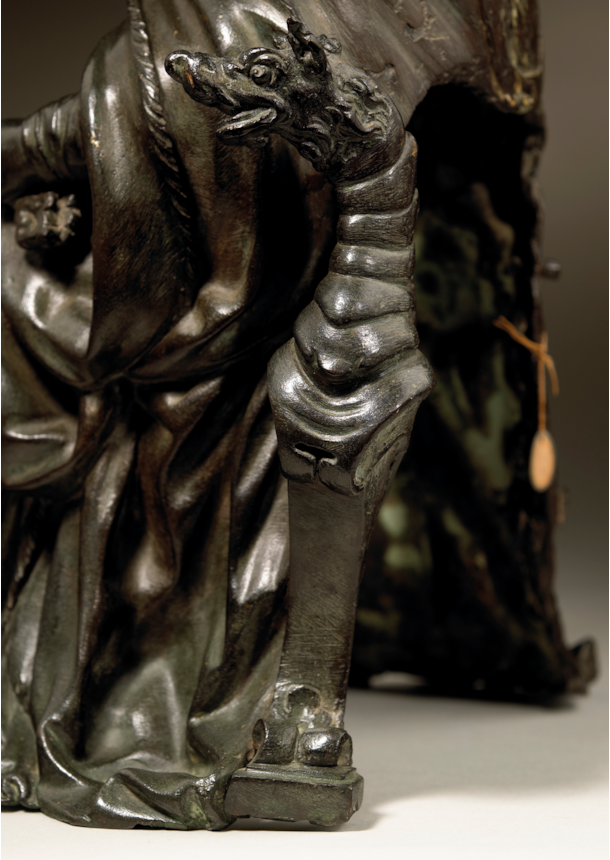
The present work can be identified, with confidence, as a cast from that wax model (or from the slightly earlier model in clay), a ricordo of Sanquirico’s design for the statue of Paul V. Virtually every aspect of this bronze—with respect to its similarities to and differences from the final monumental statue, as well as the varied treatment of it surfaces—points to its being cast from the wax or clay model that the sculptor was required to make. As in the final statue, in the small bronze the pope sits on his throne adorned at each side with a dragon, one of the Borghese heraldic animals (the dragon on the pope’s right side of the small bronze has been lost); he wears the papal tiara and other vestments, including a rochet and a cope, which envelopes his body and falls onto the base; he raises his right hand in benediction and holds the keys of St Peter in his left hand; and the visages of the pope are identical. With respect to their differences, whereas in the small bronze the pope inclines his head downward and slightly to his right, in the final work the pope’s head is less inclined both downward and to the side. The pontiff’s cope is adorned with images of Saints Peter and Paul in the present work, much as it is on Sanquirico’s 1608 medallic portrait of the pope, in contrast to the meandering acanthus pattern in the large bronze. The gesture of the blessing right hand is also different one from the other, as is the position of the hand holding the keys. In the large-scale bronze, Paul’s knees are farther apart than in the cast of the model, and the overall proportions of the pope are slightly more attenuated in the smaller work. And whereas the cope falls in a natural way upon the square base of the small bronze, in the final statue the drapery spills lava-like onto the pedestal and appears to belong to none of the ecclesiastical garments worn by the pope. These differences provide compelling evidence that the small bronze is not a later reduced copy of the statue but, instead, is a record of the sculptor’s earlier conception for it—a cast made from either the wax or clay model.
In contrast to those few small bronzes cast from Gian Lorenzo Bernini’s rather sketchy clay models, which retain the marks of his fingers and tools, this bronze is more highly finished, indicating that the model (whether in clay or wax) from which it was cast must have been similarly finished. The surfaces of the present piece are finely worked, with great care taken to distinguish between the character and texture of the different materials represented—from the broadly treated and highly polished folds of the cope, to the subtly articulated pleats of the rochet, to the delicate chasing of the decorative motifs along the borders of the cope. Less highly finished are the papal tiara, the figures of Saints Peter and Paul, and the pope’s face, all of which retain more of a sense of the original model. The pontiff’s face—with his broad forehead, sharp nose, smallish eyes, and fashionable pointed beard—is especially striking and closely corresponds to the portraits of Paul on Sanquirico’s medals. All of these features, along with the quality of the cast and its exquisite patina, distinguish this small bronze as the work of a highly skilled sculptor.
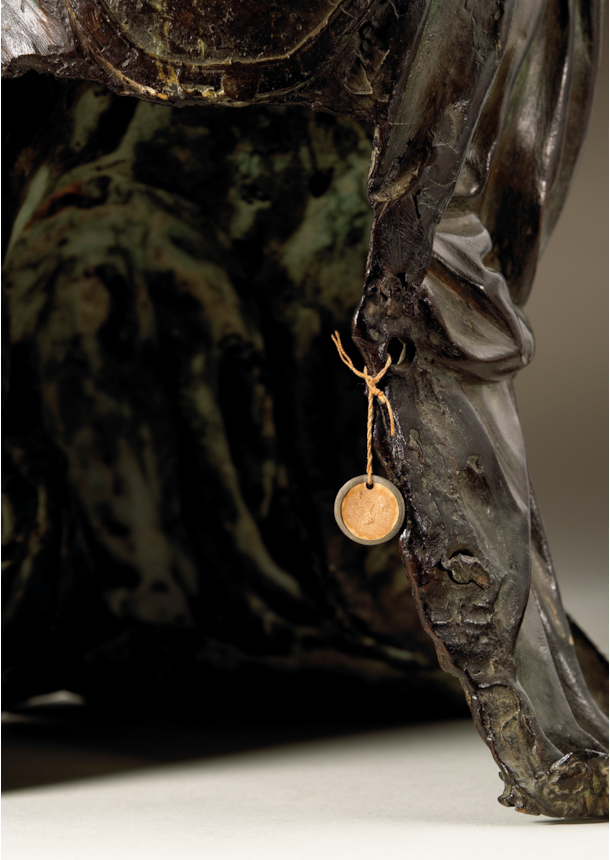
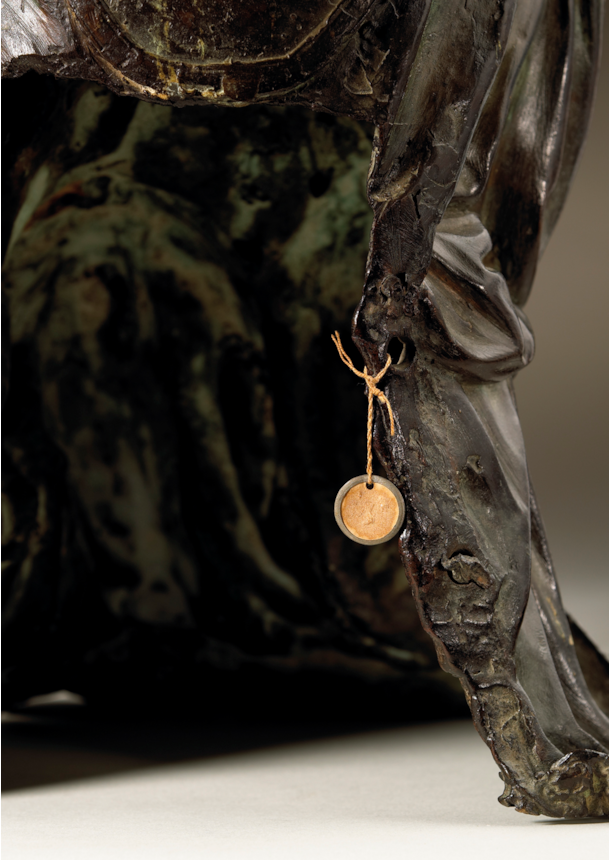
Although no documents have yet been found to illuminate the early provenance of this bronze, the fact that it was sold in 1892 by Paolo Borghese (1845-1920), the 9th Prince of Sulmona (and the great great great great great great great great nephew of Pope Paul V), points to its always having been owned, up to then, by the Borghese family. As the auction catalogue of that sale indicates, the bronze—erroneously attributed to Alessandro Algardi (1598-1644)—was among the works adorning the “grand apartment” of the prince on the primo piano of his urban palace in Rome. One can therefore speculate, with some confidence, that Sanquirico made this cast as a memento—in a more permanent medium than wax or clay—of an early stage in the design of his statue, much as his colleague Francesco Mochi did of his small model for the St. Veronica, as a gift for the pope or a close member of his family, which could be appreciated in the context of his private home. And the unfinished back of the bronze strongly suggests that it was intended to be placed in a niche. The photograph of the work (and its description) in the 1892 sales catalogue reveals that it then stood on a white marble pedestal adorned at the front with a black marble (nero antico) plaque, bearing the inscription:
TERNA×VERENDVM×QVEM×TVERIS×PRINCIPEM
CINCTVM×CORONA×HIC×PAVLVS×ILLE×MAXIMVS
EST×QVINTVS×ORBI×QVO×IMPERANTE×REDDIDIT
ASTRAEA×LAETO×SAECLA×RVRSVS×AVREA+.
Although the pedestal has been lost, the present work represents an important and much-welcomed addition to Sanquirico’s oeuvre, and a rare example of a bronze cast of a Baroque sculptor’s preliminary model.
Prof. Steven F. Ostrow
Bibliography
Catalogue des Objets d’Art et d’Amueblement qui garnissent Le Grand Appartement au Premier Étage du Palais du Prince Borghese à Rome (28 Mars – 9 Avril 1892), MM. Giacomini & Capobianchi, Rome, 1892, p. 94, no. 588 and pl. VI (as by Alessandro Algardi).