








Ferdinando Tacca (1619-1686)
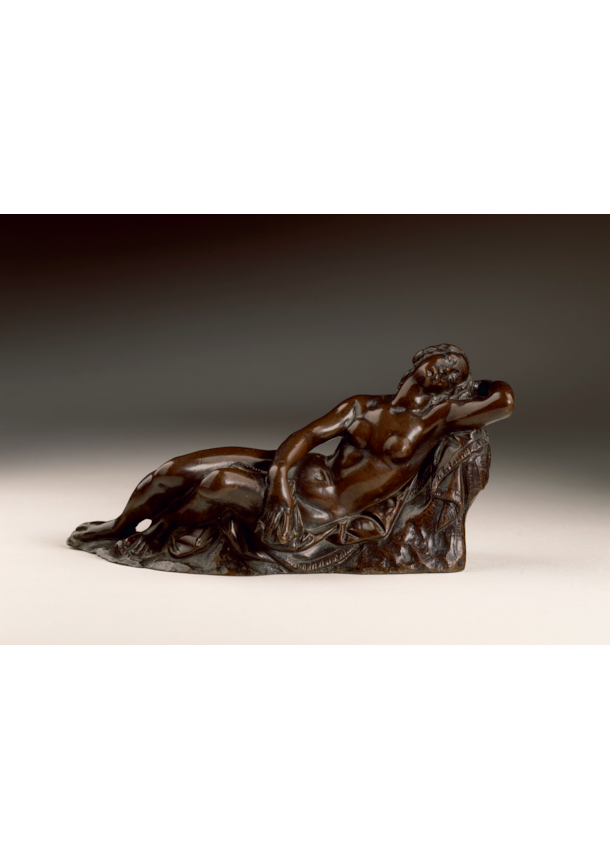
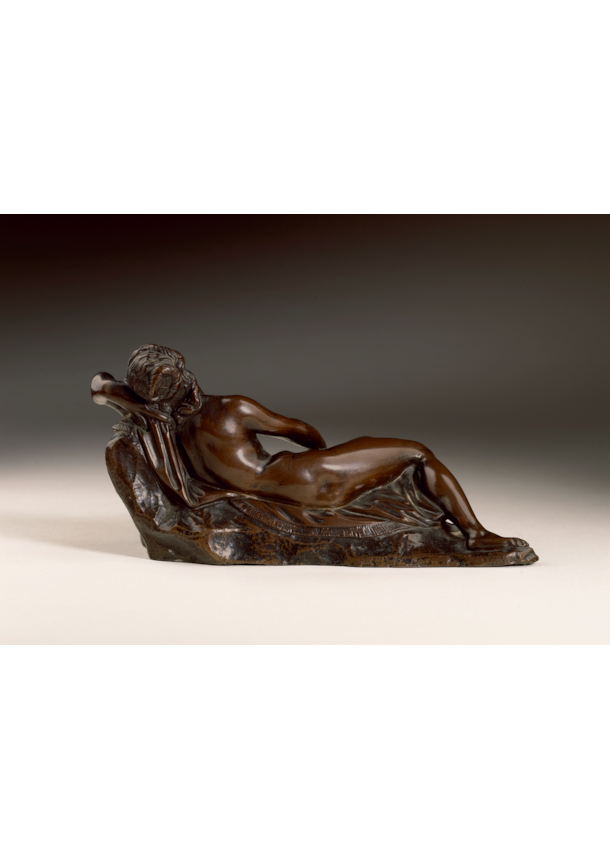
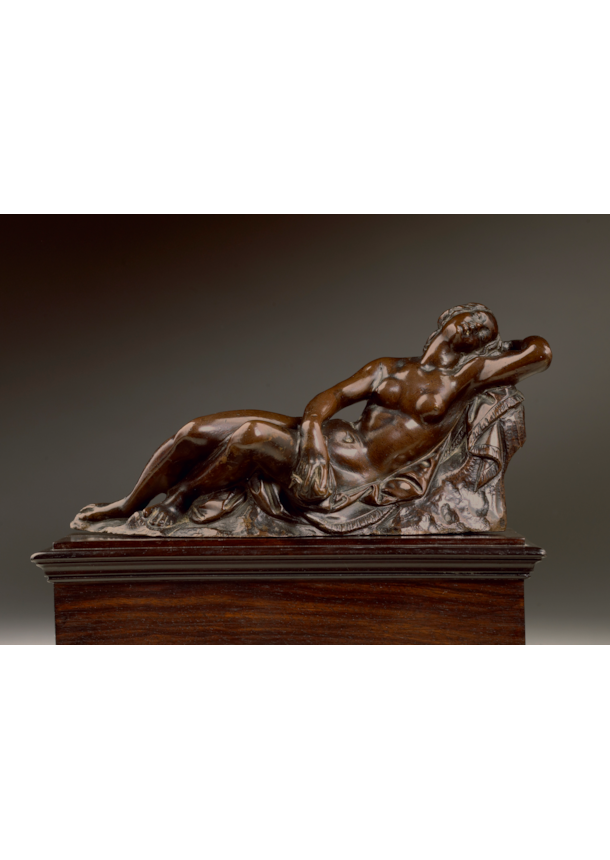
22. Sleeping Nymph
Florentine, mid 17th century
Bronze
14 cm (5 ½ in.) high, overall


Brook, A., and K. Watson, “Tacca Family.” In Grove Art Online. Oxford University Press, 2003.
Radcliffe, Anthony, “Ferdinando Tacca, the Missing Link in Florentine Baroque Bronzes.” In Kunst des Barock in der Toskana: Studien zur Kunst unter der letzten Medici, edited by H. Keutner, Munich: 1976.
The present bronze by work by Ferdinando Tacca (1619-1686), one of the leading sculptors working under the Medici in Florence in the 17th century, is exemplary of the artist’s mastery in bronze casting. Due to the reduced patronage of the Medici Grand Dukes at the time, the artist received little recognition posthumously, despite his status and skill, prior to the publication of Anthony Radcliffe’s paper ‘Ferdinando Tacca, the missing link in Florentine Baroque bronzes’ in 1976. Radcliffe connected a group of previously mis-attributed bronzes to the artist, including a bronze of Pan and Diana , as well as providing solid links to the renowned sculptor Giambologna (1529-1608), thus reaffirming the artist’s significance within the context of late Renaissance bronze sculpture.
Ferdinando’s father, Pietro Tacca (1577-1640), was trained by Giambologna in working with both marble and bronze and succeeded him upon his death in 1608. The workshop was eventually purchased by the Grand Duke Cosimo II in 1612, later acquiring the models of the late artist five years later. Thus, by 1617 Pietro Tacca had assumed the position of court sculptor and both he and Ferdinando were mindful not to abandon the celebrated style of Giambologna. To meet the high demand for his work, Giambologna typically used wood or stone for his models instead of wax, which would melt and be lost when heated in the mould, making it unsuitable for reuse. With wooden and stone models, they could be re-used by assistants, as well as be preserved for a later generation of artists.
Pietro was forced to work almost exclusively from the deceased sculptor’s compositions, due to the demands of patrons, the conditions of Giambologna’s will and conditions of the studio. Thus, as Katherine Watson explains, it was difficult to isolate Tacca’s style from those of his assistants, as well as from the work of Giambologna himself.
In 1640, succeeding Pietro, as court sculptor to Ferdinando II de’ Medici, Grand Duke of Tuscany, Ferdinando became the director of the Borgo Pinti workshops, granting him access to Giambologna’s models. Unlike his father, Ferdinando could draw inspiration from Giambologna’s work without the same constraints and thus had the freedom to lean ‘towards naturalism more marked than that displayed in Giambologna’s sculpture.’
A key model likely to have influenced the present bronze is Giambologna’s Sleeping Nymph, which was produced in serval variants. This figure, in an Ariadne-style pose, was often accompanied by a besieging satyr, an erotic motif popular during the Italian renaissance. Ferdinando referenced this tradition in his wholly original model Diana and a Satyr . The composition is notably more jagged, with harsher, more angular forms than those of Giambologna, perhaps reflective of the scene’s harrowing content. However, more similar to the present bronze is the smaller Sleeping Nymph with Satyr , who’s composition is closer to that of Giambologna’s.
Dr. Jonathan Ashley-Smith notes that it was typical of late Florentine bronzes for figures to be separately cast, in this case the figure of the satyr, and fixed by means of a bronze rod passed through the base and secured with a fresh run of bronze. This technical process explains why some versions, such as the one held at the Fitzwilliam Museum, Cambridge, depict only the nymph.
What makes it abundantly clear that this bronze can be fully attributed to Tacca is the rich chocolate patina and the deeply and frequently indented rock formation the figure is draped across. As Radcliffe noted, this 'quasi-naturalistic' style, achieved through 'unusually heavy punching,' is a hallmark of Tacca's work. Disregarding the formal and rigid ‘L’ shape created by the chaise lounge in Giambologna’s work, Ferdinando softens the curvature of the nymph’s seat with the naturalistic rock to create a more organic overall shape, complementary to the curves of the female form which is in a state of serene sleep. Even the reconfiguration of the arm, before thrown over the head in a state of dramatic surprise in Giambologna’s model as the nymph is besieged by the satyr, now supports the head in a graceful state of repose. Comparing Tacca’s Sleeping Nymph with his depiction of Pan and Diana, it appears that he was experimenting with how the composition could be adapted to suit slight variations in content. In this way, Tacca transforms Giambologna’s dramatic scene, incorporating elements from his own composition, such as the naturalistic rock formation, to better serve the solitary figure of the nymph and create a poetic image of peaceful slumber.